

Business process management consulting services are a structured discipline that helps business owners redesign, automate, and govern their operations to reduce costs, cut cycle times, and grow without adding headcount. The industry term is BPM consulting, and it covers far more than buying software. A proper engagement follows a four-phase lifecycle: assessment, process redesign, technology implementation, and governance. BPM consulting treats your operational systems as owned and understood assets, not just a collection of tasks to automate. For small to medium business owners, that distinction is the difference between lasting efficiency and expensive disappointment.
What Do Business Process Management Consulting Services Typically Involve?
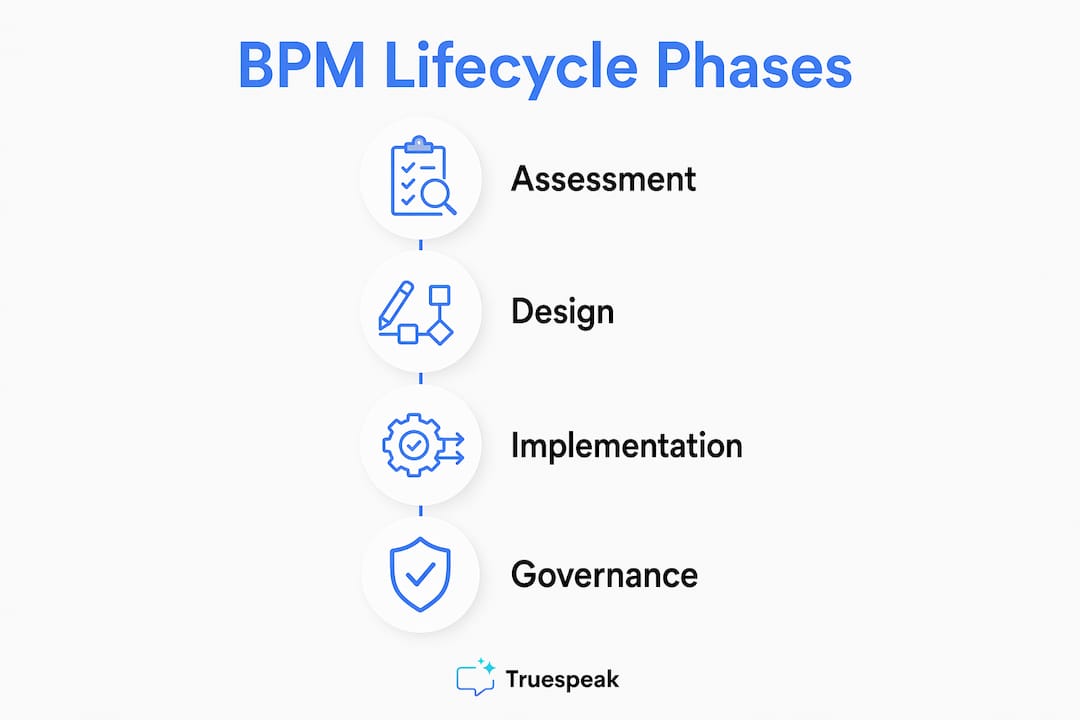
BPM consulting engagements follow a structured four-phase lifecycle: assessment and advisory, design and optimization, implementation and automation, and governance and continuous improvement. Each phase builds on the last. Skipping one creates gaps that surface later as recurring problems.
Phase 1: Assessment and Advisory
The engagement starts with process mapping. A process automation consultant documents every step in your key workflows, including who does what, how long it takes, and where errors occur. This creates an operational source of truth. Without it, any redesign is guesswork.
Phase 2: Design and Optimization
Consultants redesign mapped processes to remove redundant steps, standardize handoffs, and eliminate bottlenecks. A common example is a manual invoice approval chain that requires three email threads and two days. A redesigned version routes approvals through a single system with automated reminders, cutting that to four hours.

Phase 3: Implementation and Automation
Technology gets applied after redesign, not before. Tools like robotic process automation (RPA), AI agents, and system integrations handle repetitive tasks within the new process structure. Automating a broken process only speeds up the errors. Redesign must come first.
Phase 4: Governance and Continuous Improvement
Governance frameworks define who owns each process, which KPIs measure success, and how often performance gets reviewed. This phase is what separates a one-time project from a lasting operational upgrade.
Pro Tip: Ask any BPM consultant to show you their governance deliverables before signing an automation consulting engagement. If they cannot describe ownership models and KPI tracking, the engagement ends at implementation and your gains will erode.
How to Identify and Prioritize Which Processes to Optimize First?
The most effective BPM engagements start with quantifying pain points before touching any workflow. Cost per transaction, average cycle time, and error rates are the three metrics that reveal where your business bleeds time and money. Gut feel is not a prioritization method.
Once you have data, rank improvement opportunities by two factors: business impact and implementation effort. High-impact, low-effort processes are your starting point. They produce quick wins that build internal confidence and demonstrate ROI early in the engagement.
Common high-priority targets include:
- Manual approval bottlenecks that delay sales, procurement, or hiring decisions
- Siloed data entry where staff re-key the same information across multiple systems
- Inconsistent onboarding workflows that produce different outcomes depending on who handles them
- Untracked follow-up tasks that fall through the cracks and cost you customers
A phased roadmap matters here. Scope management is one of the most overlooked factors in BPM success. Starting with two or three high-impact processes delivers measurable results within weeks. Trying to redesign your entire operation at once stalls momentum and exhausts your team.
Pro Tip: Before your first consulting session, pull three months of data on your most complained-about internal process. Cycle time, error count, and staff hours spent. That data will cut your discovery phase in half.
Why Is Governance the Part Most Bpm Projects Get Wrong?
Governance frameworks are the most overlooked factor in lasting BPM success. Without them, redesigned workflows deteriorate within months. Staff revert to old habits, process ownership becomes unclear, and the gains from the engagement quietly disappear.
A governance framework covers four things:
- Process ownership: One named person is accountable for each process. Not a team. One person.
- KPI tracking: Defined metrics reviewed on a set schedule, monthly at minimum.
- Performance reviews: Structured check-ins to catch drift before it becomes a problem.
- Escalation paths: Clear rules for what happens when a process breaks down or a metric falls below threshold.
The second failure mode is consultant dependency. If your team cannot maintain and adjust processes without calling the consultant back, the engagement has not finished. Knowledge transfer clauses in your consulting contract protect against this. They require the consultant to train your internal team on process documentation, system configuration, and governance routines before the engagement closes.
Process drift is real and predictable. A sales team that adopts a new CRM workflow in January will have invented three workarounds by April if no one is tracking compliance. Governance prevents that. It is not bureaucracy. It is the mechanism that keeps your investment working.
Pro Tip: Build a simple process register in a shared document. List each redesigned process, its owner, its KPIs, and the last review date. Update it quarterly. That single document will catch drift faster than any software dashboard.
Key Takeaways
Effective BPM consulting requires redesign before automation, formal governance after implementation, and a phased approach that starts with high-impact processes to deliver measurable results quickly.
| Point | Details |
|---|---|
| Redesign before automation | Map and fix broken processes first; automating them without redesign multiplies errors at scale. |
| Four-phase lifecycle | Assessment, design, implementation, and governance are all required for lasting results. |
| Prioritize by data | Use cost per transaction, cycle time, and error rates to rank which processes to tackle first. |
| BPM vs. automation | Full BPM handles cross-department workflows; automation handles repetitive single-team tasks. |
| Governance prevents drift | Assign process owners, track KPIs, and include knowledge transfer in your consulting contract. |
How Truespeak Supports Your Operations as You Scale
Running a growing business means your processes need to work without you watching every step.
Truespeak, a Sydney AI automation agency, builds and runs managed AI operations that handle the follow-ups, CRM updates, admin tasks, and reporting that pile up as you scale. The work gets done 24/7 without adding headcount. For business owners who have completed a BPM redesign and want to lock in those gains with intelligent automation, Truespeak’s managed AI operations are built exactly for that stage. You can also review the full range of Truespeak services to find where AI operations fit your current workflows.
FAQ
What Does a Bpm Consultant Actually Deliver?
A BPM consultant delivers process maps, redesigned workflows, automation implementation, and governance frameworks. The engagement follows a structured lifecycle from assessment through continuous improvement.
How Much Do Business Process Management Consulting Services Cost?
Costs vary widely based on engagement scope, number of departments involved, and whether automation is included. There is no standardized flat rate across the industry.
How Is Bpm Different from Hiring a General Operations Consultant?
BPM consulting follows a defined methodology including process mapping, redesign, technology application, and governance. A general operations consultant may not apply that structured lifecycle or deliver formal governance frameworks.
When Should an SME Use Workflow Automation Instead of Full Bpm?
Use workflow automation for repetitive, single-team tasks like reminders or data routing. Apply full BPM orchestration when a process crosses multiple departments and requires formal ownership and KPI tracking.
What Is the Biggest Reason Bpm Projects Fail?
Neglecting governance is the leading cause of BPM failure. Without assigned process owners and KPI tracking, redesigned workflows revert to old patterns within months of the engagement closing.