

AI in customer service can classify enquiries, retrieve approved information, draft replies and handle clearly defined routine requests. The right scope depends on the accuracy of your information, the consequences of mistakes and the availability of human support.
What AI Technologies Power Customer Service Today?
AI in customer service runs on four core technologies: natural language processing (NLP), machine learning, AI agents, and conversational AI platforms. Each one plays a distinct role in how support teams operate.
Natural language processing lets AI read and interpret customer messages the way a human would. It powers everything from intent detection in chat to sentiment analysis in email queues. Without NLP, AI cannot understand what a customer actually wants, only what they literally typed.

Machine learning improves AI performance over time by analyzing patterns in past interactions. A machine learning model trained on thousands of resolved tickets learns which responses work for which issue types. It gets better with every interaction, which means your support quality improves without adding staff.
AI assistants can handle supported routine requests outside business hours. They need a clear boundary for unsupported questions and a handoff that gives a person the conversation history and reason for escalation.
Key applications of these technologies in real support environments include:
- Automated ticket routing: AI reads incoming requests and assigns them to the right team or agent based on topic, urgency, and customer history.
- Response suggestions: AI drafts replies for agents to review and send, cutting handle time significantly.
- Case triage: AI flags high-priority or at-risk customers before a human ever opens the ticket.
- 24/7 availability: AI agents answer common questions outside business hours without staffing costs.
- Personalized responses: AI pulls customer data from your CRM to tailor replies based on purchase history, past issues, and preferences.
Pro Tip: Connect your AI tools directly to your CRM from day one. AI that cannot access customer history delivers generic responses, and generic responses are the fastest way to frustrate a customer who has already explained their problem twice.
How Does AI Improve Customer Service Efficiency?
The most direct benefit of AI in customer support is speed. Customers get answers faster because AI does not queue, take breaks, or handle one conversation at a time. For support teams managing high volumes, that speed translates directly into lower wait times and higher satisfaction scores.
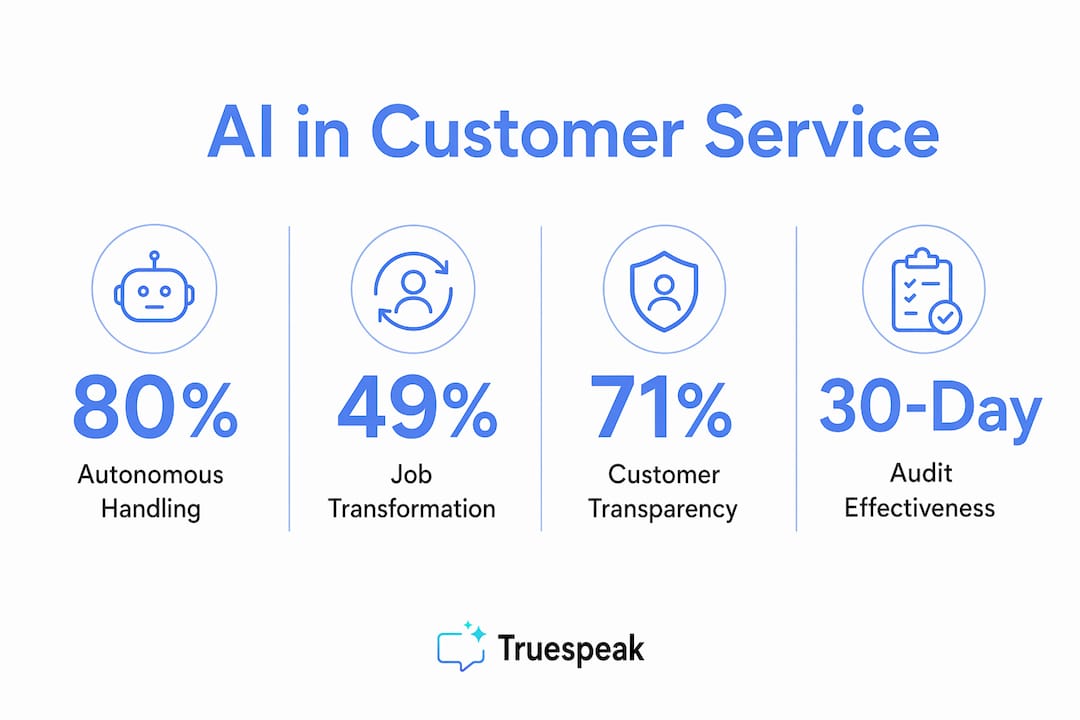
Personalization is the second major gain. AI analyzes customer data in real time and uses it to shape every interaction. A customer who recently purchased a product and contacts support gets a response that references that purchase. That context makes the interaction feel intentional rather than transactional.
The business case for AI-driven efficiency is strong. Consider what changes when AI handles the routine load:
- Reduced operational costs: Fewer routine tickets reach human agents, so your team handles more volume without growing headcount.
- Faster first response times: AI responds in seconds, not minutes or hours, which directly affects customer satisfaction scores.
- Higher agent productivity: Agents spend time on complex, high-value cases instead of resetting passwords or tracking orders.
- Scalability during peak periods: AI absorbs volume spikes without requiring emergency staffing or overtime.
- Consistent quality: AI applies the same standards to every interaction, eliminating the variability that comes with a large human team.
The future of customer service is a human-AI hybrid model, where AI handles routine inquiries and humans manage complex, high-empathy issues. That division of labor is not a compromise. It is the most effective use of both resources. Human agents become more valuable, not less, because they focus on the interactions that actually require human judgment.
What Are the Best Practices for Implementing AI in Customer Service?
Successful AI implementation requires more than selecting the right tools. The organizations that get the most from AI treat it as an ongoing operation, not a one-time deployment.
Tell customers when they are interacting with automation. Explain what it can do and how to reach a person; do not make an automated reply impersonate a named member of staff.
Key practices that separate successful implementations from failed ones:
- Disclose AI use upfront. Tell customers they are interacting with an AI at the start of the conversation. Transparency builds trust rather than eroding it.
- Build clean handoff protocols. Seamless handoffs from AI to human agents prevent customers from repeating themselves. The human agent should receive the full conversation context before they say a word.
- Integrate AI with your CRM and existing workflows. Avoiding data silos is what allows AI to deliver the personalized experience it promises. Disconnected systems produce disconnected experiences.
- Establish an AI governance framework before launch. AI governance pre-deployment prevents hallucinations, data drift, and compliance risks from surfacing after customers are already affected.
- Train staff to supervise AI, not just use it. Your team needs to understand how to monitor AI performance, catch errors, and escalate edge cases.
Pro Tip: Run a 30-day audit after launch. Track where AI fails to resolve issues, where customers request human agents, and where handoffs break down. Those three data points tell you exactly where to improve.
Successful AI adoption moves beyond automating volume. It focuses on effective integration into the total customer experience and employee workflows. Teams that treat AI as a volume reducer miss the bigger opportunity: using AI to make every interaction better, not just faster.
Automation is not “set it and forget it.” Ongoing governance is what helps keep AI aligned with approved information and operating rules as your customer base and product catalog evolve.
How Will AI Reshape Customer Service Jobs By 2030?
Automation changes which tasks a support team performs. Plan training, review responsibilities and escalation coverage with the people doing the work, rather than treating job-replacement forecasts as a staffing plan.
The roles disappearing are those built around repetitive, rule-based tasks: basic inquiry handling, scheduling, and scripted troubleshooting. AI replaces these functions while creating demand for new roles focused on AI supervision and complex problem-solving. The job title “AI supervisor” is not hypothetical. It describes someone who monitors AI agent performance, reviews edge cases, and ensures the system stays aligned with company standards.
| Role type | Status by 2030 | Skills required |
|---|---|---|
| Basic inquiry handler | Largely automated | Transitioning to AI oversight |
| Ticket router and triage agent | Replaced by AI routing | AI monitoring and quality review |
| AI supervisor | Emerging role | System management, error detection |
| Empathy specialist | Growing demand | Complex case resolution, emotional intelligence |
| Customer experience strategist | Expanding scope | AI performance analysis, journey design |
Customer service leaders must build skills in AI supervision and strategic problem-solving across their teams now. Waiting until 2028 to start that training puts your team behind. The managers who invest in upskilling today will have the workforce ready to run a hybrid AI operation when it becomes the standard.
The human-AI hybrid model is not a transitional phase. It is the destination. Humans bring empathy, ethical judgment, and relationship depth that AI cannot replicate. AI brings speed, consistency, and scale that humans cannot match. The winning support teams are the ones that combine both deliberately.
Key Takeaways
AI in customer service delivers the most value when transparency, clean integration, and ongoing governance are built in from the start, not added later.
| Point | Details |
|---|---|
| AI adoption is near-universal | Choose customer-service use cases from actual enquiries and test them against approved answers. |
| Transparency is non-negotiable | Disclose automated interactions and provide a clear human handoff. |
| Hybrid model outperforms full automation | AI handles routine volume while human agents manage complex, high-empathy cases. |
| Governance prevents costly errors | AI requires active monitoring to prevent hallucinations, data drift, and compliance failures. |
| Job roles are transforming, not disappearing | Define who maintains the knowledge base, reviews failures and handles escalations. |
How Truespeak Helps You Run AI Operations That Actually Hold Up
Building an AI-powered support operation is one thing. Keeping it running well at scale is another challenge entirely.
Truespeak builds and manages the AI systems that keep your customer operations moving, without requiring you to hire a dedicated AI team. From CRM integration to follow-up automation and reporting, Truespeak’s managed AI operations run 24/7 so nothing falls through the cracks. The systems are built around your existing workflows, not on top of them. If you are a customer service manager or business owner ready to move from experimenting with AI to running it as a reliable operation, explore Truespeak’s full service catalog to see what a managed AI setup looks like in practice.
FAQ
What Is AI in Customer Service?
AI in customer service is the use of artificial intelligence technologies, including NLP, machine learning, and AI agents, to automate and improve support interactions. It covers everything from chatbot responses to intelligent ticket routing and personalized customer communication.
How Does AI Improve Customer Service Response Times?
Automation can acknowledge a request promptly and answer supported routine questions. Response and resolution times depend on the integrations, knowledge base and human escalation process; measure both separately.
Do Customers Trust AI in Customer Support?
Trust depends on accurate answers, honest disclosure and a working path to a person. Test the experience with customers rather than assuming a general survey predicts their preferences.
Will AI Replace Customer Service Jobs?
The effect on staffing varies by business. Start by identifying tasks that can be supported safely and the human responsibilities that remain, then assess the effect on workload with the team.
What Is the Biggest Risk in Deploying AI for Customer Service?
The biggest operational risk is deploying AI without a governance framework. Without active monitoring, AI systems experience data drift and produce inaccurate or off-brand responses, which damages customer trust and creates compliance exposure.