
Most Australian businesses are small firms where a handful of staff answer the phone between quoting the work, running the jobs and chasing the invoices. The call that lands at 7:40 pm on a Tuesday has no desk to land on.
The difficulty is rarely the phone line itself. It is intake: who picks up, what they capture, who decides what happens next, and whether anyone can show the call was handled. A fast reply with no context behind it does damage of its own, because the caller repeats everything and learns the business was not really listening. An after hours answering service earns its cost only when it works as an intake, triage and consent system: capturing the details that matter, sorting emergencies from quotes and complaints, and getting permission before anyone follows up. A friendlier voicemail at the end of the same broken chain changes nothing.
Table of Contents
- Why After-Hours Calls Are Worth Catching
- After-Hours Options Compared Side by Side
- Triage Rules for Emergencies, Quotes and Complaints
- Privacy, AI Disclosure and Data Handling
- Consent Rules Before Any Follow-Up Message
- Connecting Intake, Phone and CRM Systems
- Measuring Results and Running a Safe Trial
Why After-Hours Calls Are Worth Catching
It's 7 pm on a Wednesday. The ute is packed, the last apprentice has gone home, and your phone buzzes in the cupholder with a number you don't recognise. You'll ring back tomorrow. By 8:15 pm that caller has spoken to two other trades and booked the one who answered.
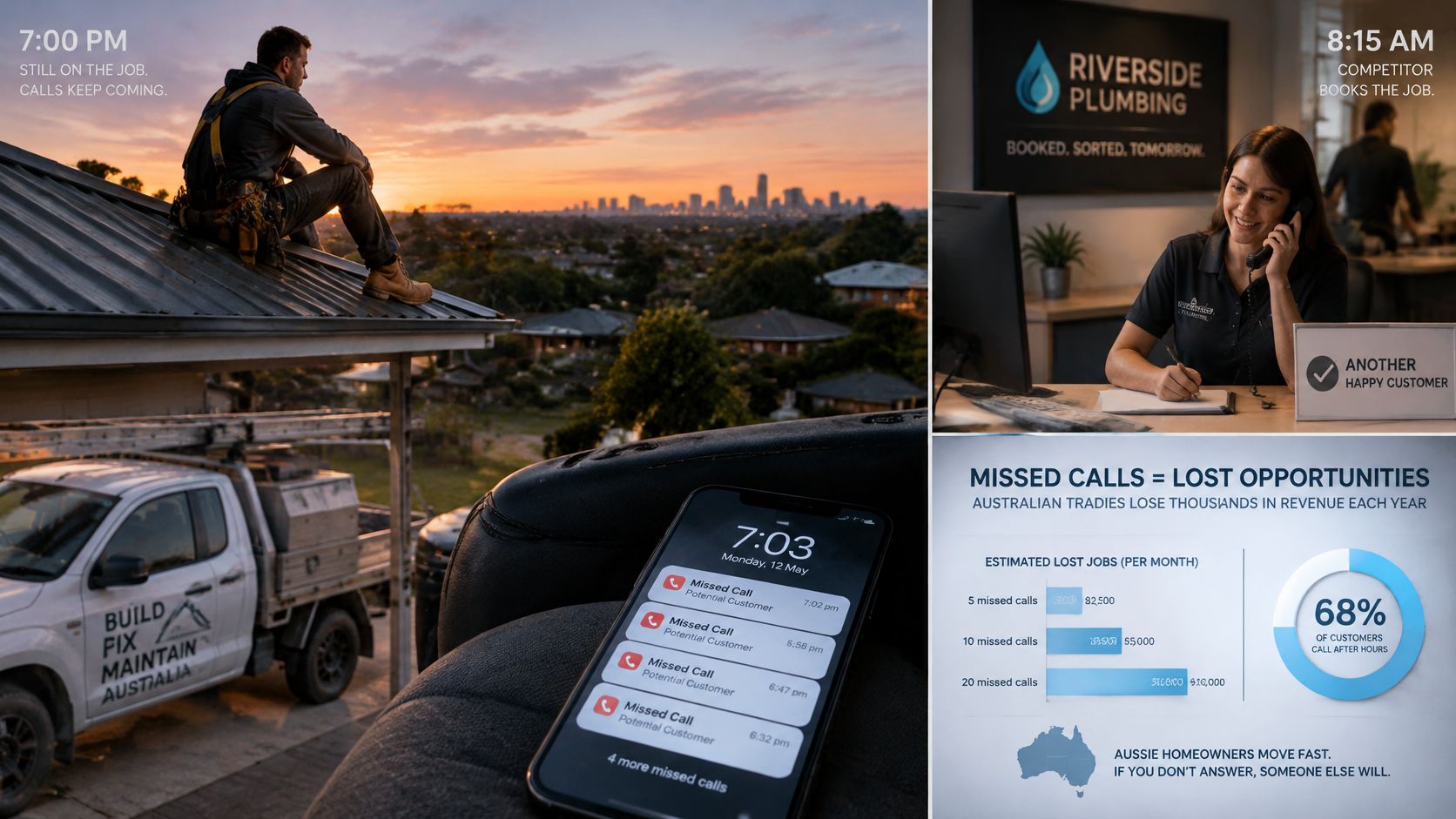
That scene repeats at scale. In a 2026 dataset of 2,098 calls to Australian businesses, 26.5%, or 557 calls, arrived outside 9 am to 5 pm on weekdays, including weekends and public holidays, per Australian small-business call data. Exclude a charity and look only at 27 small businesses, and the share was still 24.5%.
The commercial weight sits above the volume. In that small-business sample, 57.8% of after-hours conversations concerned bookings, quotes or new enquiries, against 46.0% during business hours. Only 1.1% of conversations were spam, sales calls or robocalls. Treat the figures as sample-based rather than an economy-wide estimate: they're a reason to check your own logs, not a forecast to build a budget on.
The distinction that matters: a voicemail is a message. An intake record is a decision waiting for an owner, a due time and a next action.
An after hours answering service, defined properly, is a layer that picks up when your line is unattended, works out who is calling, what they need, where the job is, how urgent it is and the best time to call back, then hands a complete record to a named person. Voicemail stores audio that nobody triages until the morning, which is why a full inbox can look like activity while nothing has moved.
Before you buy anything, run this audit. It takes an afternoon and it changes what you shop for.
- Export a month of inbound call records from your phone system or provider portal.
- Tag every call that arrived outside staffed hours, including weekends and public holidays.
- Read the notes on those calls and count how many were new work rather than existing-customer admin.
If the new-work share is anything like the sample above, the after-hours window isn't a convenience channel. It's an intake channel you've been leaving unstaffed.
After-Hours Options Compared Side by Side
Five options get sold as after-hours cover, and they're not close substitutes. The table uses the same four questions for each one: who answers, what the caller walks away with, which business it suits, and where it breaks down in practice.
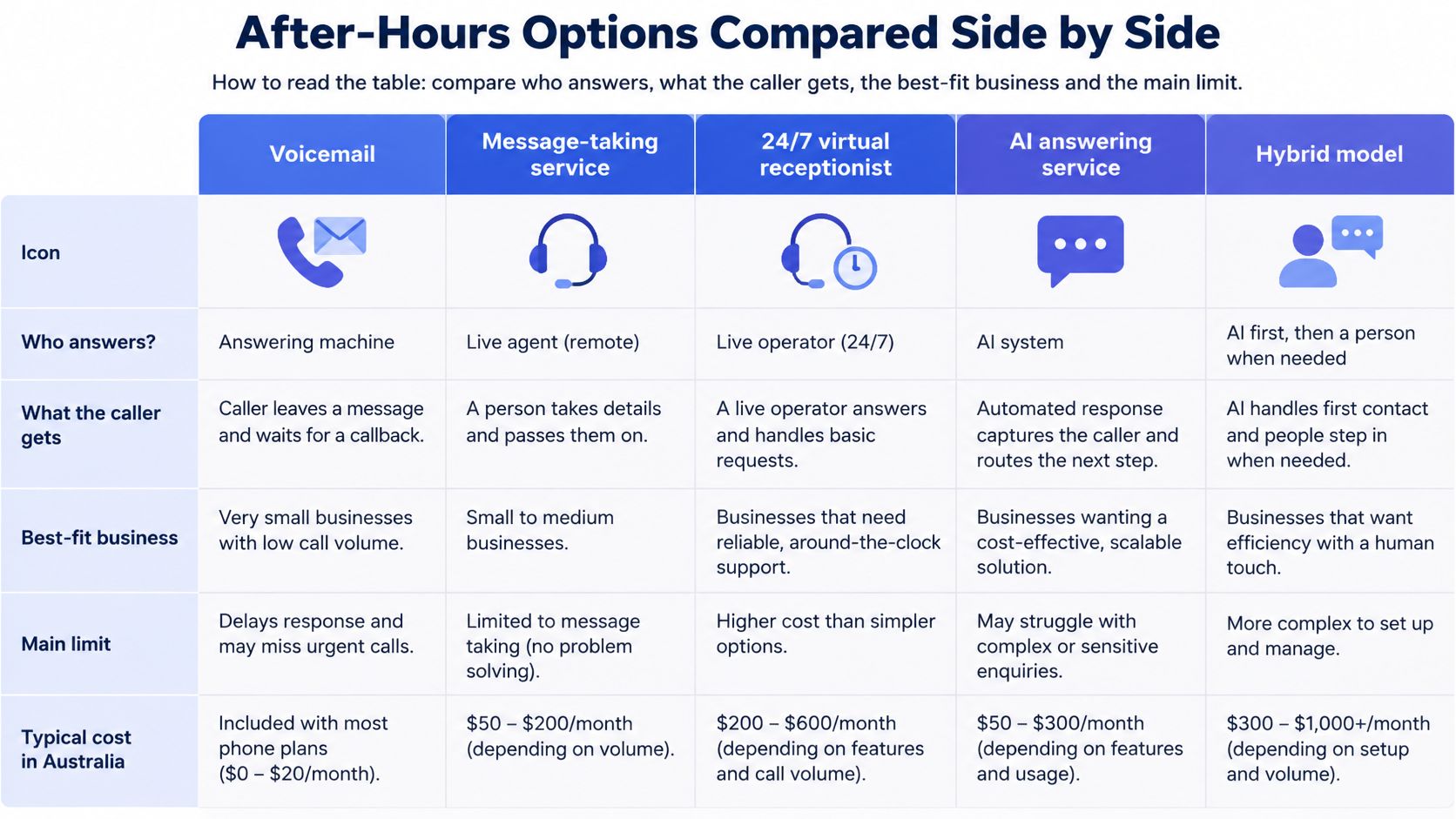
Read the table row by row rather than by price. The cheap options fail on triage, the premium ones on knowledge of your jobs, and the middle options fail on governance when nobody writes the escalation rules down.
| Option | Who answers | What the caller gets | Best fit | Main limit |
|---|---|---|---|---|
| Voicemail | Nobody, caller leaves a message | Audio message, no triage until morning | Very low after-hours call volume | Enquiries wait unsorted and urgent calls can be missed |
| Traditional call centre | Shared human agents working from scripts | Live answer with notes that vary by agent | Businesses that need live people on every call | Limited knowledge of your jobs and higher cost per call |
| Managed AI answering with human review | AI assistant, with a person approving sensitive actions | Structured capture into the CRM with a transcript | Trades, installers and firms with repetitive enquiries | Needs approved scripts and clear escalation rules |
| On-call owner or staff rota | A named person on rotation | Live answer, quality depends on who is on call | Emergency-heavy trades with a small team | Burnout risk and uneven coverage |
| Hybrid AI intake with on-call escalation | AI captures and sorts, on-call person takes urgent calls | Structured record plus live escalation for urgent work | Trades where safety-critical calls are common | More rules to maintain and test |
Voicemail is free and quiet, which is the problem. It hands you a recording that someone has to decode and re-enter into a system, and it puts a burst pipe in the same queue as a quote enquiry for a job in six months.
A traditional call centre puts a live human on the line, usually working from a script and often covering several industries on the same shift. Callers get warmth and a promise. What they rarely get is an answer about whether your crew can pour a slab on a slope or whether your electrician covers that postcode tonight.
Managed AI answering with human review does the repetitive part properly: structured capture into the CRM, a transcript, a named owner and a next action, with a person approving anything sensitive. It suits trades, installers and professional firms whose overnight calls are variations on the same six questions. It only works when you supply approved answers and genuine escalation rules, and it fails when you don't.
An on-call rota gives you judgement on the line, which is exactly what an emergency needs. It also gives one person a 2 am call after a full day on site, and coverage that sags the week they take leave.
Hybrid AI intake with on-call escalation is the model I'd recommend for most service businesses with real emergencies. The system captures and sorts everything, the on-call person is disturbed only by calls that meet your written triggers, and the rest waits in a queue with context attached.
Three variables settle the choice faster than any feature list: how many after-hours calls you receive, what share are urgent, and how much pricing or judgement sits inside the first conversation. High volume with low urgency points to a managed intake layer. Low volume with high urgency points to a rota with better rules. Most firms assume they're in the second group and discover they're in the first.
A managed model, like our managed AI operations, runs around the clock including overnight and weekends, and works with the CRM and phone tools already in place rather than replacing them. Truespeak builds and runs these systems so follow-ups, CRM updates, admin and reporting keep moving without adding permanent headcount. If you're still weighing live operators against software, this breakdown of AI receptionists versus answering services is a useful second opinion on where each model handles nuance. Whichever row you pick, the design question doesn't change: keeping a person in the loop on the calls that carry risk, which is what human-in-the-loop automation is for.
Then run the test. Take last month's missed and after-hours calls and match each one to the row that would have captured it. If most of them land in the same row, you've already made the decision.
Triage Rules for Emergencies, Quotes and Complaints
The system triages. A person decides. Write that on the wall before you buy anything, because the expensive failures in after-hours handling come from calls answered quickly with no context and no authority behind the answer. A missed call costs one lead. A fast, wrong answer costs the lead and the credibility.
| Enquiry type | Overnight handling | Next step |
|---|---|---|
| Life safety or active emergency | Give approved emergency instructions and page the on-call person | Immediate human contact |
| Gas, electrical or water leak | Give the approved safety instruction first (for example, leave the area and follow your published emergency steps), then capture site address and urgency | On-call person paged straight away |
| New job enquiry | Collect photos, budget range, location, preferred callback time and permission to call back | Callback by the next business morning |
| Quote or pricing request | Record the request and do not quote | Human quote within the agreed timeframe |
| Complaint or dispute | Acknowledge, log the details and escalate | Human response on the next business day |
| Personal data or access request | Log the request and route to an authorised person | Authorised person reviews and responds |
Read that table from the top down and notice how little the system is allowed to decide alone. Everything with a safety dimension or a commercial consequence ends at a human. What the system contributes is speed of capture and a complete record, so the person who picks it up at 8 am starts with the address, the photos, the urgency and the caller's preferred callback window already in hand. That is the difference between intake and a voicemail: the caller gets a fast answer, and the business gets enough context to make the answer worth something.
Speed without comprehension doesn't buy trust either. In ServiceNow's 2026 Australian customer-experience research, 113.5 million hours were spent on hold in 2025 and 46% of time-poor Australians said slow or poor service could make them switch providers, yet 51% named AI's inability to understand their concern as its biggest customer-service problem, even though 58% saw a benefit in 24/7 support. Comprehension at speed is the goal, and coverage alone doesn't deliver it.
Do the design work before go-live, because the first complaint about a robot is a sign it was skipped.
- Write the escalation matrix first. Six rows minimum, mapped to the enquiry types above, agreed by whoever carries the phone at night.
- Put a name against every row. A row without an owner is a row that fails at 2 am.
- Replace "we'll be in touch" with a verifiable commitment. "You'll get a call from Dan before 9:30 am tomorrow" can be measured and chased. "Someone will get back to you" can't.
- Set approval gates on anything commercial. Pricing, quotes, refunds and dispute responses wait for a person to review the context and approve the next action.
- Build the pause. When data is missing or the risk is high, the system stops with context rather than guessing or hiding the gap.
Emergency boundary: if a caller describes immediate danger to life or property, the system gives your approved safety instruction and pages the on-call person. It doesn't diagnose, advise or reassure beyond the script you approved. A reported gas, electrical or water leak sits inside this boundary until the on-call person judges otherwise.
Judgement sits at that boundary. Automation should hold policy decisions, relationship judgement, pricing, complaints and unusual exceptions for a person, while the system carries the repetitive work around them. Overnight, the machine answers, sorts and records; the human decides what the answer is worth.
Privacy, AI Disclosure and Data Handling
The working assumption is that telling callers they're speaking to an automated assistant costs you enquiries. The evidence doesn't support the fear, and the opposite risk is larger. The OAIC's 2026 national privacy survey found 93% of Australians consider protecting personal information important, 87% are more concerned about privacy than five years ago, and only 4% trust AI companies to protect and use their information.
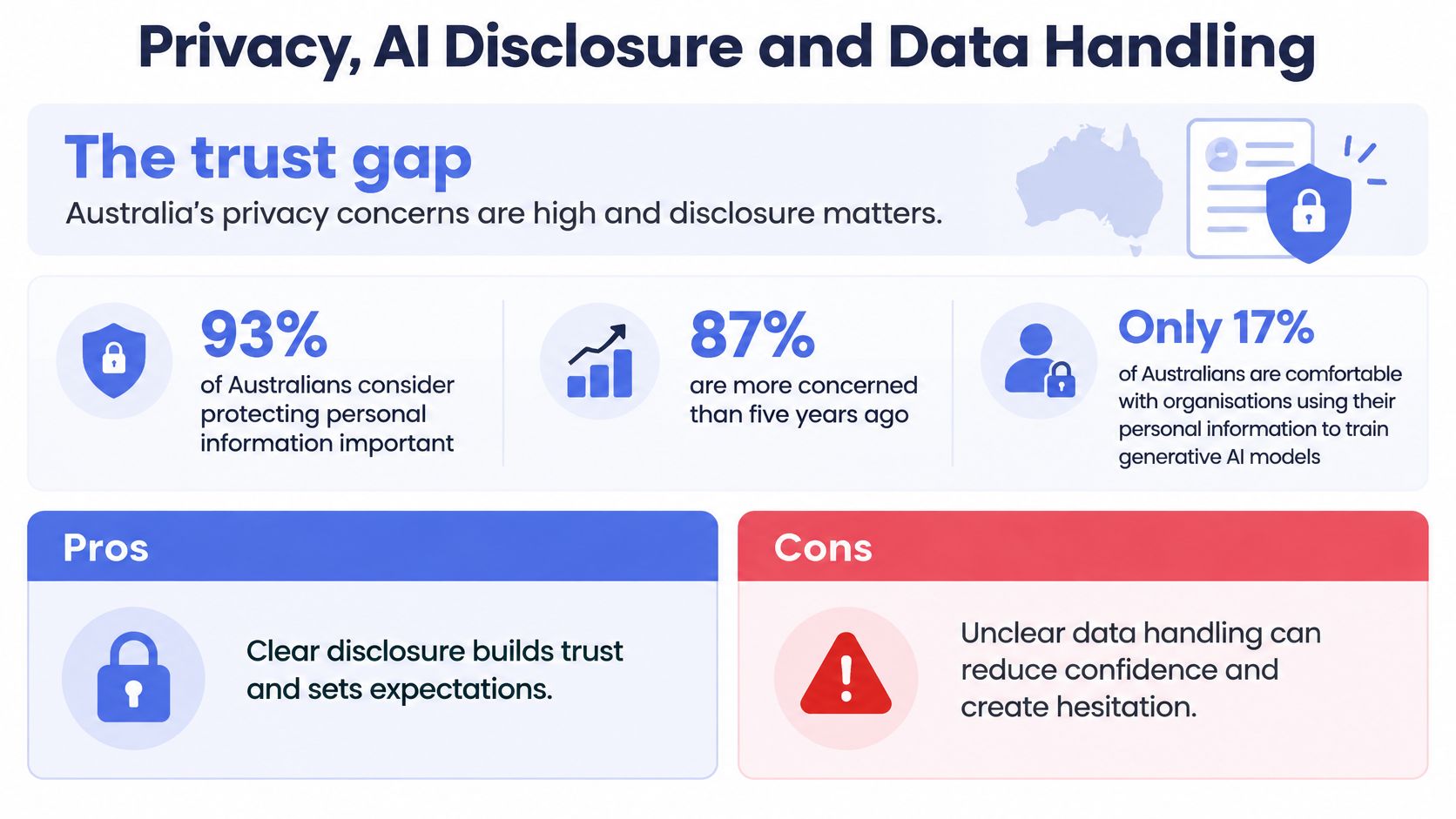
Expectations are specific, not vague. In the same survey, 79% of respondents expect to be told when AI is being used, 74% want to know when their personal information is shared with a third-party AI provider, 80% want limits on third-party retention, and 76% oppose their personal information being used to train external AI systems without consent.
The Governance Checklist
- Disclose in plain language at the start of the call, before you collect anything.
- Collect the minimum. A name, a number, the service, the location and the urgency. Not a date of birth, not a payment card.
- Set retention and deletion periods for recordings and transcripts, and enforce them automatically rather than hoping someone remembers.
- Restrict transcript access to named roles, not the whole team and certainly not a shared drive.
- Keep a human on consequential decisions, including pricing exceptions, disputes, safety matters and personal-data requests.
- Keep an audit trail that shows what was captured, what was said and who acted on it, so a complaint can be answered with evidence.
Example disclosure: "Hi, you've reached [business name]. I'm an automated assistant. I can take your details and arrange for the right person to call you back. This call is recorded so we can pass on accurate details."
The boundary matters more than the wording. AI handles low-risk work well: capturing an enquiry, confirming availability, gathering documents, routing the job. Pricing exceptions, disputes, safety matters and personal-data requests belong with an authorised person. Our own systems are built that way, which is why anything client-sensitive waits for approval, and if you want the technical side of that, whether it's safe to put client data into AI tools walks through it.
Ask any provider for its written privacy process before you sign: where data is stored, who can see it, how long it's kept and how deletion works. For privacy questions about our systems, email sonny@truespeak.io.
Consent Rules Before Any Follow-Up Message
Capturing an enquiry doesn't give you permission to market to the person who made it. Under Australian spam rules, a commercial electronic message needs consent before it's sent, must identify the sender and include contact details and a working unsubscribe, and the obligation stays with your business even when a provider sends the messages on your behalf, per ACMA's anti-spam guidance. You can't outsource consent to the answering service.
| Situation | Follow-up allowed | Evidence to keep |
|---|---|---|
| Enquiry about a job, no marketing consent | Reply about that enquiry only | Enquiry record with channel and timestamp |
| Express consent given for updates | Marketing that matches the consent terms | Consent wording, source and date |
| Existing relationship with a related product | Limited inferred-consent follow-up, checked case by case | Record of the relationship and product link |
| One-off enquiry or purchase alone | No promotional messages | Record showing no marketing consent was given |
| Opt-out or stop received | Stop marketing and honour within 5 working days | Opt-out date and action log |
A one-off purchase or enquiry doesn't create inferred consent for later campaigns. That single rule kills most of the "while we've got you" sequences built into overnight workflows, and it draws the line that matters after hours: a fast reply that answers the enquiry builds trust; a fast promotional message to the same person spends it.
The unsubscribe mechanics are where small operators get caught. ACMA's unsubscribe fact sheet sets out that the opt-out must have clear instructions, be actioned within 5 working days, cost no more than the usual cost of sending the reply, keep working for at least 30 days after the message was sent, and never require the recipient to create an account, log in or hand over more personal information.
Operating rule: capture and reply immediately, then put any marketing sequence behind a consent check you can evidence.
Practically, the consent record lives next to the enquiry itself: intake channel, consent source and date, outbound message history and current unsubscribe status on the one file. A fragmented record can't tell you whether the person agreed to hear from you again, and an answering layer that writes to four places gives you four versions of the answer. I'd treat the consent check as part of triage rather than a marketing afterthought, because context-aware follow-up only works on top of clean intake. For the legal position in full, whether automated follow-up is legal under the Spam Act covers it.
Connecting Intake, Phone and CRM Systems
Route calls to your own line first and overflow to the answering layer after a defined ring threshold, so staff coverage stays primary during business hours and the caller never notices the handover. Write the overflow rule down and test it rather than assuming it works, and write the emergency triggers down next to it.
Classify every interaction into one of three states, because a system that only knows "answered" hides the calls that matter.
- Urgent escalation: a person is paged now, using your triggers, not the caller's.
- Qualified follow-up: the record is complete enough for a callback with context, and it carries photos, budget range and preferred time.
- Information capture: a genuine question that can wait for the next working day without losing value.
Then map every intake source, including voicemail, web forms, shared inboxes and text messages, to the same CRM fields so each record lands in one place with an owner, a due time and a next action. Push the overnight queue to whoever handles the next working day, not to a general inbox that three people watch and nobody owns. If the answering layer books appointments directly, connect it to the same calendar rules your team uses, so two callers can't be promised the same slot; this guide to preventing overlapping calendar appointments covers the practical setup.
Security and testing complete the process. Limit transcript and call-summary access to named roles, set retention and deletion periods, and maintain an audit trail of who viewed or changed a record. Confirm in writing where data is stored and which subprocessors handle it, and check that the CRM sync does not copy transcripts into shared spreadsheets or unrestricted inboxes. Before go-live, send one dummy enquiry through every channel end to end, confirm the record, the owner and the next action, then repeat the test after any change to the phone system or CRM.
Measuring Results and Running a Safe Trial
Two numbers get confused constantly: acknowledgement time, when the caller first gets confirmation, and time to useful response, when they get a real answer or a booked next step. Both matter, and they fix different problems. The first tells you whether the line feels attended. The second tells you whether the enquiry will convert.
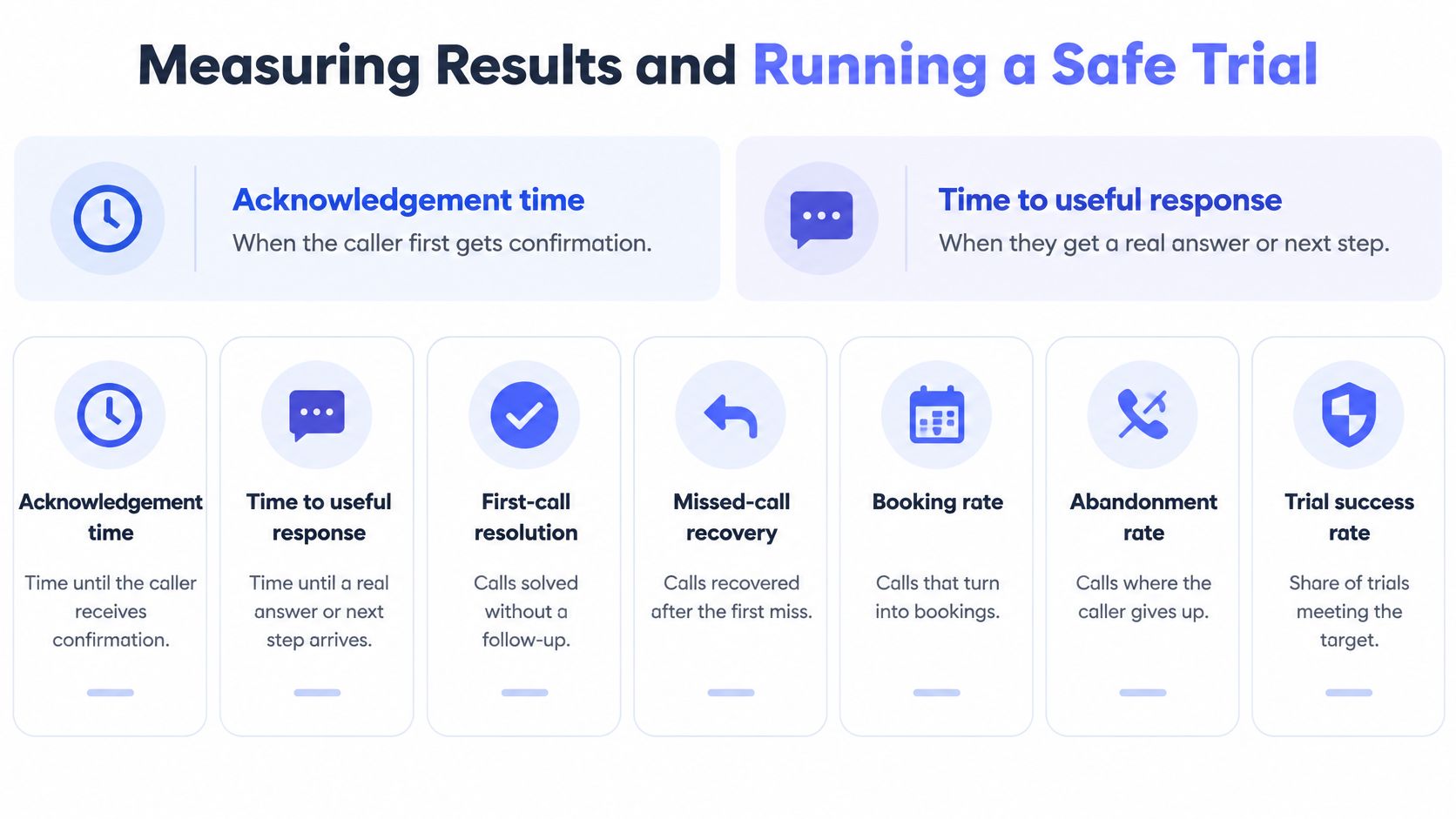
Measure them separately from day one, because a fast acknowledgement with a slow useful response creates a caller who has been reassured twice and helped once.
| Metric | What it shows | How to calculate |
|---|---|---|
| Acknowledgement time | How long until the caller first gets confirmation | First reply timestamp minus enquiry timestamp |
| Time to useful response | How long until the caller gets a real answer or next step | Qualified response timestamp minus enquiry timestamp |
| Answer rate | Share of after-hours calls picked up | Answered after-hours calls divided by all after-hours calls |
| Qualified-call rate | Share of answered calls with usable intake data | Calls with name, service, location and urgency divided by answered calls |
| Escalation rate | Share of answered calls routed to a person | Escalated calls divided by answered calls |
| Booking rate | Share of qualified calls converted to a booked next action | Bookings divided by qualified calls |
| Next-business-day completion | Share of overnight records actioned by the next working day | Completed overnight actions divided by overnight records |
For trades, qualified-call rate matters more than answer rate. A picked-up call with no name, no location and no urgency creates the same rework as a missed one, just with a nicer feeling attached. A complete overnight record holds the caller's details, the service, the location, the urgency, the consent status, a timestamped transcript and an owner-specific action.
A benchmark circulating for trade businesses puts 34% of inbound enquiry calls in the after-hours window of 6 pm to 8 am on weekdays plus weekends, according to this Australian summary of after-hours answering. It's publisher-reported rather than an ABS or ACMA series, so validate it against two to four weeks of your own telephony logs before you set a target on it.
Then run the trial properly.
- Record baseline figures for every measure above before you change anything.
- Map one messy overnight handoff end to end, from capture to logged action, and note where context disappears.
- Go live on one enquiry type using the escalation matrix and the consent rules you've already written.
- Review exceptions weekly and widen scope only where the measures beat baseline.
That is what speed-to-lead automation is for at the front end, with CRM automation turning the resulting records into action queues instead of stale rows. Bring one messy handoff to a discovery call and we'll map what should be captured, drafted, approved and logged. Then decide: managed service, hybrid on-call, or your current cover with written rules. Any of the three is defensible. Deciding nothing is the expensive option.
If your after-hours calls currently land in voicemail, a shared inbox and three different staff mobiles, Truespeak builds the intake layer that answers, captures the reason and urgency, routes the job and puts an owner and next action against every record. It runs 24/7 on the CRM and phone tools you already use, with people approving anything sensitive. Visit Truespeak to talk through the one handoff that keeps costing you work.