

An after-hours enquiry lands for a switchboard upgrade. The estimator is still on site, so the email waits. Two weeks later the quote has stalled, and a month after the work the invoice sits unchased, because no single record shows who owns the job.
The AI agents examples worth using are the ones that close those gaps while a person keeps control of fit, pricing, relationships and final approval. Read each one the same way. A trigger starts the step. Context comes from the CRM, inbox or job file you already trust. The system prepares a decision and a next action. A named person approves anything that commits the business. The output is written back, and feedback such as a reply or a stage change sets what happens next.
Do not lift a build from another firm and drop it on yours. Adapt the questions, the service area and the approval rules. The measures below are not borrowed speed-ups. Capture them in your own pipeline: stage, owner, last activity and next action. Broader catalogues, including AI agent examples from Applied, show how wide the field has become. For Australian trades, installers and professional firms, the test is simpler. Did the handoff that used to drop the work now have an owner?
Table of Contents
- 1. Speed-to-Lead First Response and Qualification
- 2. Context-Aware Lead Follow-Up for Quotes and Proposals
- 3. Structured Intake and Document Collection
- 4. CRM Hygiene Routines and Prioritised Action Queues
- 5. Human-Approved Invoice Reminders and Receivables Follow-Up
- 6. Business Process Automation and Diagnostic Assessment of Dropped Work
- 7. Managed AI Operations with Monitoring, Approval Gates, and Reporting
- How the seven AI agent examples compare by purpose, trigger, human gate and tracking metric
- Choosing Your First Agent and Measuring It Honestly
1. Speed-to-Lead First Response and Qualification

When the buyer writes at 8pm and the crew is still packing the van, a plain, fast reply beats a clever bot.
The agent acknowledges each enquiry from a form, email, phone transcript or message channel. It asks about job type, location, budget range and timing, then routes the record with a booking link. It sits on the CRM and calendar you already use. Your people still decide fit and price.
An electrical contractor's agent can take the switchboard note, confirm the suburb is in the service area, ask about property type and timing, and hold a site visit for the estimator to confirm. A cleaning business can split by postcode and service type, sending recurring contracts to the account manager and one-off jobs to the scheduler.
The Australian Bureau of Statistics reported that 12% of businesses used AI in 2024–25, compared with 1% in 2022–23, and that small and micro businesses were at about 11%. Use is growing. Smaller firms still need one tight workflow, not a transformation program.
Before You Switch the Agent On
- Map the sources: List every form, inbox and missed-call path, and write the response standard beside each.
- Name the clock: Store on the CRM whether first contact happened inside the business hours you set.
- Keep the promise honest: Say what happens next and who will call.
- Read the first month: Check transcripts weekly and fix weak questions and escalation triggers.
If after-hours enquiries are where jobs die, start here. The speed-to-lead automation page sets out that process-first shape.
2. Context-Aware Lead Follow-Up for Quotes and Proposals

Quotes stall because the client is comparing options or waiting on someone else, not because your estimator forgot the job. An agent can send a nudge that names the job, the date sent and any open question, then pause when the client replies, the CRM stage changes, or a person marks the opportunity on hold.
Approve the sequence before it runs, especially on higher-value or sensitive work. A builder's note might go three business days after a renovation quote, name the agreed scope and offer a short call. A question from the client stops the sequence and gives the estimator a call card. A bookkeeping practice can reopen proposals older than thirty days with a checklist of documents still outstanding, and the account lead approves each send.
Practical rule: Cap the follow-ups and put a cool-down between them. Messages sent is not a result. Stage movement and stalled-opportunity counts are.
Commercial email still has to respect consent, an opt-out and the Spam Act 2003, along with ACMA guidance on commercial electronic messages. Require a stage update before a sequence begins. For the note after a proposal goes out, see how to follow up a quotation. Sequence design for this handoff sits on the lead follow-up automation page.
3. Structured Intake and Document Collection

Missing photos and a blank access note are why the brief gets rebuilt halfway through the job. An intake agent walks the client through site address, access, scope, photos, measurements, certificates, existing plans and timing. It asks again for gaps and files the brief in the CRM or job system.
A carpentry flow can collect deck photos, measurements and material preferences, then flag an unanswered council-approval question before anyone prices the work. A solar installer can gather roof type, switchboard photos and a bill, so the design review does not start with a chase call.
Privacy Before You Ask for More
The Office of the Australian Information Commissioner says the Privacy Act 1988 and the Australian Privacy Principles apply to personal information entered into an AI system and to personal information in its outputs. It recommends a Privacy Impact Assessment before you adopt a commercial AI product, including how human oversight is embedded and who can access what the system takes in or produces.
- Collect less first: Start with the three to five fields that cause the most rework, then add fields only when a real gap shows up.
- Show a good photo: Include an example so the client knows what a usable image looks like.
- Lock sensitive files: Keep identity and financial documents in restricted storage with a defined retention period.
- Keep a person on impact: If an output could affect the customer, someone reviews it.
The intake automation page outlines that structure.
4. CRM Hygiene Routines and Prioritised Action Queues
Stale stages make a live job look finished. A scheduled agent looks for missing owners, outdated stages, duplicate contacts and records with no activity for a period you choose. It does not rewrite the database. It builds a short queue and a call card for the person who owns the relationship.
A professional services firm can flag opportunities with no activity for fourteen days and hand the account lead the last email plus a proposed next step. A plumbing office can spot duplicate customers created from different forms and send a merge recommendation to the office manager. The merge waits for a yes.
Business.gov.au points to the National AI Centre's AI Adoption Tracker, with four dashboards you can filter by business size, industry, location, application and business outcomes. Use that to see how firms like yours apply AI to administration. Do not borrow a response-time claim from it. Your measure is whether each record has a stage, an owner, a last activity and a next action.
A queue of ten items per owner, per day, gets worked. A queue of eighty does not.
Define stages and mandatory fields before any check runs. Start with read-only reporting, then allow limited writes once false positives make sense. CRM data quality is the habit under the agent, and CRM automation covers routing and queues.
5. Human-Approved Invoice Reminders and Receivables Follow-Up
An invoice can be overdue for different reasons: an overlooked email, a disputed scope, or a client who needs a payment arrangement. An agent can draft a reminder using the invoice date, due date and payment history, then send it to a finance or admin person for approval. Disputes, payment-plan requests and replies that fall outside the agreed sequence should pause the draft and go to a person.
For overdue invoices, the reminder should state the amount, due date and a clear next step. Keep the tone factual, and check applicable Commonwealth and state guidance before escalating late-payment language. The Office of the Australian Information Commissioner's guidance on AI and automated decision-making explains transparency obligations when personal information is used in certain decisions that may significantly affect a person's rights or interests.
A person should approve final notices and any mention of legal action.
For a building-services invoice that is overdue, the accounts officer can review a draft reminder; an invoice with a scope query should go to the owner instead. If a consultancy client requests a payment plan, route the reply to the director and pause reminders until the agreed date.
Track overdue value and days sales outstanding in the accounting system. Message volume alone does not show whether receivables are improving. Confirm which accounting records the workflow needs before connecting it, and keep approval with the person responsible for the client relationship. The invoice reminder automation page explains the approval and escalation setup.
6. Business Process Automation and Diagnostic Assessment of Dropped Work
Buy the tool after you know which handoff drops the work.
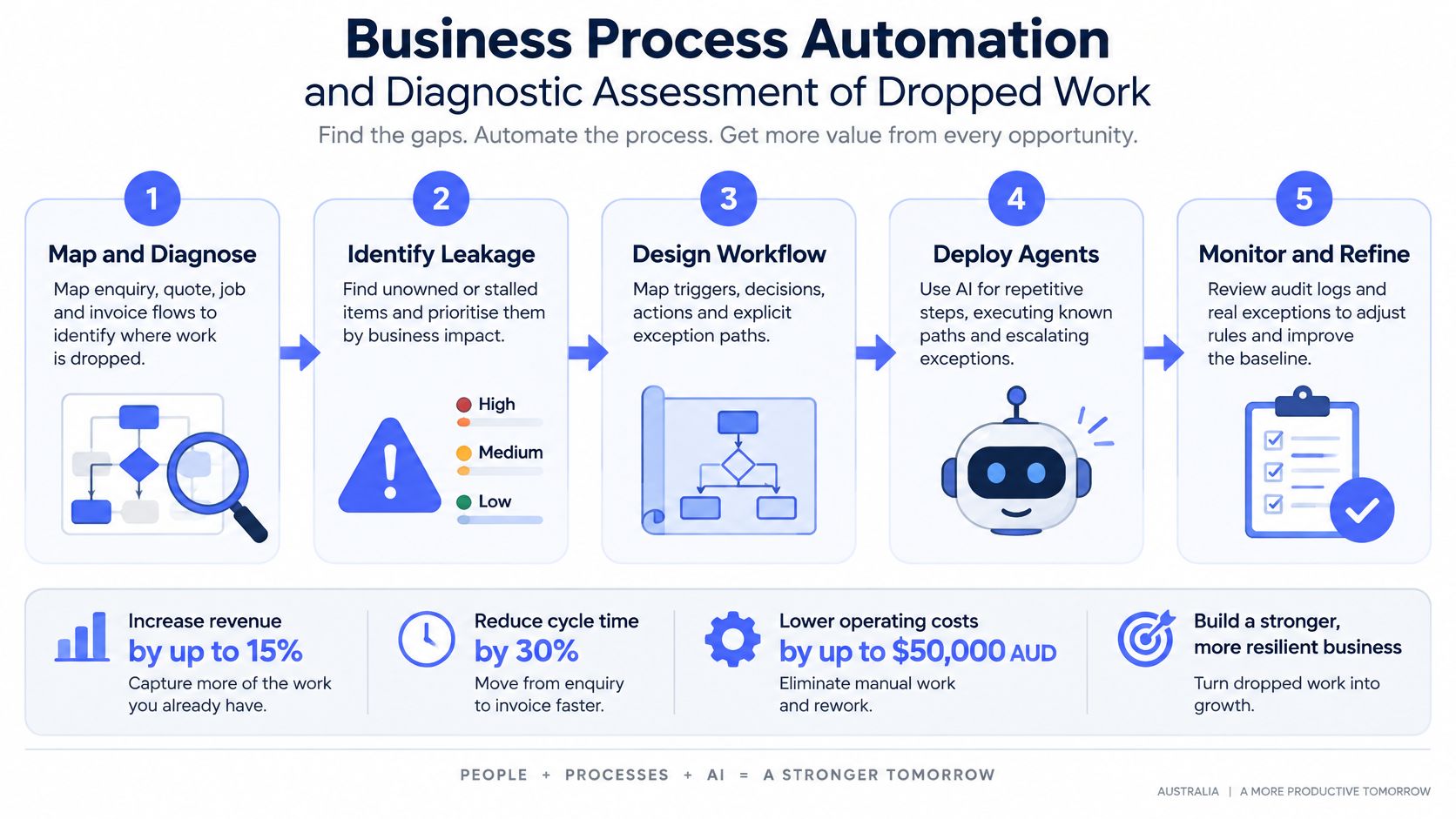
A diagnostic maps how enquiries, quotes, jobs and invoices move, then ranks leaks such as a slow first reply, an unowned lead, a thin brief or an invoice with no chaser. You write a baseline and build the smallest system for the worst gap. The agent runs the known steps and escalates anything off the path.
The Fair Work Commission deployment covered by iTnews is a public pattern of narrow agents on systems already in place. Its IT Support Genie reduced overseas conditional-access provisioning from 30 minutes to 5 minutes. Those minutes belong to that agency. Yours are the ones you log before and after.
A contractor might find that quotes die after the first week and website enquiries have no owner, so the CRM fix comes before any agent. A painting firm can map accepted quote, booking, materials order and completion invoice, with the agent sending confirmations and flagging a missing material lead time for the project manager.
The same handoff logic, from trigger to exception, is easier to see in motion.
Write the exception path before you automate the happy path, and review that log monthly. Workflow automation benefits from Safety Space only show up when the map is honest. Worked diagnoses are in diagnostic assessment examples, and the mapping method is on the business process automation page.
7. Managed AI Operations with Monitoring, Approval Gates, and Reporting
Launch day is not the operating model. Monitoring checks that the agent still follows the rules. Approval gates hold sensitive messages and actions that affect a client. Reporting shows what was handled, what escalated and what is stuck.
Around 65% of non-adopting businesses distrust AI decision-making or prefer to retain human control, and 19% say they do not know how to use AI in their business, according to AI adoption insights from the National AI Centre. That is why a fire-safety operations manager should read a weekly note of enquiries handled, escalations, stalled jobs and approvals, then reset the response standard from that note. A finance lead can read a fortnightly log of reminders paused for disputes, so the argument has an owner.
What the Runbook Has to Name
- Metrics before launch: Response standard met, stalled opportunities and exceptions, not a general claim about productivity.
- Gates on risk: We keep human control over policy decisions, pricing, complaints, unusual exceptions and final approval on risky actions.
- Access in writing: Agree who owns the data, who can open it and how handover works. Access stays limited to the records the workflow needs.
- A safety frame: Use the Australian Government's Voluntary AI Safety Standard and the AI Ethics Principles when you set those gates.
Post-launch rules, prompts, logs, alerts and a review cadence are what keep a small team from babysitting software. That ongoing layer is managed AI operations.
How the Seven AI Agent Examples Compare by Purpose, Trigger, Human Gate and Tracking Metric
| Item | Primary job | Trigger | Human approval point | Key metric to track |
|---|---|---|---|---|
| Speed-to-Lead First Response and Qualification | Acknowledge, qualify, and route inbound enquiries | New enquiry received | Staff judge fit and pricing; complex or out-of-scope enquiries escalate | Time to first response |
| Context-Aware Lead Follow-Up for Quotes and Proposals | Send relevant follow-ups and keep quote decisions moving | Quote or proposal issued | Templates and high-value opportunities reviewed before launch | Opportunity stage movement |
| Structured Intake and Document Collection | Gather required job details and documents | New client or job intake | Staff review the completed brief and any missing or sensitive information | Intake completeness |
| CRM Hygiene Routines and Prioritised Action Queues | Find CRM gaps and prioritise follow-up actions | Scheduled CRM checks | Human review of exceptions and approval of bulk changes or deletions | Stale or incomplete record rate |
| Human-Approved Invoice Reminders and Receivables Follow-Up | Prepare and manage overdue invoice reminders | Invoice becomes overdue | Finance or admin staff approve reminders; sensitive cases go to a person | Days sales outstanding and overdue value |
| Business Process Automation and Diagnostic Assessment of Dropped Work | Identify dropped work and automate priority workflows | Process assessment or recurring workflow handoff | Business owners approve workflow rules and exception paths | Dropped-work rate against baseline |
| Managed AI Operations with Monitoring, Approval Gates, and Reporting | Monitor, govern, and improve AI agent operations | Ongoing after launch | People approve sensitive or client-impacting actions | Response times, queues, and exceptions |
Choosing Your First Agent and Measuring It Honestly
Pick the workflow where work is dropped most often, not the example that sounds most impressive. If enquiries die after hours, pilot first response. If quotes go quiet, pilot follow-up. If briefs come back half empty, pilot intake. If the CRM no longer matches the actual pipeline, fix hygiene before you add another sequence. If cash sits out, pilot reminders only after the invoice data is clean.
Leave these gates with people, whatever you automate. Pricing stays human. Complaints stay human. Relationship judgement stays human. Final approval on anything risky stays human. The agent can capture, enrich, route, remind and package a brief. It should not decide whether you want the job, what you charge, or how a dispute ends.
The Australian AI ecosystem paper reports that 93% of surveyed organisations lacked an effective way to measure return on investment from AI initiatives, and 88% struggled to integrate generative AI with legacy systems. A broad rollout walks straight into that gap. Measure one workflow against a baseline you write down first.
- Response standard met: Count enquiries that received a first approved contact inside the hours you set.
- Stalled opportunities: Count quotes and jobs with no next action, and watch whether that count falls.
- Overdue value: Track days sales outstanding and the amount still late, from your own accounting file.
- Exceptions logged: Record bad routes, false matches and paused sequences, and stop or redesign the agent if oversight costs more than the gain.
Collect several weeks of enquiry, quote and invoice history before you choose. Talk to the people who chase the work, not only the managers. Revisit the baseline after three months and keep the change only if the pipeline is more visible.
If you want that diagnosis with a Sydney operations partner rather than another tool demo, Truespeak maps the dropped handoffs and runs the smallest useful system around the CRM and accounts tools you already have. We place the approval gate and stay on the monitoring after launch.
Truespeak designs, builds and manages AI operating systems for growing Australian service businesses, covering first response, follow-up, intake, CRM hygiene, invoice reminders and reporting that shows whether each job still has an owner and a next action. The work sits around the tools you already use, with people retaining judgement on fit, price and relationships. If that is the operating layer you need, visit Truespeak.