
Monday morning in a Brisbane plumbing office starts the same way it always does. A customer calls for an urgent job, the CRM shows a stale note, two reps ring back, a third can't find the record, and by the time the team sorts it out the customer has already taken the quote from someone who replied faster. That's not bad luck, it's CRM data quality breaking at the exact moment the business needs the pipeline to be honest.
I've seen this pattern in service businesses that are busy enough to feel organised and messy enough to lose work anyway. The records exist, but they don't tell the truth, because ownership is missing, stages are old, duplicates sit side by side, and nobody trusts what the CRM says when the phone's ringing.
If you're trying to turn that mess into a system, a useful starting point is how teams define and govern pipeline flow, not just how they store contacts. The operational thinking behind pipeline management is the right lens here, because the problem is rarely one field, it's the whole hand-off chain.
For retention-heavy businesses that depend on fast follow-up, even a clean list isn't enough. If you need help thinking about downstream response and customer keeping, find the right retention agency is a useful adjacent read, because the same data habits that save inbound work also protect repeat business.
Table of Contents
- When the Pipeline Stops Telling the Truth
- What CRM Data Quality Means for a Service Business
- The Drift Issues That Break Your Pipeline
- Stopping Bad Data at the Point of Entry
- A Weekly CRM Hygiene Routine You Can Run
- Where Automation Helps and Where People Must Decide
- Monitoring CRM Health Without Inventing Numbers
- Making CRM Quality an Operating Habit
When the Pipeline Stops Telling the Truth
The worst CRM failure isn't an empty database, it's a database that looks busy while the work slips away. In a Geelong electrical contractor, that usually shows up as one enquiry being chased by three people, because the form created one contact, the inbox created another, and the rep who took the call saved a third note somewhere nobody else can see.
The customer notices straight away. They've already explained the job twice, they're still getting duplicate callbacks, and then someone from another business replies within the hour and wins the work. That's how a pipeline stops being a sales tool and turns into a source of confusion.
Practical rule: if three people can touch the same enquiry and still disagree about who owns it, the CRM isn't governing the job, it's hiding it.
The drift usually starts in ordinary ways. A rep leaves and their owner field stays blank. A stage never gets updated after the quote goes out. Contact records multiply because web forms, phone calls, and spreadsheet imports all feed different intake paths. None of that is dramatic on its own, but together it means the CRM no longer reflects the actual work.
That's why this isn't a one-off cleanup problem. It's an operating discipline problem. The businesses that stay sane treat every enquiry as a tracked item with one owner, one next action, and one visible outcome. The ones that don't end up paying for the same lead twice, then wondering why the forecast feels off.
What CRM Data Quality Means for a Service Business
For a service business, CRM data quality means one thing. A record is useful only when you can see who owns it, what stage it sits in, what happens next, and what outcome the team can act on. Anything less is paperwork dressed up as process.
The Four Checks That Matter
Start with ownership. If nobody owns the record, nobody is accountable for follow-up. Then check stage, because a lead in the wrong stage will distort your queue, your reporting, and your attention.
Next comes the next action. A live record without a next step is a stalled conversation. Finish with the visible outcome, because you need to know whether the record is won, lost, nurtured, or still active.
A record that passes all four checks is useful. A record that looks complete but has no owner, no next action, and an old stage is dead weight.
Working test: pull ten random records before lunch. If more than a couple fail any of the four checks, the CRM needs governance, not another round of cosmetic cleanup.
This matters more for tradies, agencies, and professional services because speed decides the outcome. Clean reporting helps. Fast follow-up wins the work. If the phone number is right but the owner is wrong, you still lose the job. If the stage is current but the next action is missing, the record goes stale.
Use the same discipline behind a simple data quality issues checklist. Reconcile the record the same way you would reconcile any other operational system, by checking what happened, who handled it, and what should happen next.
The Drift Issues That Break Your Pipeline
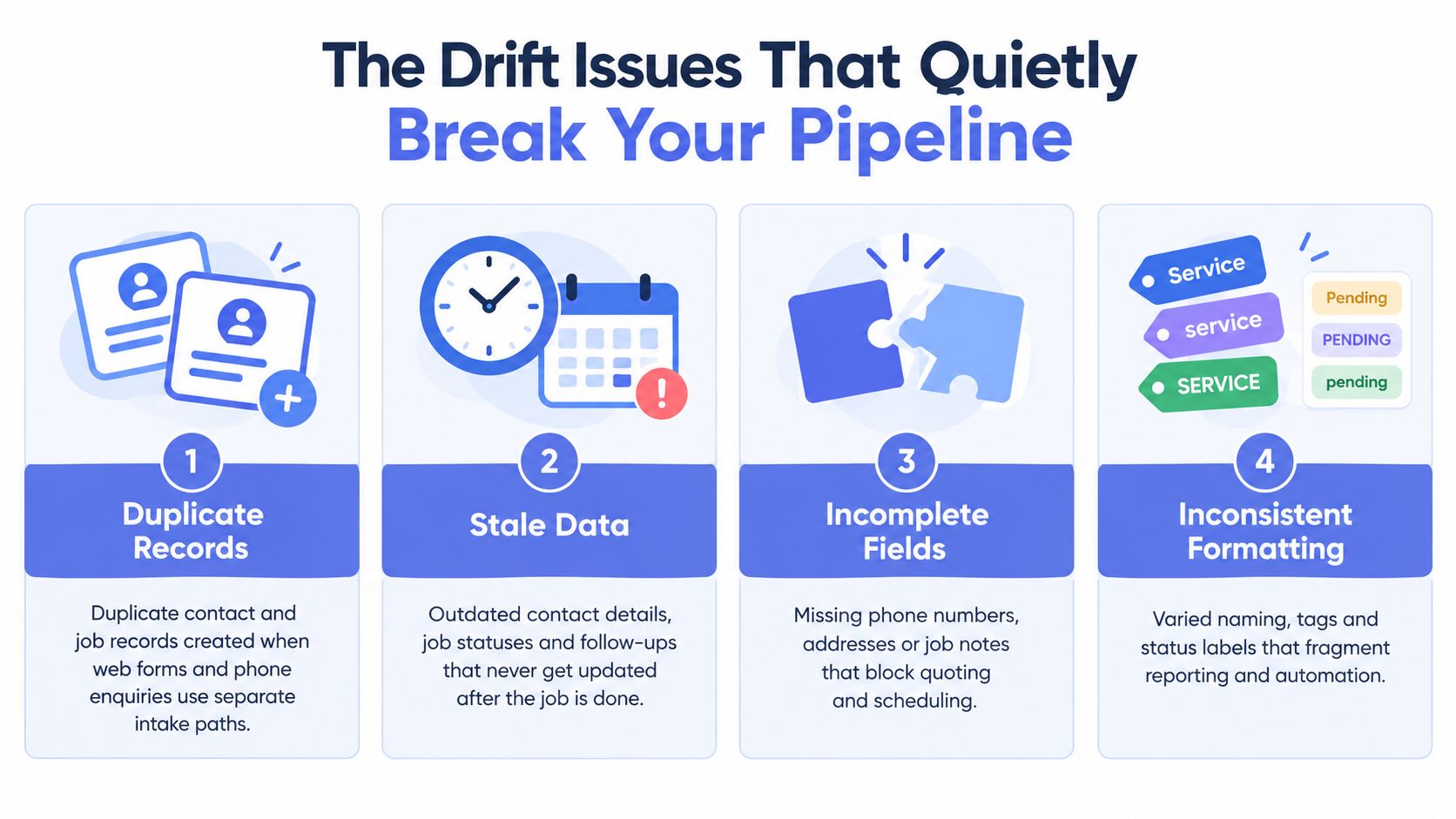
The breakage usually starts in four places, and they feed each other. Duplicates create double handling. Stale stages make forecasts lie. Missing owners leave work stranded. Orphan records sit there until no one can explain why they still exist.
The Four Drift Patterns I See Most Often
Duplicate contact and job records usually start when forms, calls, and inboxes do not feed one intake path. One customer becomes three records, and the team starts working against itself. That is when the “we already called them” complaints begin.
Stale pipeline stages are worse than they look. A quote marked “won” last month makes the pipeline look healthier than it is, while a lost opportunity still sitting open sends people after dead work. If stages do not change when the job changes, the reports are fiction.
Missing owner fields show up when a rep leaves, changes territory, or forgets to assign. The business feels it as missed callbacks and dropped follow-up. The mess stays put until someone fixes the ownership.
Orphan records are the silent waste. No activity, no stage change, no next step, no decision. Those records clog dashboards and waste time every week.
Australian evidence backs the commercial damage. In a 2022 survey, 82% of respondents linked poor-data-driven duplicate or inadequate outreach to customer loss, 61% said it led to losing existing customers, 56% said it caused lost new sales, and 42% estimated revenue losses above 10% because of poor data quality, according to Technology Decisions' coverage of the survey. That is what happens when drift goes unchecked.
How to Spot the Drift Early
Look for records created on the same day with the same name, same phone, or same job site. Look for stages that have not changed since the quote went out. Look for owner fields that went blank after a staff hand-off. Look for records with no activity and no next step.
A CRM that cannot surface those patterns quickly is not being managed. Treat that as a management gap, not a memory problem.
Stopping Bad Data at the Point of Entry
Bad records are much cheaper to stop than to clean. The first twenty seconds of capture decide whether the CRM becomes a reliable queue or a bin full of half-finished work.
Design the Form So Bad Data Is Hard to Enter
Required fields need to match the way the business works. If you need someone to call back, the form should force a next action or at least enough detail to create one. Suburb and service type should be dropdowns, not free text, because free text gives you five spellings of the same thing and makes reporting messy later.
Use conditional fields so people only see what matters. If the job doesn't need an installation date, don't ask for one. If an address matters for site work, validate it at capture, not after the customer is already waiting.
The point isn't to make forms longer. It's to make them stricter in the right places.
Route the Inbox into One Clean Path
Shared enquiry addresses are where good data goes to die if nobody owns the intake. Emails need to be parsed into the correct pipeline, stamped with sensible defaults, and handed to one person fast. If the record sits in limbo, the customer assumes you're not organised.
That's also where an internal process note like lead management software can help frame the workflow, because the issue isn't the inbox itself. It's whether every enquiry becomes a tracked record with a clear owner and a clear next move.
Phone calls need the same discipline. A rep can still have a conversation, but the call should end with a structured intake, not a loose memory note. Short and structured beats long and freeform every time, because the second version gets forgotten, misread, or never updated.
Capture standards decide whether weekly hygiene is a ten-minute tidy or a full-day rescue.
A Weekly CRM Hygiene Routine You Can Run
A weekly routine works when one person owns it and it lives in a real calendar slot. I'd put it on Tuesday morning, after stand-up, before quote requests and site calls take over the week.
Start with Duplicates
Review new records created since Monday and merge obvious matches before they spread into activities and notes. If the same customer has two entries, fix that first. Once calls, emails, and tasks start attaching to both records, cleanup gets slower and messier.
Then Clear Stalled Work
Anything sitting in the same stage past your agreed threshold needs a next action or a close-out. If the record is paused, say why. If it's dead, close it. If it's still live, give it a dated follow-up.
Check the Four Fields That Matter
The weekly pass should focus on owner, next action date, source, and outcome. Those four fields tell you whether the record can still be trusted in a live pipeline. Missing any of them makes the record harder to act on and harder to report.
Tag the Week'S Outcomes
Every record closed that week needs a clear reason, whether it was won, lost, or moved to nurture. That gives the next review something real to compare against. It also stops the team from treating closure like a shrug.
The best weekly routine is boring. One named owner, a short checklist, and a written log of what changed are enough. If you can't finish it in under an hour, the CRM is already telling you where the process is breaking.
Where Automation Helps and Where People Must Decide
Automation enforces the rules. People handle the judgement.
What Automation Should Handle
Use automation for deduplication suggestions, round-robin or territory-based assignment, mandatory field validation, stale-deal timers, and sync between forms, inboxes, and the CRM record. These are clear yes-or-no jobs. A system can do them better and faster than a tired rep after five calls.
That approach lines up with for finance teams thinking, because finance lives or dies on clean routing, clear ownership, and consistent records. The same rule applies here.
What People Still Need to Decide
Humans should decide whether two contacts with the same name are the same person, whether a stalled record is paused or dead, and whether an algorithm got the outcome wrong. Someone also needs to handle sensitive fields like pricing or contract value when context matters.
The simple rule is clear: automate every step with a definite yes or no answer, then assign a named person to every exception, every merge, and every consequential decision.
That is also where what is CRM automation fits in. Automation only earns its place when it supports a clear operating model instead of adding noise.
Practical rule: if the system can flag it, a person has to decide it.
Truespeak's managed CRM automation follows that pattern by adding validation and deduplication at capture time and keeping ownership, stage, and next action consistent. It works when the rules are strict and exceptions are reviewed by someone who understands the job.
Monitoring CRM Health Without Inventing Numbers
Good monitoring doesn't need vanity charts. It needs four simple measures that point to action.
The Four Metrics Worth Watching
Completeness rate tells you how many records have the required fields filled in. In a trades CRM, that usually means the address, site access notes, and the fields needed to reach the customer without guesswork.
Freshness is how long it's been since the last meaningful activity. If a live record hasn't moved in ages, it needs attention.
Duplicate rate shows how often a contact or account has already been captured somewhere else. If that grows, your intake process is leaking.
Ownership coverage checks whether every live record has an active owner and a defined next action. If it doesn't, the pipeline is drifting.
| Metric | How to calculate | Healthy threshold | Trigger action |
|---|---|---|---|
| Completeness | Count records with all required fields filled, divide by total live records | Set your required fields standard and review anything below it | Review missing fields and fix intake gaps |
| Freshness | Measure time since last meaningful activity on live records | Set a recency standard for active work | Flag stale records for follow-up or closure |
| Duplicate rate | Compare contacts and accounts against existing matches | Treat rising duplication as a process problem | Run merge review and check intake paths |
| Ownership coverage | Count live records with an active owner and next action | Every live record should be owned | Assign owners and close records that are stranded |
The point is not to build a dashboard for leadership theatre. It's to spot drift early enough that Tuesday's review can fix it before Friday's pipeline meeting turns into guesswork.
Making CRM Quality an Operating Habit
CRM quality only holds when someone owns it, reviews it on a schedule, and treats it like part of revenue operations, not admin cleanup. If you leave it to a six-month scramble, the business pays for the same mess over and over.
A weekly routine backed by automation beats an occasional rescue job every time. The first one keeps the CRM honest while the team is busy. The second one reminds everyone how much work the system has already lost.
Pick an owner, schedule the review, set the four monitoring metrics, and bring the results to the next leadership meeting. If the CRM is meant to guide follow-up, routing, and reporting, it has to stay trustworthy on ordinary weeks, not just after a clean-up sprint.
If you want a CRM that stays usable after the first week of setup, Truespeak builds the routines, routing, and exception handling around the tools you already use. Visit Truespeak if you want managed CRM hygiene that keeps follow-up visible, ownership clear, and the pipeline honest.