

An enquiry lands after hours through your website. It sits in a shared inbox overnight, someone reads it in the morning, and nobody logs it in the CRM. There's no owner, no stage, no next action, and by the time anyone notices, the prospect has booked someone else.
That pattern is common because connectivity isn't the same as control. In the Australian Bureau of Statistics 2024-25 business survey, only 10% of businesses actively collected or analysed data to support informed decisions, just 6% used predictive analysis, and only 7% measured the contribution of digital activities to overall business performance. A diagnostic assessment closes that measurement gap before you choose any tool.
The seven diagnostic assessment examples below are repeatable audits, not published client results. Each one names a data source, a typical finding pattern, a measurable KPI, a leakage scenario, and a remediation path. Pick the one that matches your most visible gap, run it over recent records, and fix the process you can see in front of you.
Table of Contents
- 1. Speed-to-Lead Response Audit
- 2. Enquiry Channel Reconciliation (Dropped Hand-off Audit)
- 3. Service Blueprint of Intake and Hand-offs
- 4. CRM Data Drift and Stale Record Audit
- 5. Stalled Pipeline and Quote Follow-up Audit
- 6. Receivables Ageing and Invoice Chasing Diagnostic
- 7. Exception and Rework Log Review (Root Cause Analysis)
- How each diagnostic example is run, what it produces and where it leads
- Turning One Finding Into a First Fix
1. Speed-to-Lead Response Audit

This audit measures the gap between an enquiry arriving and the first meaningful response, meaning a reply that qualifies, routes, or books a next step. Pull timestamps from web forms, email, phone logs, marketplace platforms, and the CRM, then compare them. An automatic acknowledgement doesn't count as a qualified reply, so define that in writing before you start measuring.
A representative trades business might find after-hours form submissions acknowledged the next morning, with the first qualifying question sent only after a second chase. A representative professional services firm might find website enquiries landing in a mailbox only one person checks, while phone referrals never get logged at all. For background on why that delay matters, see this guide to reducing lead response time in service businesses.
How to Run It
- Pull a proper sample: Use a sustained period of enquiry records so one busy week doesn't distort the pattern.
- Record channel and queue: Elapsed time alone hides whether the delay sits with a person, a mailbox, or a hand-off.
- Show the spread, not just the average: A simple table of enquiries, response time, and outcome exposes outliers an average conceals.
Your KPI is time to first meaningful response by channel. Once the gap is confirmed with evidence, the fix can be scoped through speed-to-lead automation rather than guesswork.
2. Enquiry Channel Reconciliation (Dropped Hand-Off Audit)
Run a count-and-match exercise. Export every enquiry from each channel over one sample period: website form submissions, the shared inbox, the phone log, referrals, and text messages. Trace each entry to a CRM record with an owner and a next action. Anything without a match is a dropped hand-off, and the result tells you exactly which channel is leaking.
The pattern is usually structural, not careless. A representative installer might find builder referrals arriving by phone, written onto paper job sheets, and never reaching the CRM. A representative consultancy might find a web form still routing notifications to a former employee's inbox. The work exists, but the system cannot see it, so nothing follows it up.
Treat an unmatched enquiry as a process defect to fix at source, not a data-entry error to tidy up afterwards.
Your KPI is the match rate: matched CRM records divided by total known enquiries, broken down by channel. That channel split matters. One broken route, such as an orphaned form or an unwatched mailbox, can account for most of the misses while every other channel looks healthy.
To close the gap, make the source field mandatory, re-check form and inbox routing whenever staff leave, and log each exception you find. Where the same break repeats on a schedule, the evidence supports scoping a fix through business process automation rather than another reminder to be more careful.
3. Service Blueprint of Intake and Hand-Offs
A service blueprint maps one flow in two layers. Front-stage actions are what the client sees. Back-stage actions are what staff and systems do behind the line of visibility to deliver them. The method, developed by G. Lynn Shostack, shows where a promise to the client depends on an internal step that's undocumented, slow, or unowned.
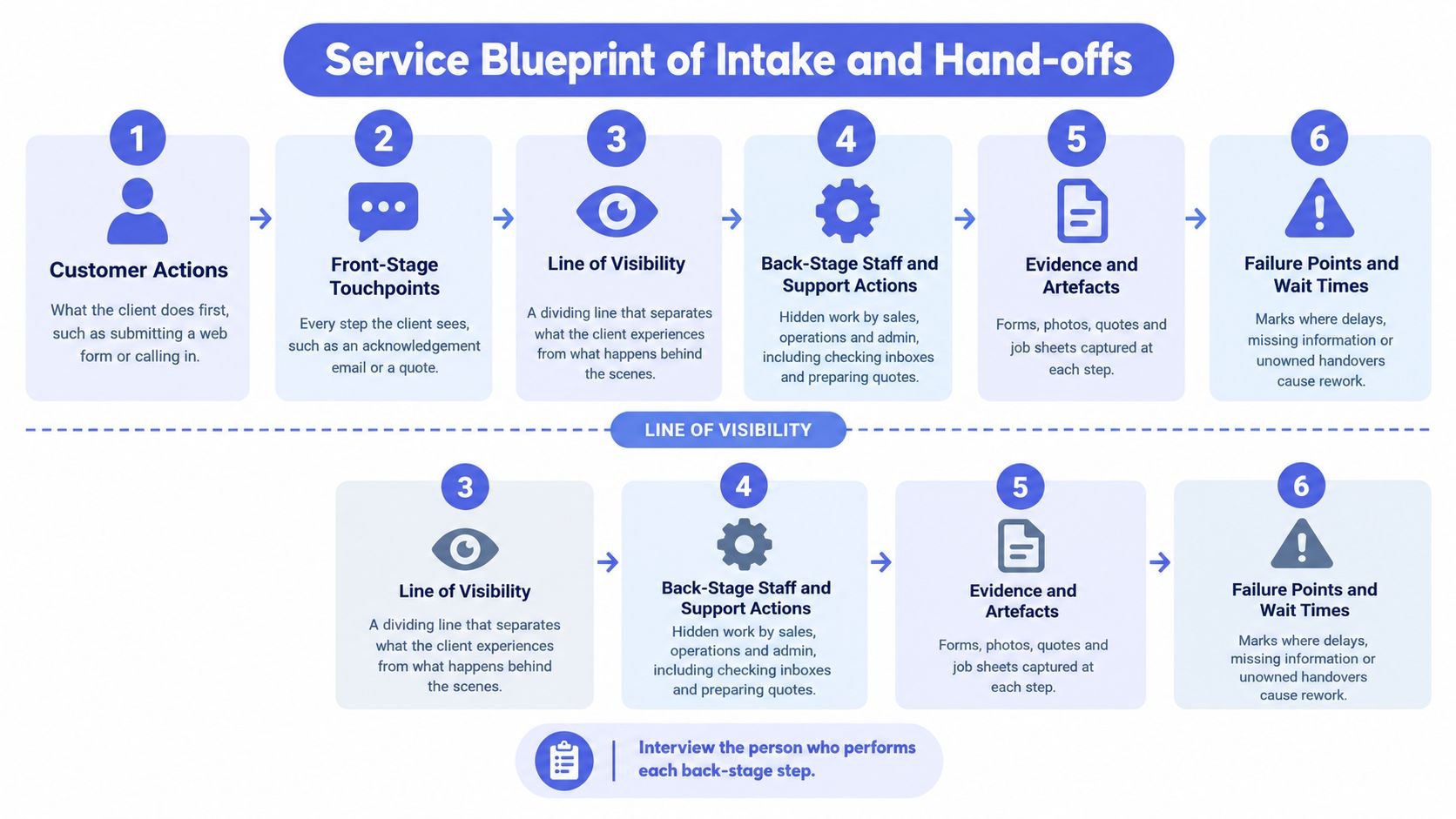
The data source here is the walk-through itself: timestamps on quote requests, the shared inbox, job sheets, and the people who perform each step in practice. The finding pattern to watch for is a client-facing promise resting on a back-stage step nobody owns.
A representative renovation business might map quote requests and discover site photos are requested after the quote is prepared, causing revisits and corrections. A representative bookkeeping practice might find document requests sent by untracked email, so missing bank statements stall onboarding without anyone noticing. Both are hand-off problems, not effort problems.
Running the Blueprint as an Audit
- Limit the scope: Map one flow, such as enquiry to booked job, so the first version stays usable.
- Interview the doer: Talk to the person performing each back-stage step, not only the manager describing it. Maps written from the office miss the shortcuts, exceptions, and manual checks that real work runs on.
- Mark every client promise: Wherever the client is told something will happen, check it's owned and tracked.
The output is a documented record of how work moves today, with each hand-off named, owned, and evidenced. That document is what turns a vague sense of "things slip" into a list of fixable gaps.
Your KPIs are incomplete intake rate and rework events per job. Where missing information clusters, structured capture through intake automation usually beats more chasing.
4. CRM Data Drift and Stale Record Audit
A tidy pipeline can still be wrong. This audit checks whether CRM records reflect reality: correct owner, current stage, recent last activity, and a defined next action. Score records for completeness, timeliness, and consistency, then list the stalled ones that should still have work attached.
A representative services firm might find open opportunities ownerless after a staff member left, with quotes pending and nobody responsible. A representative trades business might find jobs marked as quoted long after clients accepted by phone, so the pipeline overstates open work and understates completed work. This guide to improving CRM data quality covers the hygiene standards that prevent that drift.
Drift isn't just a sales inconvenience. It undermines record control more broadly, because ASIC guidance on managing director obligations says directors must ensure records clearly show income, expenses, bills, debts, and the company's current financial position, with appropriate controls to keep records complete and accurate. A CRM nobody trusts can't support that standard.
Set the stale threshold per stage, since a quote follow-up and a dormant lead run on different clocks. Assign clean-up to named roles, not to everyone, and measure drift again after a few weeks to see whether standards hold. Your KPI is the share of open records missing an owner, recent activity, or next action. Once the baseline is stable, connect the cleaned data to CRM automation routines.
5. Stalled Pipeline and Quote Follow-Up Audit

Open a stage-ageing report and look at what's been sitting still. This audit examines how long quotes, proposals, and opportunities have stayed in each stage and whether each has a documented next action. The key distinction is between work truly paused by the client and work your team has just forgotten.
A representative builder might find quotes older than the normal decision window with no follow-up logged, because a standard sequence was never switched on for proposals. A representative consultancy might find proposals sent by email with no CRM record, leaving the follow-up owner blind to who hasn't responded.
Practical rule: Every stalled deal gets a reason from a short list, a named owner, and a next action before the next pipeline meeting, or it gets closed.
Agree a typical decision window per service type before judging stage age, and close out deals that are clearly lost so the pipeline reflects live work. In a typical engagement we see leakage show up this way, as missed follow-up, unclear ownership, and stalled opportunities rather than a dollar figure you can publish. Judge it by what stays unresolved.
Your KPI is median stage age against the agreed decision window, plus the count of stalled deals with no next action. With that baseline clear, sequences from lead follow-up automation can target quotes and dormant opportunities properly.
6. Receivables Ageing and Invoice Chasing Diagnostic
Export the accounts receivable ledger by age band, then tag why each invoice is unpaid. Common causes include a missing purchase order number, disputed work, a wrong contact, no reminders sent, or nobody owning the chase. That tagging separates client-side delay from your own invoicing errors. For practical collection steps, see this guide to collecting unpaid invoices without damaging client relationships.
The national context makes this worth measuring. An Australian Taxation Office explanatory memorandum citing analysis of more than 10 million invoices estimated more than one-third of small-business invoices were paid after 30 days, and those invoices took an average of 63 days to be paid.
Checkpoints That Hold Up
- Test record control: ASIC guidance on running your company requires records including invoices and receipts to be retained for at least seven years and retrievable promptly.
- Confirm agreed terms: Business.gov.au guidance on managing cash flow recommends stating payment terms in invoices and contracts, including due timing, accepted methods, and how overdue debts will be collected.
- Measure the hand-off: An Australian commercial electrical case study from Benchmark Business Advisory found an average 14-day cycle from job completion to invoice issuance before redesigning mobile completion data and same-day sign-off.
Your KPIs are days from completion to invoice and overdue invoices by cause. Fix accuracy first, get human approval on reminder wording, then schedule follow-up through invoice reminder automation.
7. Exception and Rework Log Review (Root Cause Analysis)
Your team already knows where work breaks. They fix it by hand every week: re-quoting, re-keying data, chasing missing details, correcting jobs after hand-over. This diagnostic uses the exception and rework log as its data source, capturing each fix over a set period, grouping entries by cause, and working back to the underlying fault with the five whys or an Ishikawa fishbone diagram.
The finding pattern is a short list of causes that repeat. An installer might log several weeks of job exceptions and find most rework traces to incomplete site measurements captured in the field; the fix is an intake form change, not a new scheduling tool. A service firm might find repeat client queries caused by one unclear onboarding email, revise it, and track repeat questions afterwards.
Keep the log to a handful of fields so it takes under a minute to complete. Review it weekly at first, and frame discussion around the process rather than individual performance.
The log also shows where AI belongs. Reporting from the Australian Government AI adoption insights for December 2025 to February 2026 found many businesses applied AI to isolated tasks without changing underlying workflows. Test approval gates, escalation triggers, privacy boundaries, audit logs and rollback steps against your recurring causes before automating customer communication.
Your KPIs are rework events per job and share of logged exceptions with a confirmed root cause. Fix the highest-frequency cause first, get a person to sign off on changes that touch clients, then feed stable causes into a runbook supported by managed AI operations where ongoing monitoring is needed.
How Each Diagnostic Example Is Run, What It Produces and Where It Leads
| Item | Primary Data Source | Main Output | Best For | Related Service |
|---|---|---|---|---|
| Speed-to-Lead Response Audit | Enquiry timestamps across forms, email, phone, referrals and CRM | Response-time and reply-quality gaps | Finding slow or missing first responses | /speed-to-lead-automation |
| Enquiry Channel Reconciliation (Dropped Hand-off Audit) | Intake channels matched against CRM or job-system records | Unmatched enquiries and hand-off gaps | Finding enquiries that lack an owner or next action | /intake-automation |
| Service Blueprint of Intake and Hand-offs | Customer journey, staff actions, systems and process artefacts | Mapped service flow with hand-offs, delays and failure points | Clarifying intake, quoting and onboarding processes | /business-process-automation |
| CRM Data Drift and Stale Record Audit | CRM records, activity history and ownership data | Data-quality issues and stale records | Improving CRM reliability and pipeline visibility | /crm-automation |
| Stalled Pipeline and Quote Follow-up Audit | CRM opportunity stages, activity and follow-up records | Aged deals and missing next actions | Recovering overlooked quotes and improving follow-up | /lead-follow-up-automation |
| Receivables Ageing and Invoice Chasing Diagnostic | Accounting ledger, invoice records and payment terms | Overdue invoice causes and follow-up gaps | Diagnosing collection delays and cash-flow issues | /invoice-reminder-automation |
| Exception and Rework Log Review (Root Cause Analysis) | Exception and rework logs from service processes | Prioritised root causes and corrective actions | Reducing recurring errors and targeting process improvements | /business-process-automation |
Turning One Finding into a First Fix
Don't run all seven audits at once. Choose the single example that matches your most visible gap, whether that's slow first response, dropped enquiries, stale CRM records, or overdue invoices. Run it over one month of records so you're working from a pattern rather than a bad week.
Start with the smallest useful change. For most service businesses that's one source of truth for leads and work in progress, where every record carries an owner, stage, last activity, and next action. That single standard improves consistency, visibility, and response speed without a large system rebuild. It also gives you a baseline, so any later automation can be judged against qualified leads booked, incomplete intakes reduced, or overdue invoices recovered rather than a vendor's promise.
The broader adoption picture supports that order of operations. In the ABS Characteristics of Australian Business latest release, 12% of Australian businesses reported using artificial intelligence in 2024-25, up from 1% in 2021-22. Adoption is moving quickly, but as the measurement figures earlier show, owning the technology isn't evidence it's working.
A practical next step is a discovery call. Bring one repeated process and an example of where it stalls, and we'll look at the trigger, the hand-off, the approval steps, and what should confirm completion. We test the normal path, missing information, and approval steps against real examples, and when data is missing or risk is high, the system pauses with context rather than hiding the failure. Pricing, complaints, and sensitive client messages still need a person to review and approve the next action.
Sonny replies by email to arrange a 15-minute discovery call. Bring the messy hand-off. Leave with a clear view of what should be captured, drafted, approved, and logged.
If dropped enquiries, stale records, or unpaid invoices are costing you work you can't see, Truespeak can run the diagnostic first and then build and manage the smallest useful system around the tools you already use. Visit Truespeak to book a short discovery call and bring one process that keeps stalling.