
The job's finished, the invoice went out weeks ago, and the money still hasn't landed. You're checking the bank, scrolling a shared inbox, and trying to remember who last spoke to the customer. That's the moment unpaid invoice collection usually starts in a small service business, and it's already too late. A calmer approach treats collection as relationship-preserving escalation with clear owners, evidence and human approval points, so you're not choosing between being paid and keeping the customer.
Table of Contents
- Why Unpaid Invoices Stall Before Anyone Chases
- Building an Invoice Process That Prevents Chasing
- Setting a Reminder Cadence Based on Invoice Age
- Escalation Paths When Standard Reminders Fail
- Legal Checks Before Letters of Demand and Write-Offs
- Metrics That Show Whether Collection Is Working
- Choosing Automation That Keeps People in Control
Why Unpaid Invoices Stall Before Anyone Chases
An overdue invoice sitting in an inbox rarely means someone forgot to send a reminder. More often, nobody can see who owns it, what was last said, or why it hasn't been paid. It stalls while newer work takes priority.
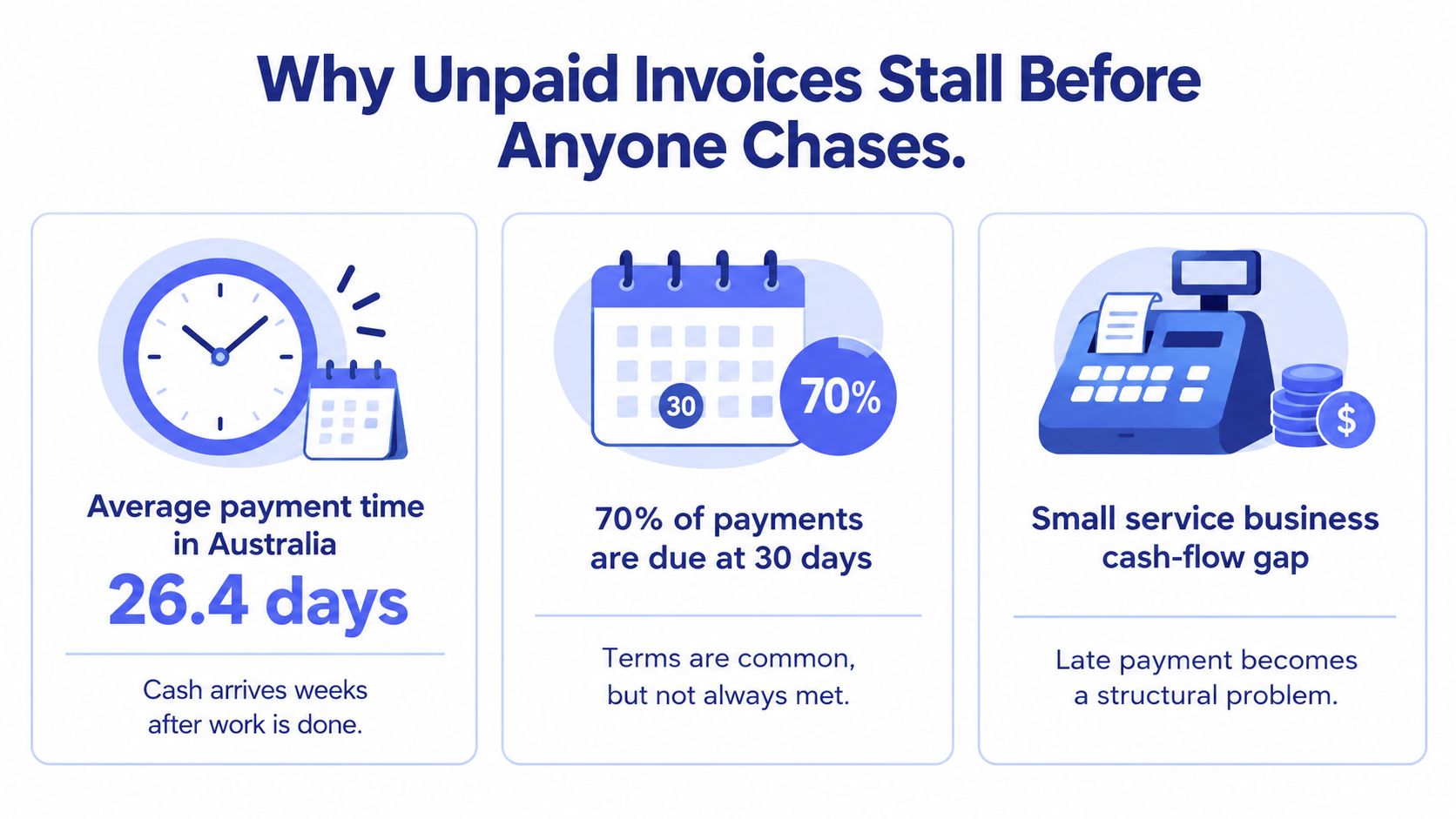
Late payment is structural in Australia, not a one-off lapse. The Australian Small Business and Family Enterprise Ombudsman's payment times review reported an average payment time of 36.74 days, exceeding the commonly accepted 30-day standard, with about half of respondents reporting more than 40% of their invoices paid late and 28% reporting more than 60% paid late. If your terms assume payment on day 30 but cash regularly arrives later, you need active monitoring built into normal operations.
Sort by Cause Before You Send Anything
Identical reminders fail because delayed invoices stall for different reasons. Sending a firmer email to the wrong problem wastes goodwill and doesn't remove the blocker.
- Missing purchase-order details: Accounts payable can't process the invoice, even though the work's approved.
- Unclear scope or acceptance: The customer hasn't signed off a milestone, variation or completion point.
- Invoice accuracy dispute: Amounts, tax details, contact details or the description of work don't match their records.
- Approval bottleneck: The invoice is waiting inside a larger customer's procurement or payment run.
- Deliberate slow payment: The invoice is correct and accepted, but payment is being deferred.
Practical rule: Classify the blocker before you choose the tone. A missing purchase order needs administration, a quality dispute needs a person, and only an undisputed, accepted invoice needs a straightforward chase.
Start with your current overdue list and tag each invoice with one likely cause, plus owner, last contact and next action. That simple sort turns a vague ageing report into a work queue. It also stops staff from repeatedly chasing a customer who's already raised a genuine query.
Building an Invoice Process That Prevents Chasing
Prevention starts before the invoice leaves your system. If the customer has to ask how to pay, what the charge covers, or when it's due, you've created avoidable friction. Clear paperwork won't solve deliberate slow payment, but it removes the excuses and queries that delay ordinary payments.
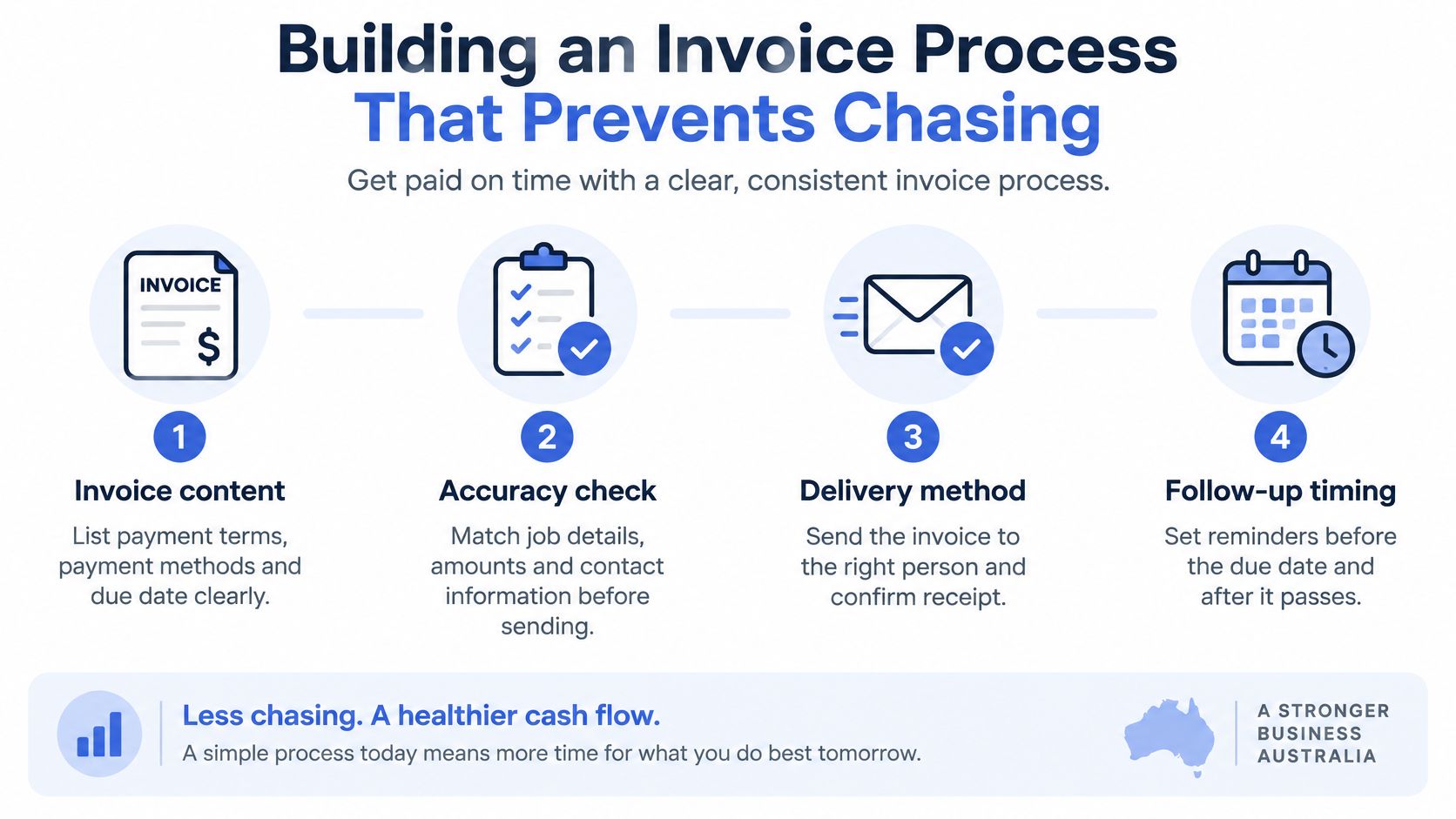
Business.gov.au guidance on how to invoice recommends stating payment methods and payment terms clearly on each invoice, offering multiple payment options, and providing detailed descriptions of the work supplied to reduce disputes. The same guidance identifies reminders or letters of demand as possible next steps when an amount remains unpaid. For a plain-language view of why terms need to be settled upfront, it's worth reading how to prevent late payments with clear terms alongside the government guidance.
The Record Every Invoice Needs
Don't rely on the accounting file alone. Each invoice needs one operational record that your team can act on without hunting through email threads.
- Separate date fields: Store issue date, receipt date, agreed terms and due date as distinct fields.
- Payment status: Record unpaid, part-paid, promised, paid or written off.
- Dispute status: Flag whether scope, quality, delivery or accuracy is being questioned.
- Contact history: Log calls, emails, promised dates and dispute reasons.
- Named owner and next action: Assign a person and a dated next step until the invoice is paid, written off or escalated.
A Short Pre-Send Check
Before sending, validate the invoice against the contract or quote, purchase order, delivery or completion evidence, tax details and payment instructions. Confirm you're sending it to the correct accounts-payable contact, not just the person who booked the job. That check takes minutes and prevents the common loop where the invoice is resent weeks later because it never reached the payer.
The video below is useful background on tightening the basics before follow-up begins.
Treat that single record as the source of truth. Reminders, escalation and reporting all depend on it being current.
Setting a Reminder Cadence Based on Invoice Age
Timing matters, but only if you're counting from the right date. Many businesses trigger reminders from the invoice date alone, then discover the customer's terms or receipt date tell a different story. That's how a polite system sends an overdue notice for an invoice that isn't overdue yet.
Under the Payment Times Reporting Scheme guidance on payment-time calculations, payment time is generally based on the date the invoice was received, or the issue date if receipt can't readily be determined, and time is measured in calendar days. Where terms are a range, the maximum period applies, so 30 days from month end is treated as a 61-day standard payment period. Check unusual wording against the contract before automation declares the invoice late.
Reminder Actions by Days Past Due
| Days past due | Typical action | Human approval point |
|---|---|---|
| Not yet due | Friendly pre-due notice confirming receipt and payment path | No approval if details are verified |
| 1-30 | Post-due confirmation request, resend invoice if needed | Owner checks for disputes or promises |
| 31-60 | Firmer follow-up and direct contact with accounts payable | Approve tone for valuable or sensitive accounts |
| 61-90 | Personal call, payment plan discussion or service-pause warning where allowed | Manager approval before warning |
| 90-plus | Formal escalation assessment, letter of demand or external recovery review | Authorised person decides next step |
You're adapting pressure to age, not sending the same message louder. If you're setting this up in your accounting platform, our guide to sending invoice reminders in Xero covers the practical configuration side.
What Each Reminder Should Contain
Keep templates short and complete. Every reminder should state the invoice number, amount, due date and how to pay, and invite the customer to raise a query if something doesn't match. A pre-due notice confirms receipt. A post-due message asks whether payment is scheduled. A firmer follow-up names the consequence or next step without inventing threats you won't carry out.
If a customer replies with a dispute, stop the cadence. Continuing automated reminders while a query is unresolved signals that nobody is listening.
Escalation Paths When Standard Reminders Fail
More pressure isn't always the right answer. An automated demand may accelerate one payment, but it can also damage repeat revenue or trigger a dispute that makes recovery harder. Escalation should be a decision, not just the next template in a sequence.
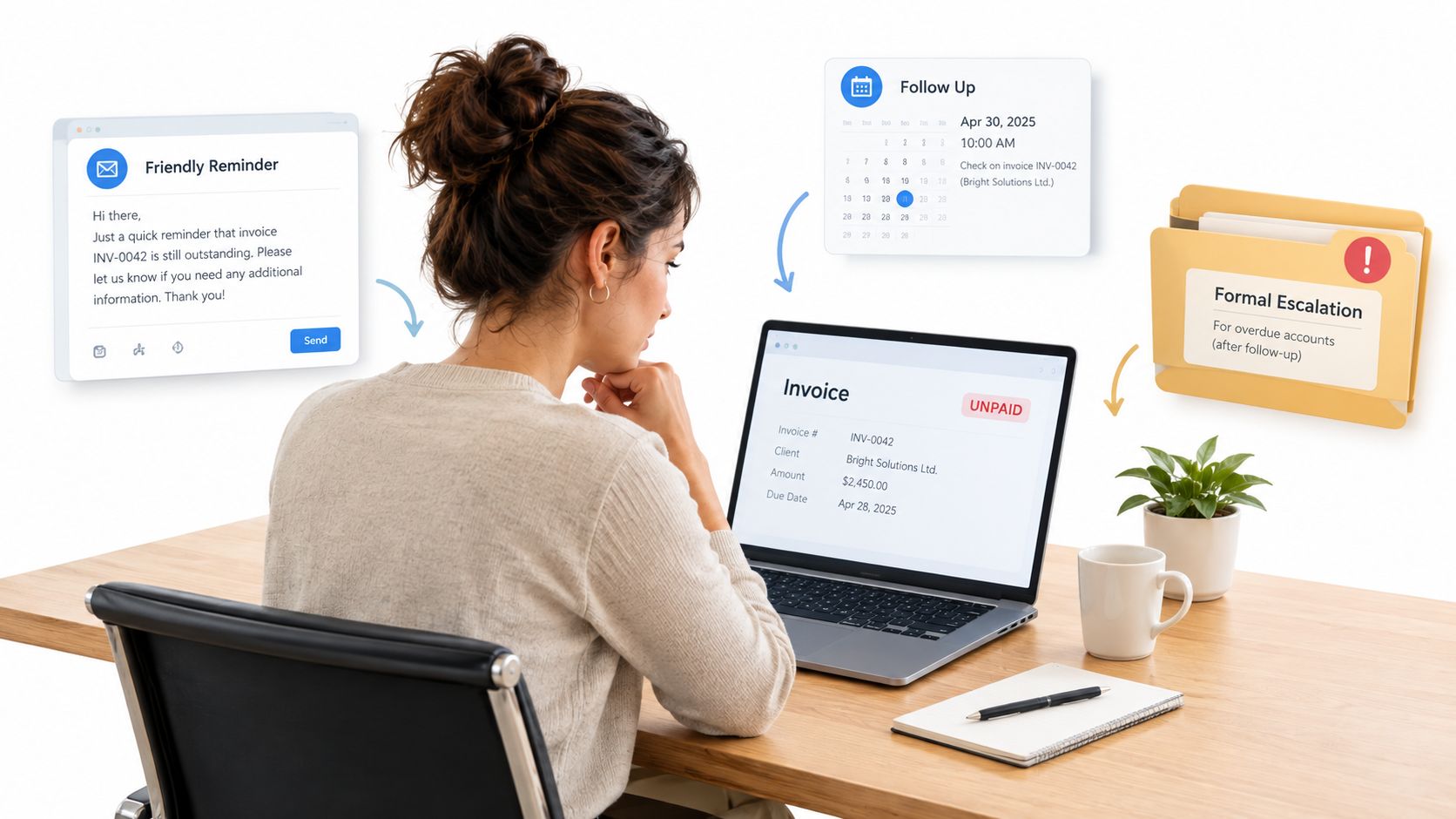
Between a standard reminder and formal recovery, you've got several options. Pause automation when a dispute is raised and assign a person to resolve it. Call the accounts contact personally when emails aren't answered. Agree a payment plan where the customer can pay but not in full at once. Issue a service-pause warning only where the contract allows it and a manager approves it. Move to a letter of demand or external recovery when those steps fail or aren't appropriate. If you need wording for the formal end of that path, our invoice payment reminder letter guide sets out a measured structure.
Choosing the Next Step
Prioritise using four factors together, not age alone.
- Invoice age: Older debts need a different treatment from invoices that have just slipped.
- Invoice value: Recovery effort and external costs should be proportionate to the amount.
- Strategic importance: A long-term customer with a clean history warrants a personal call before a formal notice.
- Probability of recovery: Disputed, undocumented or financially distressed debts may not justify the same spend.
We recommend that pricing, advice, disputes, relationship-sensitive messages, commercial judgement and edge cases stay human, while the system carries repetitive work around judgement. Automation can surface the stalled invoice, draft the follow-up and log the outcome. It shouldn't decide to pause services, accept a reduced settlement, or send a consequential message to a sensitive account without approval.
That boundary protects both cash and trust. The customer hears a consistent, professional process, and your team intervenes where judgement changes the outcome.
Legal Checks Before Letters of Demand and Write-Offs
This part is general information, not legal advice for your situation. Before you issue a letter of demand, check that the payment term you're relying on is clear in the contract or accepted quote. A firm letter built on vague terms invites argument instead of payment.
Gather the evidence first. You want the signed quote or contract, purchase order if there is one, delivery or acceptance records, the invoice itself, reminder history and any dispute correspondence. If the customer accepted the work in writing, keep that with the file. A tidy evidence pack helps whether you're negotiating, involving an adviser, or assessing external recovery.
Separate Reminders from Write-Off Decisions
A write-off isn't an admin tidy-up. The Australian Taxation Office guidance on bad debts states that a business accounting for GST on a non-cash, or accruals, basis may claim a decreasing adjustment where it made a taxable sale, paid the GST, hasn't received the consideration, and either writes the debt off as bad or the debt has been overdue for 12 months or more. It also states that a debt can't be written off as bad if it has been forgiven or set off against another liability.
That distinction has a practical consequence for your workflow. Route potential write-offs to an appropriately authorised person with the evidence attached. Don't let an automated process close, forgive or write off an account because a date threshold was reached.
- Before a letter of demand: Confirm terms, amount, acceptance evidence and prior contact.
- Before a write-off: Confirm recovery efforts, dispute status, GST treatment and who authorised the decision.
- Before external recovery: Assess whether the amount and likelihood of recovery justify the cost and relationship impact.
Preserve the record either way. Future credit decisions about that customer depend on knowing what happened.
Metrics That Show Whether Collection Is Working
A single collection success rate sounds tidy and usually misleads. It means little unless you've defined the denominator, observation window and invoice value threshold, and whether credits, disputes and write-offs are included. Change any one of those and the same performance produces a different number. For a clear explainer on why the calculation base matters, see understanding collection rate denominators before you set a target.
Benchmark against Australian payment-time distributions, not just your nominal terms. Statutory-review evidence on large business payment times shows only 18% of large businesses paid small-business suppliers within 21-30 days, while 36% paid in 31-60 days, 9% in 61-90 days and 24% took more than 120 days, with only 13% paying in fewer than 20 days. If large customers dominate your ledger, expecting every invoice inside terms isn't a realistic operating plan.
A Weekly Receivables Review
Segment receivables into current, 1-30, 31-60, 61-90 and 90-plus days, showing both invoice count and dollar value in each bucket. Flag disputed balances separately so they don't inflate the chase queue. Prioritise high-value invoices in the 31-60 day bucket before they migrate into late-stage recovery.
Track a small set of measures each week.
- On-time payment rate: Share of invoices paid by the due date.
- Median days-to-pay: The typical experience, without extremes dominating.
- 95th-percentile days-to-pay: How slow the slowest payers are, a measure the Payment Times Reporting Scheme uses as a slow-payer indicator.
- Promise-to-pay kept rate: Whether agreed dates are met.
- Dispute-resolution time and write-off rate: Where process quality and credit decisions need attention.
Review the movement between buckets, not just the total owing. Cash collected matters, but invoices ageing into the next bucket tell you where next month's problem is forming.
Choosing Automation That Keeps People in Control
You've got three broad ways to run collection, and the right choice depends on volume, dispute frequency and how much visibility you need. The cheapest option on paper can become expensive if invoices stall without an owner.
Manual tracking in a spreadsheet or shared inbox works at very low volume. It breaks when staff are away, when threads split across inboxes, or when nobody updates the sheet after a call. You also can't reliably see next actions or approval points.
A standalone reminder tool improves consistency. It sends scheduled messages and reduces awkward manual chasing, but it may not know about disputes, project status or relationship context held elsewhere. Sector-specific platforms show the same design challenge in other settings, such as efforts to simplify internet service payment collection where recurring billing still needs exception handling. If you're comparing tools, our invoice reminder software comparison explains what to test before you buy.
A managed approach connects reminders to the CRM, reporting and exception queues. Rules handle the repetitive follow-up, and stalled or sensitive items surface for a person to judge.
Criteria That Matter More Than Features
- Visibility: Can you see owner, stage, last activity and next action for every invoice?
- Approval gates: Can sensitive messages wait for human approval?
- Dispute handling: Does a reply pause the cadence and create a task?
- Fit with existing tools: Does it work around your current accounting and CRM systems?
- Reporting: Can you review ageing buckets and promises kept without manual exports?
Our invoice reminder automation service provides polite, human-approved payment follow-up that doesn't rely on awkward manual chasing. Reminders can be automated where the rules are clear, but disputes, pricing questions and write-off decisions stay with a person.
Start with a practical step this week. List your ten oldest overdue invoices and note the owner, last action and likely blocker for each. If several have no owner or no next action, that's your first operating gap. Sonny will reply by email to arrange a 15-minute discovery call, and on that call we look at the business beforehand and come prepared with at least one specific gap and what it costs, with no pitch deck and no obligation.
If overdue invoices are sitting in a spreadsheet or shared inbox without an owner or next action, Truespeak can build a polite, human-approved reminder process around the tools you already use, with disputes and sensitive decisions kept with your team. Visit Truespeak to arrange a short discovery call and get a prepared view of where follow-up is breaking down in your business.