
You can have a full bookkeeper stack, a clean chart of accounts, and still spend Monday morning digging through inboxes to work out why last week's invoice hasn't moved. One customer says they never received it, another says the PO was wrong, and a third is “just waiting on approval”, while the same overdue file gets chased twice by two different people. That's usually the point where the receivables function stops being a finance task and starts being an ownership problem.
A cash collection process works when every invoice has a clear owner, a visible stage, a last activity, and a next action. Reminders matter, but they only work when the invoice is already clean, the reason for lateness is known, and the follow-up is tracked in one system of record instead of being scattered across memory, spreadsheets, and forwarded emails.
Table of Contents
- Why Most Invoice Chasing Falls Apart Before the First Reminder
- What the Data Says About Late Payment in Australia
- Setting Up the Invoice So Collection Has Something to Collect
- The Collection Cadence That Keeps Invoices Moving
- Matching the Action to Why an Invoice Is Late
- When the Right Move Is Not Another Reminder
- Putting the Process Around Your Existing Tools
Why Most Invoice Chasing Falls Apart Before the First Reminder
Tuesday morning at a trade or professional services firm often starts the same way. The inbox is crowded, the spreadsheet is out of date, and one overdue account has already been chased twice because two people assumed it belonged to them. Meanwhile, a larger invoice sits untouched because nobody checked who should own the next step.
That's why “just send more reminders” is weak advice. If the invoice wasn't issued cleanly, if the recipient was wrong, or if no one recorded the last touchpoint, the follow-up sequence is already broken before the first overdue notice goes out. The process fails because the work is spread across inboxes and heads, not because the team lacks enough urgency.

Ownership Beats Noise
A workable collection system treats each invoice as a live record with stage, owner, last activity and next action. That gives the team one answer to a simple question, “What happens next?” It also stops the common problem where reminders are sent because someone feels something should be chased, not because the file is ready for escalation.
Practical rule: if nobody can see who owns the invoice, the invoice doesn't really have an owner.
That's where automation earns its place. It can send the invoice, log the activity, schedule the next reminder, and surface overdue accounts, but it shouldn't decide tone on disputed or relationship-sensitive matters. If you want a deeper look at getting the customer record clean enough for this to work, crm data quality is the upstream problem many teams ignore.
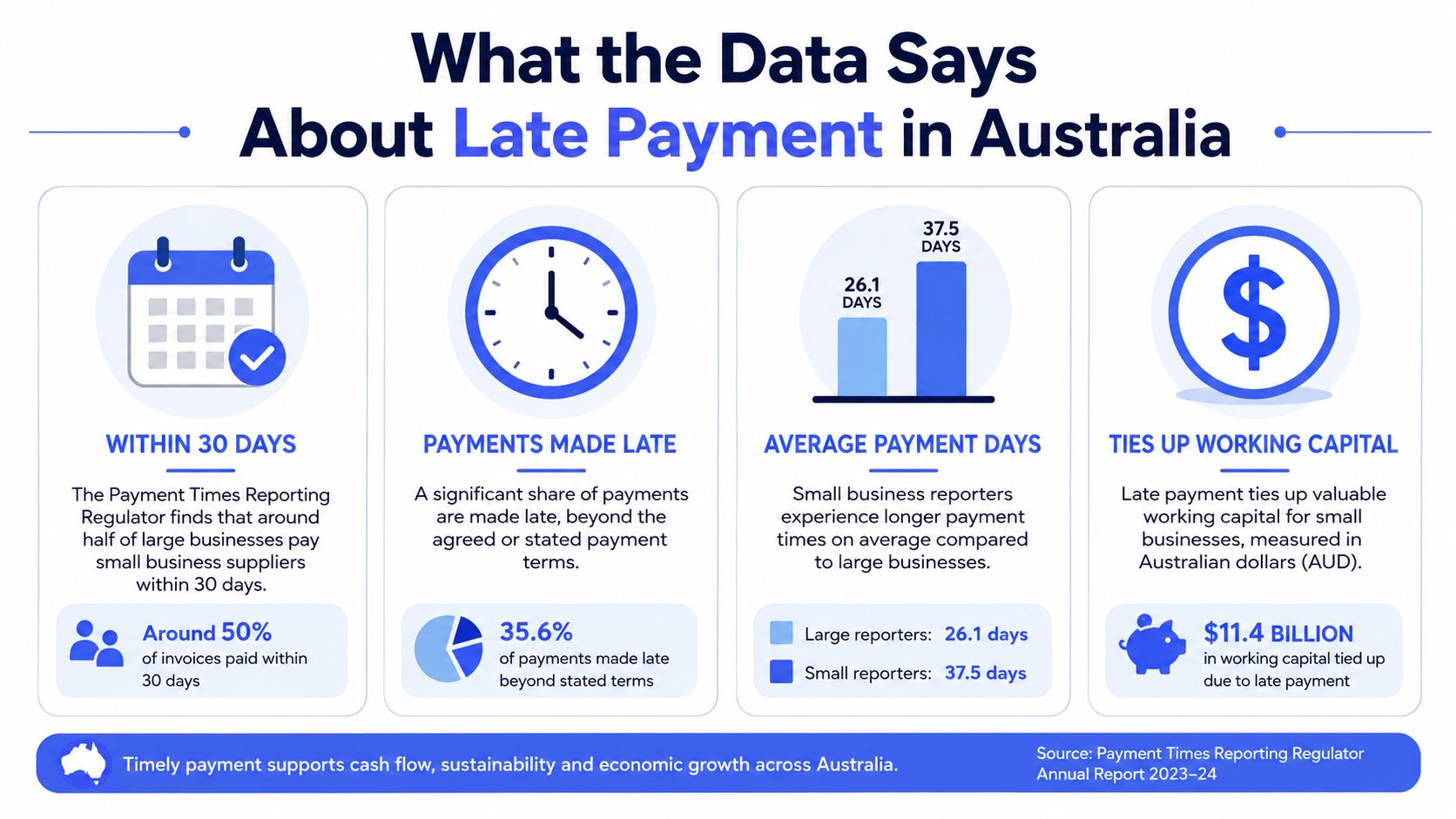
What the Data Says About Late Payment in Australia
A clean collection process starts with a clear view of where money stalls. Australian payment data shows why that matters. In the 2012-13 financial year, 803,377 invoices, or 96.11%, were paid within 30 days by Australian Government agencies, but 32,546 invoices were still paid late, and those late invoices were worth about $215.1 million. A small share of late invoices can still trap a large amount of working capital when the bills are large, so aging by dollar value matters as much as invoice count. Treasury's government payments report
Late Payment Is Structural, Not Occasional
The current Australian payment environment still shows the same pattern. Among more than 7,000 large businesses in the Payment Times Reporting Scheme, 24% took more than 120 days to pay small-business suppliers, 36% took 31 to 60 days, 9% took 61 to 90 days, and only 13% paid in fewer than 20 days. In construction, only 18% of large businesses paid small businesses within 30 days, which is a hard reminder for builders, installers, and trades that follow-up cannot rely on goodwill alone. ASBFEO's regulator update
The regulator's July 2024 update points to the same habit. 36% of reporting entities paid 95% or more of their small-business payments more than 60 days late, while only 21.4% paid at least 95% within 30 days. ASBFEO's regulator update For a collection team, that means early reminders, documented disputes, and escalation rules have to be built into the workflow before an account goes stale.
What the Numbers Mean Operationally
A good process does not just ask how many invoices are overdue. It asks which overdue invoices are tying up the most cash, and why.
That shift matters. Admin failure needs a different fix from a genuine dispute, a cash-constrained customer needs a different approval path again, and a habitual late payer should not be handled with the same tone as a one-off lapse. If every overdue invoice gets the same escalating email, the team wastes time, strains relationships, and still misses the underlying blockers.
Late payment only becomes manageable when the team can see the value at risk, not just the count of overdue files.
For Australian service businesses, that means overdue aging by dollar value, not just invoice volume, and a follow-up cadence that starts before an invoice drifts into arrears.
Setting Up the Invoice So Collection Has Something to Collect
The collection process starts before work is delivered. If the terms, customer details, and approval path aren't clear upfront, chasing later becomes harder because the problem is already baked into the invoice. The cleanest receivables teams treat invoicing as a structured handoff, not an email attachment.
Four Blocks to Lock in Before the Job Is Done
First, set the payment terms in writing and make sure the customer accepts them. Second, capture the customer's legal entity and the correct accounts-payable contact, because invoices sent to the wrong person slow everything down. Third, confirm whether the customer needs a purchase order, work-order number, or approval reference before they'll process payment. Fourth, issue the tax invoice immediately after the contractual trigger, not days later when someone remembers to do it.
The Australian Taxation Office treats a tax invoice as a structured record, not a casual bill. For taxable sales under $1,000, the invoice needs enough information to show it's a tax invoice, the supplier's identity and ABN, the issue date, a description and price of the items supplied, the GST amount or a statement that the total includes GST, and the extent to which each supply is taxable. For taxable sales of $1,000 or more, the buyer's identity or ABN must also appear. ATO tax invoice requirements
Build a Pre-Send Validation Gate
Before the invoice leaves your system, check the customer identity, contract or work-order reference, PO, recipient, amount, GST treatment, bank details, due date, attachments, and approval status. Anything incomplete should be parked in a manual review queue rather than sent and hoped for. That one control cuts out a lot of unnecessary back-and-forth later, especially when the invoice is disputed because a field is wrong rather than because the customer can't pay.
The ATO also distinguishes between a standard invoice and a tax invoice. If the business is GST-registered, the document should be called a tax invoice. If it isn't registered, it should be a standard invoice and not use the tax invoice wording. ATO record-keeping guidance
The Collection Cadence That Keeps Invoices Moving
A dated cadence works because each contact has a different job. The first message confirms receipt, the next one prevents accidental delay, the due-date touchpoint checks whether payment is already scheduled, and the overdue steps create an escalation path without turning every reminder into a threat. If you've ever had to follow an invoice more than once, you already know that one notice usually isn't enough.
A Sequence with a Purpose
The first confirmation should go out within 1-2 business days of issue. Then send a courteous pre-due reminder around 5-7 days before the due date, followed by a due-date confirmation. After that, escalate at 3-7 days, 14 days, 30 days, and 60+ days overdue, with the tone and owner changing as the file becomes more serious.
Each contact should record the promised payment date, dispute reason, owner, and next action in the CRM or finance ledger. That keeps the conversation attached to the invoice record instead of buried in someone's inbox. It also makes it easier to see which accounts are genuinely delayed and which ones are only waiting on a promised date.
Why Multi-Stage Follow-Up Works Better Than One Overdue Email
ASBFEO's payment-times analysis found that businesses commonly needed to pursue overdue invoices more than twice, with 34.6% saying two to four follow-ups per invoice was common. That supports a defined multi-stage cadence rather than a single overdue notice. ASBFEO payment-times analysis
If you want a practical walkthrough of reminder sequencing in Xero, how to send invoice reminders in Xero is useful context for the mechanics. For broader collection discipline and legal posture, Australian debt collection strategies is a helpful reference point, especially when the tone needs to stay firm without becoming sloppy.
The job isn't to send the loudest email. The job is to move the account to a clear outcome, paid, disputed, promised, or escalated.
At the end of each day, match bank receipts against invoice number, customer, amount, and remittance reference. Anything unmatched should become an exception within one business day, because slow reconciliation creates fake arrears and hides real ones.
Matching the Action to Why an Invoice Is Late
A lot of collection work goes wrong because every overdue invoice gets the same treatment. That is a process problem. The next step should depend on the reason the invoice is late, because a wrong recipient needs a different response from a cash-strapped customer or a habitual late payer.
| Cause of lateness | Next action | Escalation threshold | Approval gate |
|---|---|---|---|
| Administrative failure | Correct the invoice, resend it to the right contact, and confirm receipt by phone or email | Escalate immediately if the customer still cannot locate the invoice after resend | Finance or operations review before resend |
| Genuine dispute | Gather evidence, pause routine chasing, and move the file into a documented resolution path | Escalate when the dispute stalls or the evidence is incomplete | Commercial or project manager approval before further contact |
| Cash constraint | Request a written payment plan and reduce exposure until the plan is honoured | Escalate if the promise date is missed or the plan keeps slipping | Finance or owner approval before further work |
| Habitual late payer | Tighten terms, limit new work, and consider formal recovery if the pattern continues | Escalate after repeated missed promises or repeated late cycles | Owner approval before service suspension or recovery action |
Why This Distinction Matters
An administrative failure often comes from the wrong inbox, a broken attachment, or missing purchase-order data. That calls for a corrected invoice and a contact-driven resend, not a sharper email. A genuine dispute needs evidence and ownership, because chasing a disputed amount before the paperwork is settled only creates more noise.
Cash constraint is different again. If the customer is under real pressure, a written payment plan with a clear commitment date is more useful than repeated reminders that the business already knows it cannot meet. Habitual late payers are the ones where you stop being polite at the expense of your own cash flow and start tightening terms.
how to reduce bad debt becomes more than a finance slogan here, because the right answer is often to protect the ledger before the debt becomes uncollectable. The key is to write the reason for lateness into the record so the next owner knows whether they are dealing with an admin fix, a dispute, a payment plan, or a behavioural problem.
When the Right Move Is Not Another Reminder
More chasing doesn't always mean more cash. For some accounts, the smarter move is to stop extending exposure, ask for a deposit, pause further work, or shift to formal recovery. That's uncomfortable, but so is funding a customer who keeps treating your business like an interest-free lender.
Atradius reported that more than half of B2B invoices were overdue, bad debts affected just over 10% of B2B invoices on average, and construction was a particularly affected sector. Australian SMBs in the 2025 Pursuing Payments survey also spent up to three hours per week on collection, which is a strong signal that repeated manual chasing has a real operating cost. Atradius payment practices barometer

The Trade-Off Is Cash Now Versus Risk Later
For builders, trades, installers, and professional services firms, the wrong escalation can damage the relationship when the underlying issue is a missing variation approval or an incomplete site sign-off. State and territory security-of-payment rules for construction can also create a separate path that sits alongside normal commercial chasing, so the account shouldn't be handled as if every debt lives in the same lane.
The decision shouldn't be based on invoice age alone. Look at payment history, concentration exposure, disputed-value share, project stage, promised-payment reliability, and strategic importance before you decide whether to keep chasing, pause work, or change terms. That's the difference between a controlled receivables process and a team that keeps throwing reminders at a problem it hasn't properly diagnosed.
If the customer keeps missing promises, the collection process needs a commercial response, not just a more urgent subject line.
Putting the Process Around Your Existing Tools
The working view is simple, invoice stage, owner, last activity, next action. Around that, the dashboard should show invoice defects, delivery failures, overdue exposure, disputes, promised payments, and cash recovered, segmented by customer and workflow stage. That's the minimum needed to tell whether the process is actually moving money or just creating more activity.
ASBFEO reported that about 1.2 billion invoices are exchanged annually in Australia, with 20% sent to the wrong person and 30% containing incorrect information, which is why a pre-send validation gate is the most powerful technical control in any cash collection process. ASBFEO newsletter
What to Measure First
Track invoice-to-cash days, percentage paid by due date, overdue balance by aging bucket, first-contact resolution, dispute cycle time, promise-to-pay kept rate, and recovery rate by reminder stage. Those metrics tell you whether the workflow is tightening or whether accounts are still drifting into unmanaged arrears. If you want to automate the mechanics around Xero, xero automation what to automate and how is a practical place to compare options.
For teams that want a managed layer rather than another tool to babysit, Truespeak runs invoice reminder automation that checks payment status and prior reminders, drafts follow-ups, and pauses disputes, payment arrangements, and relationship-sensitive messages for human approval. That kind of setup works best when the business already has a clear process and wants the reminders, approvals, and exceptions to live inside it.
A sensible first 30 days looks like this: define the system of record, write the cadence rules, build the pre-send validation gate, set the approval gates, and decide where human review is essential, especially for bank-detail changes, service suspension, and sensitive communications.
If you want help turning your receivables into a visible process instead of a pile of chasing tasks, visit Truespeak. They build and manage invoice reminder automation, CRM hygiene, and follow-up workflows around the tools you already use, with human approval for the messages and decisions that matter most.