
In Australia, 48% of invoices issued by small businesses were paid late in 2021, and 10% arrived more than one month after the due date. The strongest invoice payment reminder letter is factual and context-specific, with the invoice number, amount, due date, payment method and a clear next step, not a supposedly winning formula.
The popular advice is to find one perfect subject line, send three identical emails and wait for the money. That approach misses the actual work. Payment chasing is a sequence of proportionate, documented actions that should identify whether the problem is oversight, an accounts-payable delay, a dispute or financial hardship.
The seven examples below move from a courtesy contact to overdue follow-up, problem-solving, phone escalation and a controlled workflow. Timing should follow your payment terms, while results should be measured in your own billing records. Tone, communication rules, accurate records and human approval matter more than clever wording.
For Australian service businesses, this matters because late payment consumes both cash and staff time. The Australian Government guidance on payment terms recommends stating when payment is expected, accepted payment methods and how overdue debts will be handled. A reminder process using invoice reminder software gives those terms a practical operating rhythm.
Table of Contents
- 1. Courtesy Reminder on or Before Due Date
- 2. Overdue Invoice Follow-Up 5 to 10 Days Past Due
- 3. Firm Payment Request with Named Contact
- 4. Payment Plan or Dispute Resolution Offer
- 5. Automated SMS or WhatsApp Reminder
- 6. Pre-Formatted CRM Task or Call Card for Phone Follow-Up
- 7. Logging, Sequencing and Escalation Rule Framework
- 7-Point Invoice Reminder Comparison
- Turn Good Wording Into a Controlled Process
1. Courtesy Reminder on or Before Due Date
A courtesy reminder should arrive on or shortly before the due date, depending on the payment terms agreed with the customer. It isn't a demand. It assumes the invoice may have been overlooked and gives the recipient everything needed to pay without searching through old emails.
Use a subject such as Invoice INV-1042, $[amount] due [date]. The body can stay short:
Hi [Name],
A quick reminder that invoice [number] for [amount] is due on [date]. The invoice relates to [service or project]. You can pay via [payment method or link].
If you've already arranged payment, please disregard this note. If anything is unclear, contact [name] on [phone] or [email].
Kind regards, [Sender]
The practical details do most of the work. Include the invoice number, issue date, amount, description of the supplied service, GST details where applicable and payment instructions. The ATO tax invoice guidance explains the information that should appear on Australian tax invoices, including additional recipient and supply details for taxable sales of $1,000 or more.
Make the First Touch Easy to Act On
Embed this message in the standard billing workflow rather than relying on memory. Log the send date in your CRM or accounting system, attach the original invoice, and include a tested payment link where available. If you're using Xero, this guide to sending invoice reminders can help you align the reminder with your existing process.
Don't claim that one subject line always wins. Sender reputation, the audience and the invoice context affect whether a message gets opened. Test clear, factual subjects against your own records and compare days-to-payment before and after changes.
2. Overdue Invoice Follow-Up 5 to 10 Days Past Due
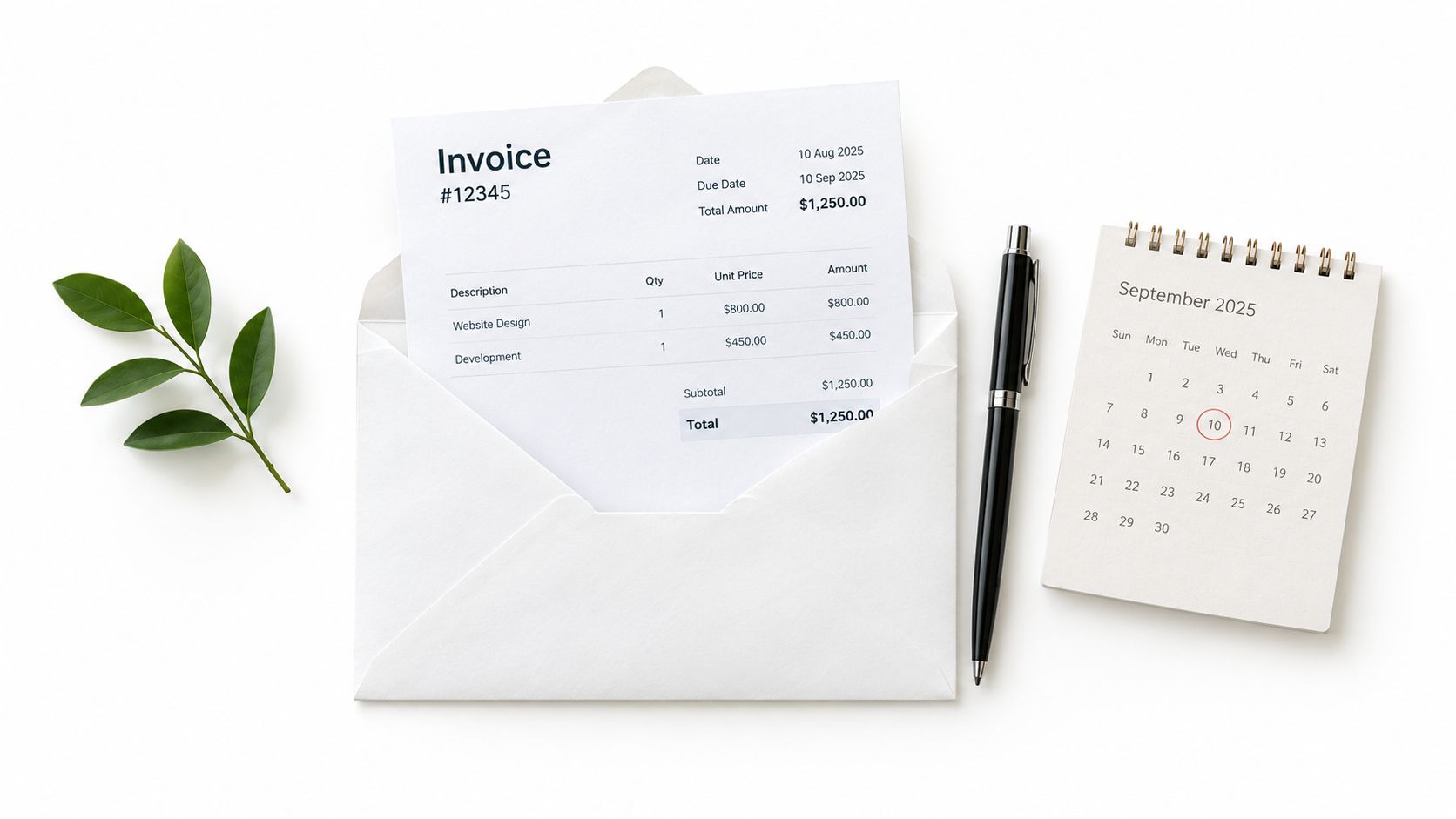
Once the due date has passed, the message should become more direct without becoming accusatory. A follow-up sent 5 to 10 days after the due date can state that the invoice is overdue, restate the amount and ask whether the customer received it or has a query holding up payment.
For example:
Hi [Name],
Invoice [number] for [amount], due on [date], is now overdue. Could you please confirm that the invoice was received and advise when payment is expected?
If there's an issue with the work, purchase order, supporting documents or invoice details, please let [name] know so we can resolve it. Payment can be made via [method or link].
Regards, [Sender]
This wording does two jobs. It requests payment, but it also opens a path for an administrative blocker to surface. That distinction matters for builders, trades, installers and professional services firms, where an approval, variation, timesheet or handover document can hold up an otherwise valid invoice.
Treat a Dispute as a Different Workflow
Don't keep sending routine reminders after the customer raises a dispute. Record the concern, identify the disputed and undisputed amounts, attach relevant evidence and route the matter to a manager before sending another collection message. A signed approval, variation record, delivery confirmation, timesheet or statement of account may help the right person investigate.
Use a subject such as Invoice [number] now overdue, [amount] due. Log the follow-up in the CRM and create the next action if there's no response within your chosen window. A practical invoice reminder email template can help standardise the wording, but it shouldn't replace checking the facts.
3. Firm Payment Request with Named Contact
A firm reminder is appropriate when an invoice remains unpaid 15 to 20 days after its due date, provided the account isn't already in a documented dispute or payment arrangement. The change isn't about sounding angry. It's about making ownership, timing and the next action unmistakable.
Name a real person who can answer questions and approve a resolution. That could be the Finance Manager, Operations Manager or owner, but don't use a title if nobody is available to respond. A clear version might read:
Hi [Name],
Invoice [number] for [amount], due on [date], remains unpaid. Please arrange payment by [date], or contact [named person] on [phone] or [email] to discuss any issue with the account.
If payment has already been made, please send the remittance advice so we can update our records. If the invoice is disputed, please outline the concern and identify the relevant work or amount.
Regards, [Named contact]
A specific deadline is more useful than vague urgency. For example, you might request payment by a date 5 business days from the letter, but choose a date that fits the contract, customer context and amount owed.
Approve the Escalation Before It Leaves
Have an owner or manager check the invoice number, amount, due date, customer history and wording. This review catches common errors, such as chasing an account that has already paid or sending a firm message to the wrong contact.
Australian Government guidance recommends beginning late-payment escalation with a polite phone or email reminder, followed where necessary by a letter of demand or debt-collection service. A firm reminder should therefore sit inside a documented commercial process, not create legal consequences by implication.
Log the message, its exact content and the send date in the CRM. Keep the phone number and email visible so the customer can respond immediately with payment confirmation or a dispute.
4. Payment Plan or Dispute Resolution Offer
Some unpaid invoices need a solution, not a stronger adjective. If earlier factual reminders have received no response, invite the customer to explain whether the barrier is a genuine dispute, internal approval delay or financial hardship.
A problem-solving letter can say:
Hi [Name],
We haven't yet received payment for invoice [number] for [amount], due on [date]. Please call [name] by [date] to discuss payment or any concern about the account.
If you need to propose instalments, please suggest the amount and payment dates. If part of the invoice is disputed, identify that amount and the reason so we can review it separately from any undisputed balance.
We want to resolve this promptly and keep the account record accurate.
Regards, [Sender]
This approach is particularly useful where work may continue while variations, scope, quality, completion or contractual matters remain unresolved. It also helps separate a commercial disagreement from an inability to pay.
Put Any Arrangement in Writing
If you agree to a payment plan, record each milestone and follow-up date in the CRM and billing system. Confirm the arrangement to the customer in writing, including what happens if an instalment is missed. Don't let the invoice remain in a generic automated queue while a manager is negotiating a resolution.
A credit, rework commitment or adjustment should receive owner or manager approval. Record the reason and outcome so recurring dispute patterns become visible. If customers repeatedly challenge the same type of invoice, the solution may be clearer scope, better variation approval or stronger supporting documents before billing.
The first reminder may be less forceful than the later ones because it gives the customer a safe way to identify the blocker. That isn't weakness. It protects the relationship while directing the account towards a specific resolution.
5. Automated SMS or Whatsapp Reminder
A short message can be useful when the customer has explicitly opted into that channel and the invoice is time-sensitive. SMS and WhatsApp should support the written record, not replace it. Keep the content factual, brief and easy to verify.
For example:
Invoice #[number] for $[amount] is due [date]. Pay here: [link]. Questions? Call [name] on [number].
For SMS, keep the message within the practical character limit used by your provider, which is 160 characters for a standard SMS format. Don't send payment reminders to every mobile number you hold. Record consent for SMS or WhatsApp in the CRM, respect contact preferences and schedule messages during business hours, such as 9 am to 5 pm, rather than at inconvenient times.
Channel rule: Use WhatsApp where there's an established client relationship and recorded consent. Use SMS only where the recipient has explicitly opted in.
Test the payment link before adding it to an automated workflow. Check that the invoice reference, amount and customer record are correct, and make sure a reply reaches a monitored inbox or phone. A broken link turns a concise reminder into another source of friction.
Keep Automation Visible to the Team
Log the timestamp, delivery status and response in the CRM. Stop the sequence when payment arrives, a dispute is raised or a payment plan is agreed. A guide to invoice reminder software may help you assess workflow options, while this step-by-step invoice reminder automation guide provides another practical reference.
Don't assume a faster read means a faster payment. Compare channel performance using your own records, including replies, payment outcomes, disputes and staff time. A messaging channel is useful when it fits the customer and the account context, not because it sounds more modern.
6. Pre-Formatted CRM Task or Call Card for Phone Follow-Up
Email is efficient, but it can hide the reason for non-payment. A CRM-generated call task gives a team member the context to ask one useful question, confirm a payment date or identify a dispute.
The call card should show the invoice number, amount, due date, customer contact details, previous reminder history and preferred contact time. It should also give the caller a short script:
- Acknowledge the account: “I'm calling about invoice [number], which is currently overdue.”
- Find the blocker: “Has anything prevented approval or payment?”
- Confirm the action: “What payment date should we record?”
- Handle the response: Record paid, promised date, dispute escalated or unreachable.
The caller shouldn't improvise threats or approve a credit adjustment. If the customer says the invoice is in the queue, ask for the expected payment date and confirm it in writing. If there's a dispute, pause routine reminders and send the details to the responsible manager. If the customer asks to pay next week, record the promise and create the follow-up task immediately.
Trigger the Task from Account Context
A rule might create the call card after earlier email reminders have been sent and no payment has been received. Some businesses may choose a threshold such as 10 days overdue, but that timing should reflect payment terms, customer importance, invoice value and internal capacity. It isn't a universal cadence.
Log the outcome as soon as the call ends. If a promised date is missed, the CRM should create the next task without relying on a manual reminder. The system can prompt and organise the work, but a person should decide whether the next contact is routine, sensitive or escalated.
7. Logging, Sequencing and Escalation Rule Framework
The most useful invoice payment reminder letter is part of a controlled sequence. Start with the terms in your contract and invoice, then map each action to the invoice's status. Australian Government business guidance says payment terms should explain accepted payment methods, when payment is expected and how overdue debts will be collected, which gives the sequence a clear commercial foundation.
A representative framework could look like this:
- Day 0: Send a courtesy reminder on or before the due date.
- Day 5: Send an overdue follow-up and ask whether a query is blocking payment.
- Day 10: Create a phone task if earlier messages received no response.
- Day 15: Send a firm request with a named contact and a reasonable deadline.
- Day 20: Route the account to manager review, dispute handling or an approved collection pathway.
These are operating points, not guarantees. Match them to the agreed payment terms and customer context. Australian payment data shows why elapsed time matters. In the six months to 30 June 2024, large entities reported paying an average of 68.9% of small-business invoices within 30 days, compared with 63.2% when reporting began, while reported average payment terms were 35.1 days and the median was 30 days. The Australian Payment Times Regulator update also reported that approximately 36% of reporting entities paid 95% or more of their small-business invoices more than 60 days late, while only 21.4% paid 95% or more within 30 days.
Practical rule: Automation should flag the next action. A human should approve firm, sensitive or escalation messages.
Build Exceptions into the Workflow
Test the sequence manually with a small cohort of 20 to 30 invoices before automating it. Review days-to-payment, payment after each stage, dispute rate, promises kept, overdue balance and manual chase time. Keep every send, reply, payment promise and outcome in one system of record, not across spreadsheets, inboxes and handwritten notes.
Pause routine reminders for customers in a payment plan, active dispute or hardship discussion. Review the framework quarterly and adjust rules when the records show missed handoffs, duplicate messages or repeated invoice defects.
7-Point Invoice Reminder Comparison
| Reminder Type | Implementation Complexity 🔄 | Resource Requirements ⚡ | Expected Outcomes ⭐📊 | Ideal Use Cases 💡 | Key Advantages |
|---|---|---|---|---|---|
| Courtesy Reminder on or Before Due Date | Low 🔄, single template, scheduled send | Minimal ⚡, email template, CRM trigger, payment link | Moderate ⭐, reduces overlooked invoices, small days-to-pay improvement 📊 | Net‑30+ service contracts; routine billing | Early catch; low friction; professional tone |
| Overdue Invoice Follow-Up (5–10 Days Past Due) | Low–Medium 🔄, timed follow‑up rule | Minimal–Moderate ⚡, template + CRM logging | High ⭐⭐, catches early overdue issues, prompts dialogue 📊 | Businesses where most pay on time but some slip to 35–40 days | Flags problems; preserves relationship; easy to automate |
| Firm Payment Request with Named Contact (15–20 Days Overdue) | Medium 🔄, approval gate, firmer wording | Moderate ⚡, manager contact, documented deadline | High ⭐⭐⭐, increases payment likelihood, signals escalation 📊 | Tight cash‑flow trades, builders, and strict‑terms clients | Accountability via named contact; clear deadline; prompts action |
| Payment Plan or Dispute Resolution Offer | Medium 🔄, negotiable terms, case handling | Moderate ⚡, manager review, tracking payment plans | Variable ⭐, often resolves disputes but may reduce short‑term cash 📊 | Dispute‑prone sectors (trades, builders), clients with hardship | Preserves relationship; uncovers disputes; flexible resolution |
| Automated SMS or WhatsApp Reminder (Rapid, Multi‑Channel) | Medium 🔄, integration + compliance steps | Moderate–High ⚡, messaging platform, opt‑in data, link testing | High ⭐⭐⭐, faster reads/responses; immediate action likelihood 📊 | Repeat clients, time‑sensitive invoices, mobile‑first audiences | High open rates; concise CTA; fast payment but requires opt‑in |
| Pre‑Formatted CRM Task / Call Card for Phone Follow‑Up | Medium 🔄, CRM task rules + scripts | High ⚡, staff time, training, phone follow‑ups | High ⭐⭐⭐, resolves disputes fastest; uncovers hidden issues 📊 | Small client bases, high‑value invoices, relationship‑driven work | Personal contact; uncovers causes; measurable call outcomes |
| Logging, Sequencing & Escalation Rule Framework | High 🔄, design, test, govern complex rules | High ⚡, setup effort, reliable data, ongoing review | Very High ⭐⭐⭐, consistent, scalable collection, strong audit trail 📊 | Businesses with >20–30 invoices/month; scaling operations | Consistency; auditability; automation at scale; measurable ROI |
Turn Good Wording into a Controlled Process
A well-written reminder won't fix an inaccurate invoice, an unclear payment term or an unresolved variation. It can, however, make the next action obvious and give your team a consistent record of what happened.
Use this operating checklist when you review the process:
- Match the message to the stage: Use courtesy language before or on the due date, factual wording after it becomes overdue, and firmer communication only after the account has been checked.
- Verify the account details: Confirm the invoice number, amount, due date, supplied service, payment method and recipient before every sensitive message.
- Respect communication preferences: Use the customer's approved channel and consider applicable communication and privacy rules before sharing debtor information with a third party.
- Pause for exceptions: Stop automation when the customer raises a dispute, enters a payment plan or reports hardship.
- Require human approval: Have an owner or manager approve firm requests, credit decisions, rework commitments and collection escalation.
- Keep one record: Log every send, reply, phone call, payment promise, dispute, payment update and outcome in the CRM or billing system.
The case for a documented process is practical. Xero reported that Australian small businesses waited an average of 22.6 days to be paid in the March 2024 quarter, including an average 6.5-day lateness. Businesses receiving 60% to 80% of their payments late experienced 17% more cash-flow crunches than businesses usually paid on time, according to Xero's submission to Treasury.
The cost isn't only financial. Xero's Australian small-business evidence estimated $1.1 billion in annual costs associated with late payment, while more recent survey evidence reported by GoCardless on Australian late payments found that 63% of Australian businesses were losing money because of late payments. The same source reported that 20% spent six to twelve working days each year chasing overdue payments and 26% spent at least one hour per week on collection activity. Use these figures as context for prioritising the process, not as a promise that a particular template will recover every account.
Truespeak's invoice reminder automation, CRM automation and business process automation services are relevant when reminders need status checks, drafted messages, approval gates, escalation prompts and central logging around the tools you already use. The aim is to stop chasing payments manually while keeping people responsible for disputes, sensitive customers and commercial decisions. You can review the available workflow options at Truespeak.
Truespeak can help Australian service businesses design and manage invoice reminder workflows that check invoice status, draft factual follow-ups, queue messages for human approval and log responses and payment updates. Visit Truespeak to discuss a controlled reminder process that fits your CRM, billing tools and escalation policy.