

You're probably looking at a messy inbox right now. A quote request came in after hours, a Facebook message sat unread until lunch, and a web form from this morning is already stale because the buyer has moved on to the next plumber, builder, or consultant who replied first. That's the job of lead response time, it isn't a sales vanity metric, it's the gap between a live enquiry and a lost one.
For Australian SMEs, the problem usually isn't that nobody cares. It's that leads arrive through different channels, at different times, and without a clear owner. A good system treats those enquiries like jobs on a board, not messages drifting around email.
That's why the first useful model is simple, one CRM, one owner, one next action, and a response expectation that matches the enquiry's channel and intent. If you want the broader operating picture behind that idea, the core of lead management is laid out well in what lead management is. If you're also trying to decide how enquiry signals should be routed in real time, Sift AI's guide to routing support signals is a useful reference point.
Table of Contents
- Understanding Lead Response Time and What Counts as a Response
- Benchmarks That Show Why Speed Wins in Australia
- How Channel and Timing Change Your Response Rules
- How to Measure Lead Response Time Without Fooling Yourself
- Practical Tactics to Shorten Time to First Useful Response
- Conclusion Building a Visible System That Keeps Every Lead Moving
Understanding Lead Response Time and What Counts as a Response
Think of an enquiry like a customer walking up to a shop counter. An automatic “thanks, we got it” is the door chime, useful, but it's not service yet. Lead response time is the time until a person makes first meaningful contact, not the time until a form auto-receipt lands in someone's inbox.
First contact is not the same as acknowledgement
That distinction matters because teams often report the wrong thing. A confirmation email can reassure the buyer, but it doesn't answer questions, qualify fit, or move the conversation forward. In practical terms, a real response is the point where someone on your side has taken ownership and can handle the enquiry, not just noticed it.
A clean operating definition helps. The lead gets entered into a CRM, assigned an owner, given a next action, and tagged with a clear response expectation. From there, the question isn't "did the inbox fire?", it's "did a person move this forward?"
Practical rule: if nobody can point to an owner and the next action, the lead hasn't really been responded to yet.
Intent changes the response standard
Not every lead needs the same pace. A pricing request or demo enquiry usually signals high intent, so a fast human reply matters more than a long nurture sequence. A lower-intent enquiry can wait longer, but it still needs ownership and follow-up visibility.
That is where automation helps and where it stops. Software can route, assign, and remind. It can't decide what a good first reply sounds like, or whether the message needs a human touch before it goes out.
If you keep that model in mind, the rest gets easier. The job isn't “reply fast to everything”. It's “match the first response to the lead's intent, then keep the enquiry visible until it has a clear outcome.”
Benchmarks That Show Why Speed Wins in Australia
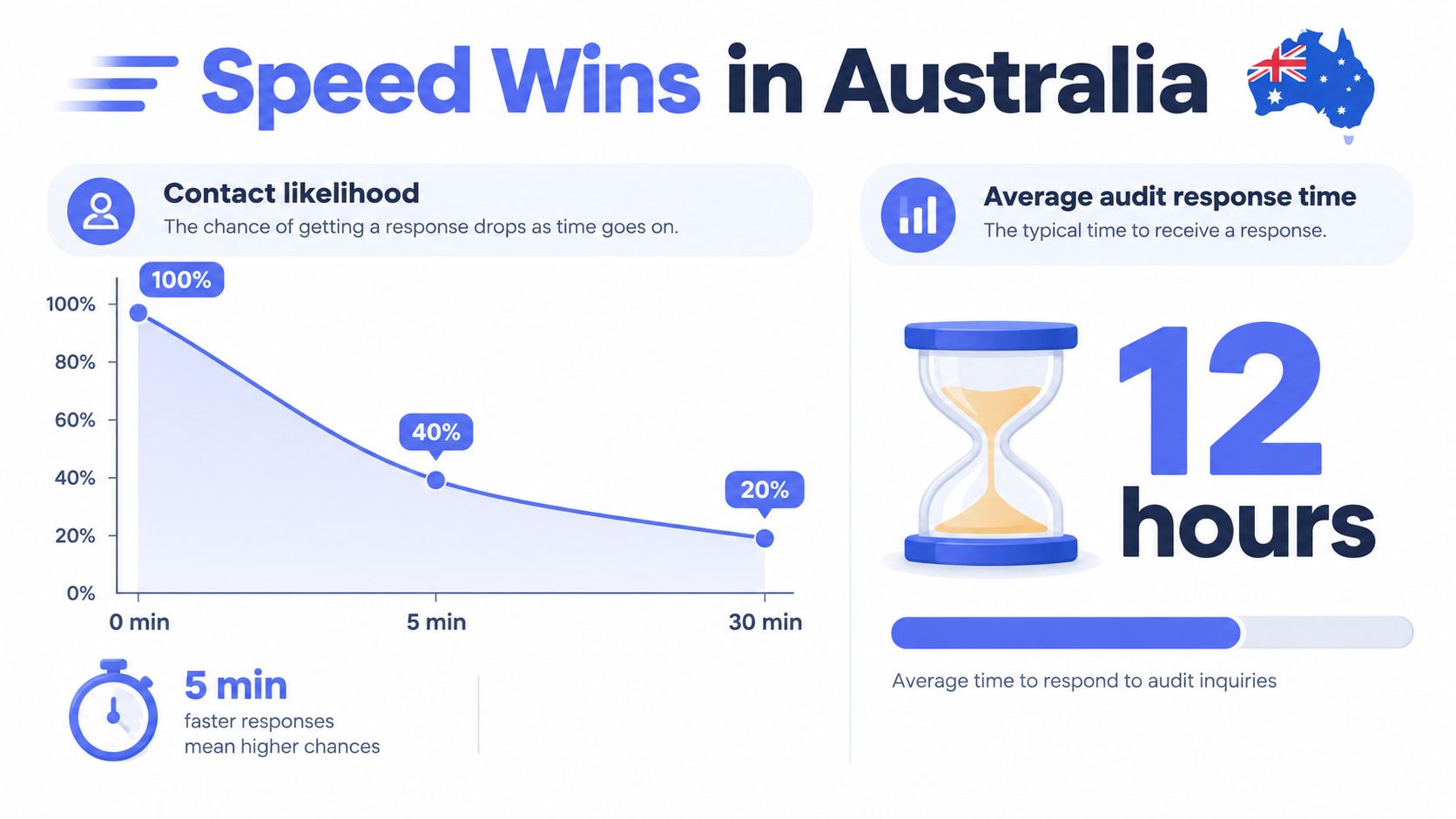
A lead can go cold while the inbox still looks busy. Australian benchmarks point to a narrow window, with the first five minutes carrying the most weight and contact odds falling sharply after that, while best-in-class performance under 60 seconds sits at the top end of what local service businesses aim for (Australian lead response benchmarks). For trades, building, and professional services firms, that is the difference between reaching a buyer while they are still comparing options and arriving after they have already moved on.
What the numbers mean in practice
The point of the benchmark is not to shame slower teams. It sets the working window. If a lead gets a useful first reply in minutes, it is still in the zone where attention is high. If it waits for hours, the conversation has usually drifted into the long tail of delay.
A separate Australian guide on lead management software and response standards says high-intent web enquiries should get first human contact within 5 minutes during business hours, and it recommends watching both median and 90th-percentile first-response time so the slow tail does not hide behind a neat average (lead response benchmarks). That matters because many owners check one average and assume the team is fine, while a few late replies are carrying most of the risk.
The right lesson is simple. Speed is not a vanity metric. It is a way to keep the lead visible before the buyer starts comparing other names.
Why local buyers feel this so sharply
Australian service customers rarely wait on one callback. They compare providers quickly, especially when the work is urgent or the request is high value. The first response wins because it arrives while the problem is still front of mind, not because it sounds clever.
The Australian Taxation Office gives a useful public reference point. It publishes a service commitment to respond to inbound general calls within an average wait time of less than 15 minutes, and its 2024–25 result was 9 minutes 01 seconds year to date as at 30 June 2025 (ATO service commitments). That does not mean every SME needs the same queue setup. It does show what visible timeliness looks like in practice.
For a busy owner, the rule of thumb is easy to remember. High-intent leads need minutes. Lower-intent enquiries can wait longer, but they still need an owner, a next action, and a clear place in the system.
How Channel and Timing Change Your Response Rules
A single SLA sounds tidy, but it breaks down fast. Email, Facebook, Instagram, weekend enquiries, and quoted work don't behave the same way, so treating them as one bucket usually creates avoidable delay. The better question is which channels deserve a human response now, and which ones can wait for a structured follow-up path.
Channel speed is not equal
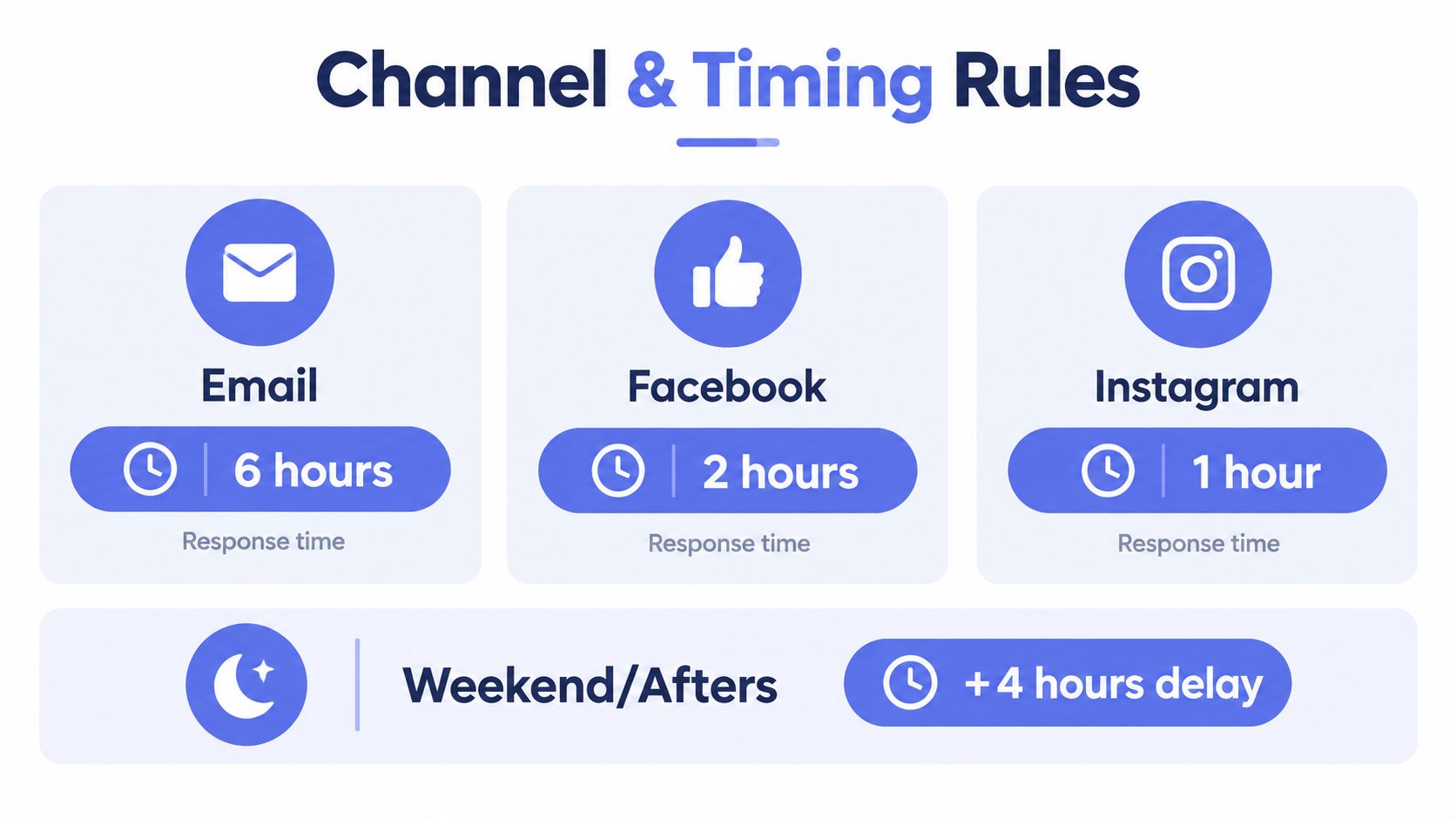
Australian-specific channel data shows just how different the timing can be. In one fitness industry study, email enquiries were answered in 7.5 hours on average, Facebook messages in 19 hours, and Instagram inquiries in 31 hours. The same study reported an overall average response time of 1,902 minutes, and 70.27% of replies took longer than 24 hours (Australia fitness industry study).
That gap tells you something important. The bottleneck isn't just the sales script. It's the channel itself, the time the message came in, and whether anyone owned it before the day got away from the team. If your enquiry path looks like that study, a lot of opportunities are already cold by the time a human opens them.
A weekend lead is not a Monday-morning lead with a different timestamp. It's a different service problem.
Timing and intent need separate rules
Recent Australian guidance says weekend and after-hours enquiries are often left until the next business day, and Sunday submissions can sit 16 to 40 hours before action in practice (weekend lead timing). That's why high-intent leads need their own rule set. A demo request or pricing enquiry should move in minutes. A lower-intent question can go into a slower sequence, but it still needs visible ownership.
Another Australia-focused source summarising established research says contacting a lead within one hour makes businesses 7x more likely to qualify it than waiting two hours, and 60x more likely than waiting 24 hours (Australian lead follow-up automation guide). That's the core operational point. The delay window matters, and different lead types need different response clocks.
A simple decision rule
Use channel and intent together, not separately.
- High-intent web forms: fast human contact, same day, with an owner assigned immediately.
- Social enquiries: quick acknowledgement, then a clear path to a real conversation.
- Lower-intent questions: slower than pricing requests, but still tracked with a next action.
- Weekend submissions: separate expectation, because the lead is arriving outside normal staffing patterns.
You don't need one universal SLA. You need a visible rule by lead type, by channel, and by time of day.
How to Measure Lead Response Time Without Fooling Yourself
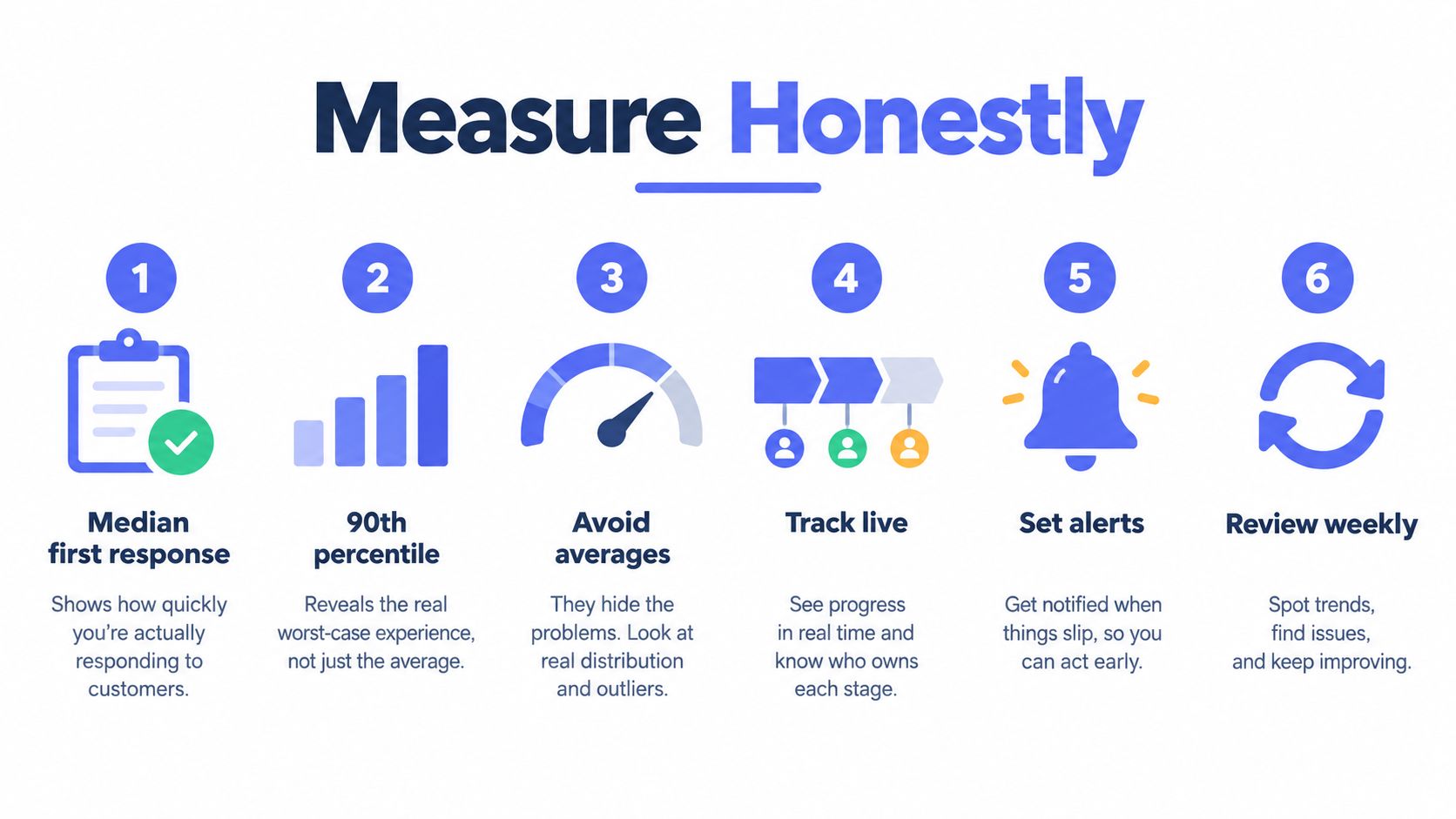
They don't need a fancier report. They need a truer one. A single average can make the operation look calmer than it is, especially when a few leads are answered quickly and the rest sit untouched until the next day.
Measure the right time, not just the easy one
The useful metric is first meaningful response time, tracked by lead type and channel. For high-intent enquiries, that means the moment a person starts helping, not the moment the auto-ack fires. For the team, the cleanest view is a CRM that shows each lead's stage, owner, source, last activity, and next action.
Averages hide tails, so use median first response time and the 90th percentile instead. That gives you a more honest view of what most leads experience and what the slowest important cases are doing to your pipeline. If the median looks fine but the 90th percentile keeps drifting, your process has a handoff problem somewhere.
Watch the tail. A business rarely loses leads because every reply is a bit slow. It loses them because some leads are very late and nobody sees the pattern soon enough.
Keep the pipeline live
The other mistake is letting the lead disappear once it's touched. Every enquiry should stay visible until it has a clear outcome, won, lost, disqualified, or nurtured. That visibility is what exposes stalled enquiries, missed hand-offs, and the leads that got trapped in forms, inboxes, spreadsheets, or memory.
The Australian lead-follow-up guidance points in the same direction, recommending routing leads into a CRM with owner assignment, next action, and visible follow-up tracking instead of leaving them in email or spreadsheets (lead follow-up guidance). That's not just neat administration. It's how you stop the same lead from being “owned” by three people and worked by none.
A measurement rhythm that works
Use a short weekly review.
- Check the median: is normal response time improving or slipping?
- Inspect the 90th percentile: which leads are waiting too long?
- Look at ownership: are hand-offs clear, or are leads bouncing?
- Scan stalled items: what's been sitting too long without a next action?
If you do that consistently, you'll see the operating issue. It's usually not effort. It's invisible delay.
Practical Tactics to Shorten Time to First Useful Response
A lead moves faster when the system does not rely on memory. The cleanest fix is to make the CRM the source of truth, so the enquiry is not sitting in email, a spreadsheet, and someone's head at the same time. Once the record lives in one place, you can qualify it, assign ownership, and set the next action as soon as it arrives.
Build the handoff before you chase speed
Fast replies break when intake is vague. If the form leaves out the context your team needs, someone has to rework the enquiry before they can answer it properly. That slows the first useful response, even if the team is busy and trying to be helpful.
Structured intake solves that problem for trades, installers, and service teams that need a job brief before they can quote with confidence.
A workable pattern is simple. High-intent leads go straight to the right owner, sensitive messages stay with a human review step, and stalled items trigger reminders instead of slipping into the background. That gives you quick first contact without turning every enquiry into a blunt auto-reply.
Keep ownership visible
A managed operating layer earns its keep here. In a Sydney SME context, Truespeak is one option that can connect first response and follow-up automation around an existing CRM, with routing, reminders, and workflow visibility built into the process. The point is not the tool itself. The point is that the lead has a visible owner and a clear next step from the moment it lands.
For a practical framework, lead routing best practices shows why routing should happen before the first reply, not after it. A lead that is assigned cleanly is less likely to sit in a forgotten inbox while everyone assumes someone else is handling it.
That same visibility matters for tracking home service lead conversions, because you cannot improve response flow if the lead disappears before the outcome is recorded.
Make follow-through routine, not heroic
The last piece is rhythm. Weekly visibility keeps the team honest because stalled enquiries show up before they turn into lost work. The aim is not to make every person faster by force. It is to reduce rework, remove confusion, and keep the right lead moving with the right owner.
A simple operating rule helps:
- Route immediately: no lead should wait for someone to “get to it later”.
- Assign the next action: every lead needs a next step, not just a name.
- Review exceptions: slow replies, weekend leads, and missed hand-offs need attention.
That is how speed becomes repeatable instead of occasional.
Conclusion Building a Visible System That Keeps Every Lead Moving
The cleanest way to think about lead response time is as an operating system, not a slogan. Every enquiry should enter one CRM, get qualified for fit, intent, and urgency, and carry an owner plus a next action until it reaches a clear outcome. That's the difference between reacting to messages and running a visible pipeline.
The benchmark work makes the urgency clear, especially for high-intent leads that arrive in the first few minutes of interest. The channel data shows why one SLA doesn't fit every enquiry. The measurement discipline keeps you honest, because you can't improve what you only half-track. The practical workflows then turn that visibility into consistent follow-through.
Don't start by rewriting everything. Start by checking where leads are landing, who owns them, and which ones go quiet without a next action. Weekend enquiries, social messages, and pricing requests usually reveal the biggest gaps first.
Truespeak helps Australian service businesses build managed systems around first response, follow-up, CRM hygiene, and intake, so leads stay visible from enquiry to outcome. If you want a practical way to tighten ownership and shorten the time to useful contact, visit Truespeak and take a look at how the workflow fits your current tools.