
51% of Australian B2B marketers already had a marketing automation platform in 2016, yet only 36% said they had a satisfactory volume of leads followed up by Sales. That gap is why lead nurturing is not just about emails, it's about making sure enquiries are captured, routed, followed up, and never left to drift.
A lot of Australian service businesses recognise the problem only after the work has already gone cold. The form came in, someone saw it, someone else assumed it had been handled, and by the time the team got back to the prospect, the buyer had moved on.
Table of Contents
- Why Enquiries Go Cold in Australian Service Businesses
- What Lead Nurturing Actually Means
- The Operational Stages of the Nurture Cycle
- Timing, Touches, and the Speed-to-Lead Imperative
- Balancing Automation with Human Judgment
- Measuring What Matters in Lead Nurturing
- Common Pitfalls to Avoid
- Conclusion - Building a Resilient Nurture System
Why Enquiries Go Cold in Australian Service Businesses
The failure usually starts in the wrong place. A web form lands in a personal inbox, the office phone rings, a tradie is on site, and the enquiry sits unopened until the end of the day. By then, the prospect has already spoken to someone who replied faster and sounded more organised.
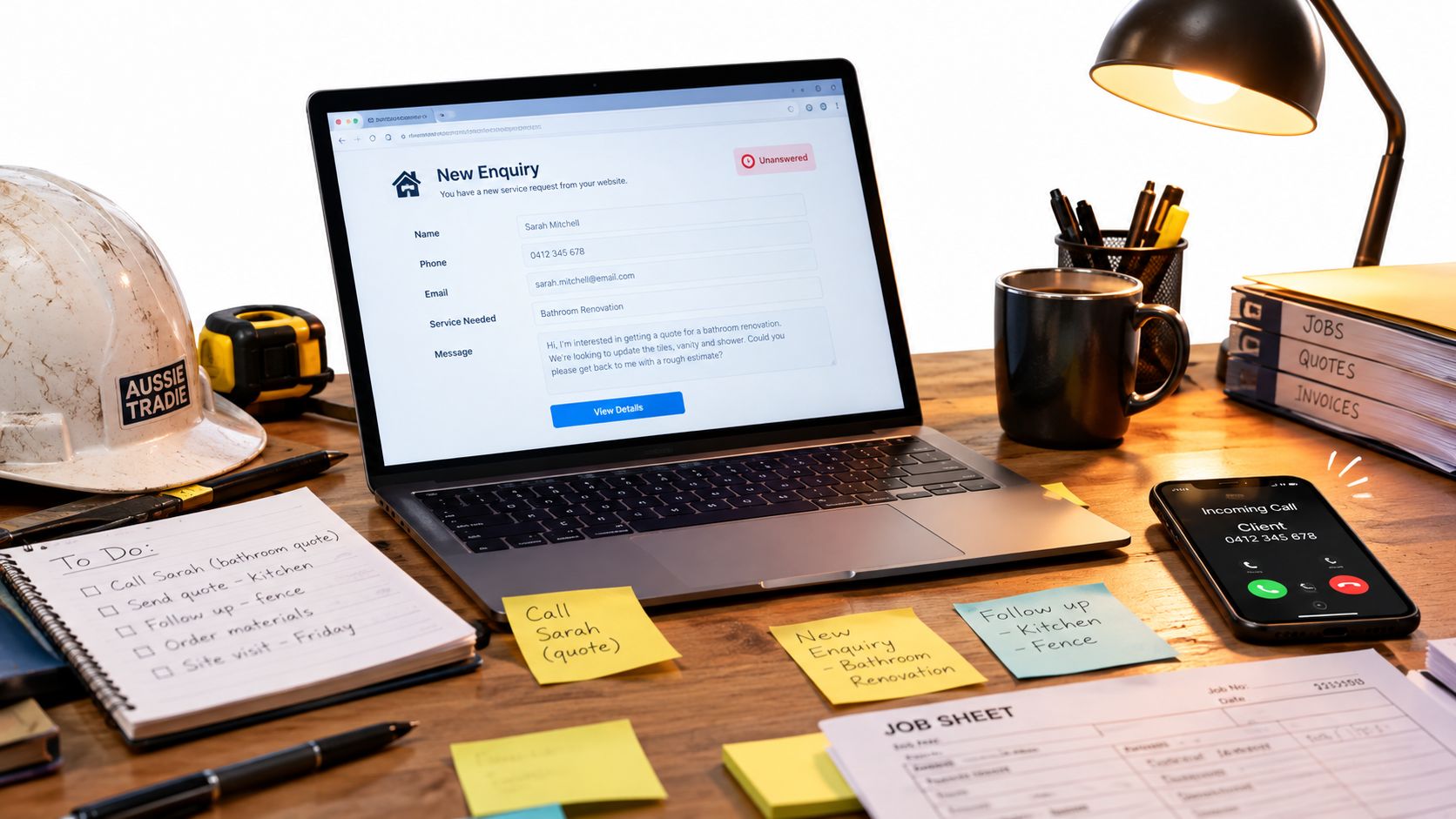
What makes this worse is the scatter. One lead lives in email, another in a spreadsheet, another in someone's head, and the hand-off depends on memory rather than a visible process. If you've ever watched a business lose track of a quote request because three people thought the other person had replied, you already know why this matters.
Practical rule: if a lead isn't in one place with one owner and one next step, it's already at risk.
The damage isn't only the missed reply. It's the leakage between intake, qualification, routing, and follow-up, which is why speed to lead matters in practice. That same operational problem is why many businesses also need better top-of-funnel demand, including finding more leads with video, because more enquiries won't help if the existing ones keep disappearing into inboxes.
A lot of owners think they have a lead problem when they have a coordination problem. The people doing the work are busy, but the system around them is thin, so enquiries go cold before anyone has even had a proper conversation.
What Lead Nurturing Actually Means
Lead nurturing is the operating discipline that moves a prospect from first contact to a clear outcome through timely, relevant interactions. In an Australian service business, capture, qualification, routing, follow-up, and closure must function as one connected flow. If those steps sit in separate inboxes, spreadsheets, or habits, revenue leaks between them.
The work is less about polishing messages than repairing the points where enquiries stall. A reliable process shows the lead's current stage, the person responsible, the information still needed, and the next action due. That visibility lets a manager find an abandoned enquiry before it disappears from the pipeline.
Why Automation Alone Doesn'T Solve It
Marketing automation adoption was already substantial in Australia in 2016, yet the same survey found only 26% of businesses had at least one in three leads closed by Sales (historical AU lead nurturing survey). The operational lesson is clear: access to a platform does not create ownership, accurate records, or consistent follow-up. Those controls have to be designed and maintained by the business.
A CRM should act as the system of record. Every enquiry needs a usable status, an accountable owner, and a dated next action. If staff leave updates in personal inboxes or record them late, the CRM becomes a historical archive rather than a working control system. Follow-up then depends on memory, and the prospect may cool before a meaningful conversation begins.
Lead nurturing works when every lead has one owner, one stage, and one visible next action.
Effective nurture systems treat marketing and sales activity as part of the same operating process. They preserve momentum until the lead is won, lost, disqualified, or placed into a longer follow-up path, while making gaps visible enough for someone to correct them.
The Operational Stages of the Nurture Cycle
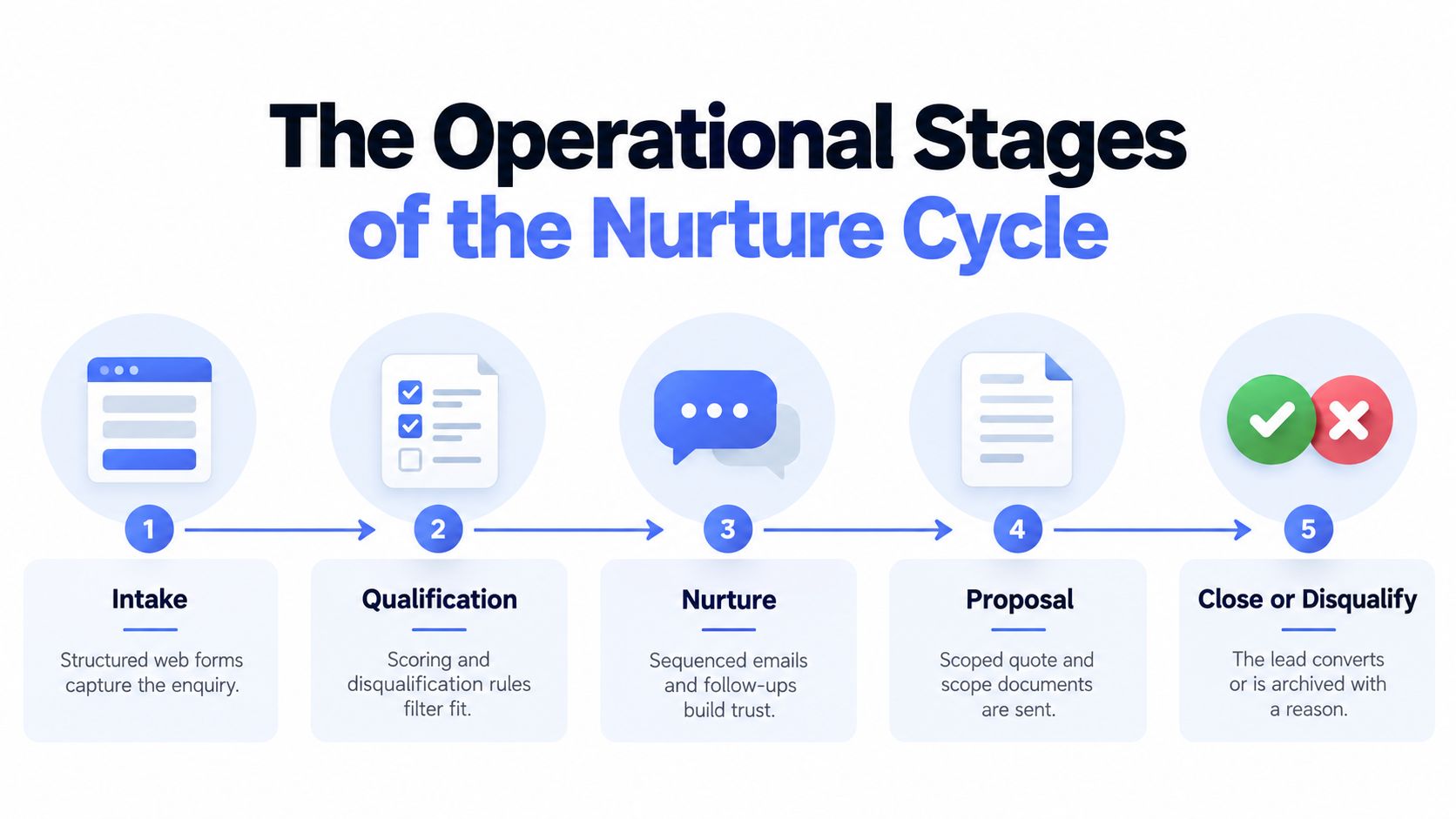
Intake Comes First
A strong nurture cycle starts with structured intake. Forms should collect only what the team needs to respond properly, then route the enquiry into the right place without retyping or chasing missing details. The fewer manual hand-offs you create at the front door, the less rework you create later.
Qualification Decides the Next Path
Not every enquiry deserves the same treatment. Fit, intent, and urgency should shape the next move, because a high-intent quote request needs a different response from a vague enquiry that's still early in the buying process. That's where many businesses waste time, by treating all leads as equal and then wondering why the pipeline clogs.
Routing and Follow-Up Keep the Job Moving
Once qualified, the lead needs the right owner and the right cadence. The goal isn't just to send an email, it's to keep the lead visible until there's a clear outcome. Where useful, you can map this workflow against a managed system like lead follow-up automation, especially when enquiries, quotes, and dormant opportunities all need different handling.
Proposal and Closure Need a Visible Loop
When the lead reaches proposal stage, the process should capture the next action, the decision owner, and the expected timing. If the lead goes quiet, the system should mark it as dormant instead of letting it sit in the active queue forever. That's how you prevent clutter from hiding real opportunities.
The five-stage flow matters because it gives operations managers a way to find the break. If intake is clean but proposals stall, the issue isn't awareness. If response is fast but leads still vanish, the problem is usually ownership or follow-up discipline.
Timing, Touches, and the Speed-to-Lead Imperative
For Australian service businesses, speed reads as professionalism. A prospect who waits hours, or worse, until tomorrow, often assumes the business is disorganised, even if the work itself is excellent.
The operational benchmark is simple, contact hot inbound leads within 5 minutes. Australian lead-response guidance cites research showing a lead is about 21x more likely to qualify when contacted within 5 minutes than when the business waits 30 minutes, while the odds of even making contact can fall by roughly 100x between minute 5 and minute 30 (speed-to-lead benchmark). That is why a first response rule matters so much.
| Response Time | Likelihood to Qualify | Likelihood of Contact |
|---|---|---|
| Within 5 minutes | About 21x more likely than waiting 30 minutes | Strongest window |
| 5 to 30 minutes | Falls rapidly | Can drop by roughly 100x by minute 30 |
Multi-Touch Follow-Up Beats One-and-Done Chasing
The follow-up sequence matters just as much as the first reply. One Australian article notes that 80% of sales require 5+ follow-ups to close, which is a good reminder that nurture has to be structured, not improvised (structured follow-up guidance). If the first message doesn't land, the second or third often does.
That's why a practical cadence should front-load the earliest touches, then space them out instead of sending everything at the same interval. A usable benchmark for planning is 5 to 7 emails over 30 to 45 days for shorter cycles, or 8 to 12 emails over 60 to 90 days for longer cycles, with 5 to 7 days between sends (cadence benchmark).
For service businesses, the point isn't to sound busy. It's to stay present while the buyer is still comparing options, asking questions, and deciding who feels easiest to trust. If that's the part your team struggles with, a managed workflow such as speed to lead automation is usually more useful than a generic drip campaign.
Balancing Automation with Human Judgment

Automation should handle repetitive capture, enrichment, routing, and reminders. People should handle judgement, context, relationships, and any communication where the wrong tone could damage trust.
That matters in trades, installs, and professional services because the buying cycle is often higher-stakes than a simple brochure request. A rushed sequence can feel cold, while a well-timed human review can stop an awkward or irrelevant message before it goes out. If you want a practical reference point for workflow design, streamlining workflows with cxconnect.ai is a useful way to think about automation as process support rather than a replacement for people.
Where Human Review Should Stay in the Loop
The safest pattern is approval gates for sensitive steps, especially where the lead has raised a complex issue, a pricing objection, or a relationship-sensitive request. That's also where the human-in-the-loop approach does the most good, because it keeps the system fast without making it tone-deaf.
A managed model also beats a set-and-forget build because the process changes as failures appear. If a field goes missing, a routing rule breaks, or a reminder lands at the wrong time, someone needs to tune the workflow rather than hoping it fixes itself.
The best systems feel calm to the customer. They're fast enough to catch intent, but structured enough that a real person steps in whenever the conversation needs judgement.
Measuring What Matters in Lead Nurturing
A tidy open-rate report can hide a broken follow-up process. If enquiries sit untouched, bounce between owners, or lose a next step in the CRM, the business is still leaking revenue.
Measure the work that keeps leads moving. Track how fast the first response lands, whether the enquiry reached the right owner, whether the next action was logged, and whether the CRM shows a current status that matches reality. If managers keep asking who owns a lead, the reporting is not helping operations.
Response time deserves the most attention because intent cools quickly. The earlier Australian survey cited earlier showed weak hand-off habits, which is a process problem, not a creative one. The practical test is simple: does the team respond while the lead is still active, or only after interest has faded?
What to Watch Week to Week
- Response speed: Check whether hot enquiries are contacted within the first few minutes, not later in the day.
- Routing accuracy: Confirm each lead reaches the right owner instead of sitting in a shared inbox.
- Follow-up consistency: Look for a next step on quotes, proposals, and dormant opportunities.
- CRM hygiene: Flag missing stages, stale records, and duplicate entries that obscure the actual workload.
- Outcome quality: See whether the sequence moves leads toward a clear result instead of creating activity for its own sake.
- Aging actions: Track the share of leads with no next action more than 48 hours old. That number exposes silent leakage fast.
If you outsource any part of the messaging, the hand-off still needs process control. email outsourcing tips from Lead Printer is useful if you want to keep content production aligned with ownership, timing, and CRM discipline.
The point of measurement is straightforward. The system should tell the truth about where every lead stands, who owns it, and what happens next.
Common Pitfalls to Avoid
The biggest mistake is assuming more automation automatically means better nurture. If the workflow is built on messy intake and weak ownership, automation just makes the mess happen faster.
A second mistake is using one sequence for every lead. Fresh enquiries, quoting-stage prospects, and dormant opportunities need different treatment, or the messages start to feel irrelevant. That's when prospects stop engaging and the business blames the channel instead of the design.
The Problems That Quietly Drain Conversion
CRM drift is the silent killer. Records get stale, stages stop matching reality, and nobody trusts the system enough to use it properly. Once that happens, follow-up turns into guesswork again.
Over-messaging is the other trap. Prospects don't want to be chased endlessly, they want useful contact at the right time, with enough space to think. If your sequence sounds like pressure rather than help, it will create the very silence you're trying to avoid.
If the team can't tell the difference between a live lead, a warm lead, and a dormant one, the nurture system isn't finished yet.
The fix isn't more noise, it's cleaner ownership and better rules. One source of truth, stage-based follow-up, and human review where the risks are greatest will usually do more for revenue leakage than another batch of templates ever will.
Conclusion - Building a Resilient Nurture System
Lead nurturing only works when the operating basics are in place. Fast first response, structured follow-up, clean CRM ownership, and human judgement at the right moments do more for conversion than scattered reminders ever will.
For Australian service businesses, that usually means treating nurture as an operational layer, not a marketing side task. The question isn't whether you send enough emails, it's whether every enquiry is visible, owned, and moved to a clear outcome without falling through the cracks.
That's the standard worth aiming for. When the system is built properly, cold enquiries don't disappear, stalled quotes get attention, and the team can see where revenue is leaking before it becomes normal.
If your enquiries are going cold because the hand-offs are messy, Truespeak builds and manages the operating layer around first response, follow-up, intake, CRM hygiene, and reporting. Visit Truespeak to see how lead follow-up automation and managed AI operations can help your team keep every lead visible until it's won, lost, or properly nurtured.