
12% of Australian businesses used AI in their workplace in 2024–25, up from about 1% in 2021–22. If you're running a service business, that tells you the market has already moved from curiosity to deployment, and the firms winning work are the ones tightening response times, follow-up, and admin without adding headcount.
The pressure usually shows up in ordinary ways. A quote sits in an inbox, a voicemail gets missed, a CRM note is half-finished, and the owner ends up paying for the delay with lost momentum. That is exactly where AI agents Australia becomes a practical operations question, not a technology trend.
Table of Contents
- Why Australian SMEs Are Turning to AI Agents Now
- Understanding What AI Agents Actually Are
- Practical Use Cases for Australian Service Businesses
- Navigating the Australian AI Agent Vendor Landscape
- Managed Services Versus Internal Build-Out Strategies
- Common Pitfalls and Misconceptions in AI Adoption
- Compliance and Data Privacy in Australian AI Systems
- Recommended First Steps for Getting Started
Why Australian SMEs Are Turning to AI Agents Now
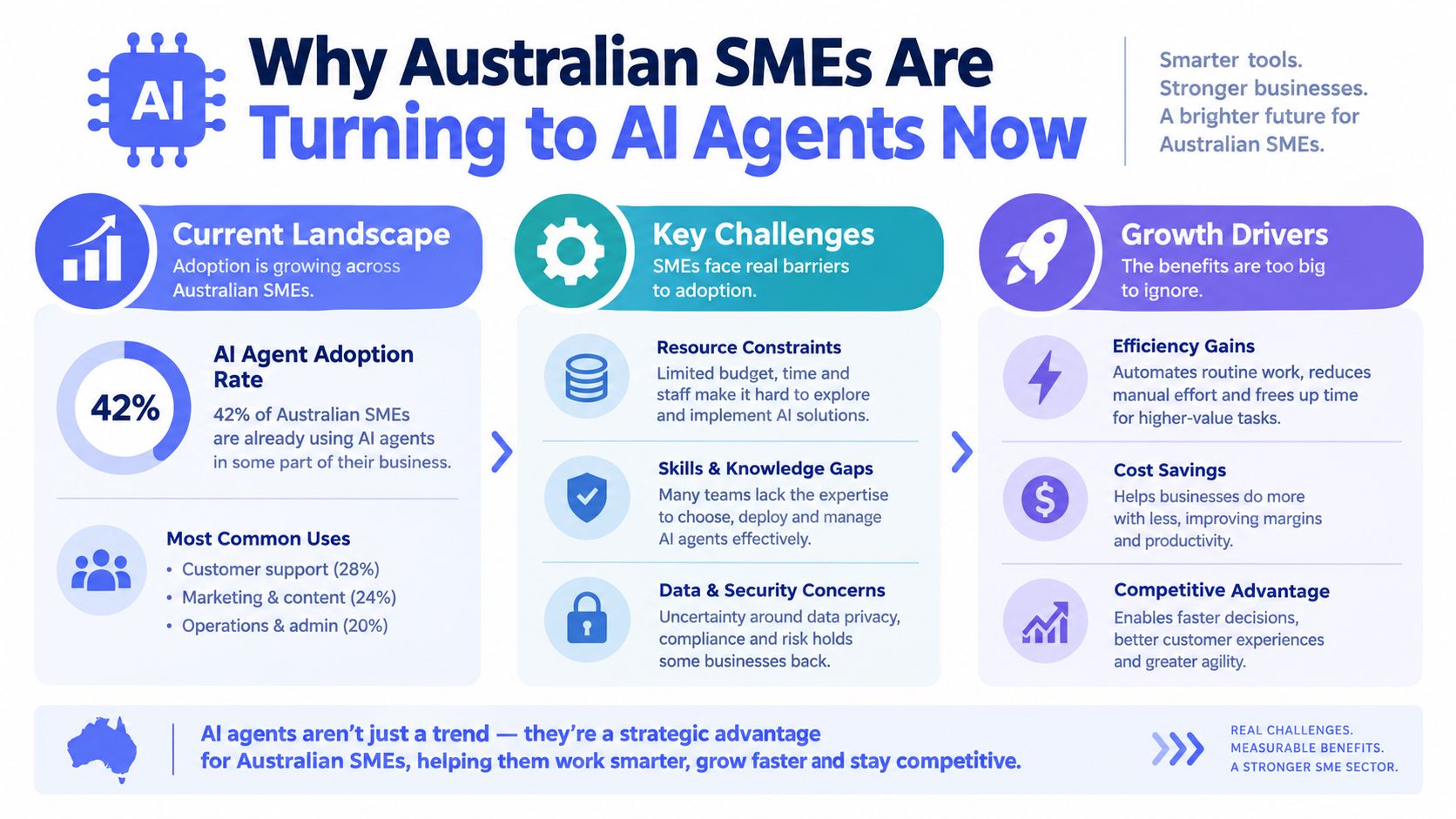
A Sydney plumber does not need another software demo. They need every lead answered, every job logged, and every follow-up sent before the customer rings someone else. That is why interest is rising. The ABS says around 12% of Australian businesses used AI in 2024–25, up from about 1% in 2021–22, with adoption much higher in larger firms, at about 35% for large businesses and 22% for medium-sized businesses, compared with around 11% for small and micro businesses (ABS release).
The Pressure Point Is Operational, Not Philosophical
That gap matters because small businesses do not buy AI to explore innovation. They buy it to stop dropping work. The same ABS release noted that 46% of businesses were actively seeking savings and efficiencies through innovation and new technologies. For a six-person electrical firm, that shows up fast. Three or four missed after-hours enquiries in a week can mean lost quotes, slow callbacks, and a crew sitting idle the next morning.
Practical rule: If an enquiry, reminder, or intake task follows a clear pattern, it belongs in an agent-assisted workflow.
AI agents Australia becomes a managed operations question. The businesses feeling the most pressure are service firms with human-heavy work, thin margins, and messy hand-offs. A managed agent system helps because it does not just automate tasks, it forces governance into the process. You get clearer intake, named approval points, and a human-in-the-loop design that keeps mistakes from spreading through the business.
Understanding What AI Agents Actually Are
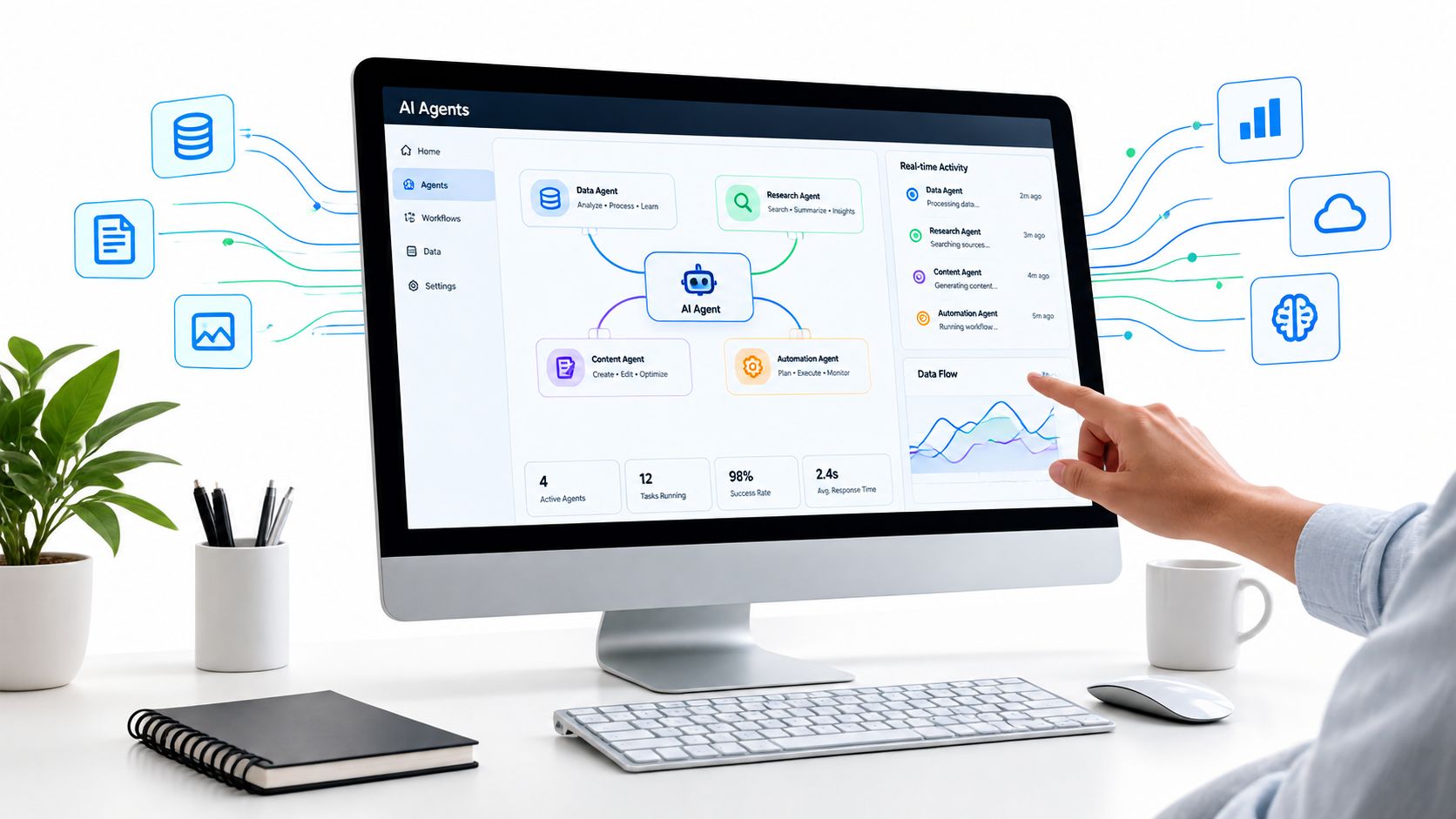
An AI agent is not a smarter chatbot with a nicer interface. A chatbot answers questions. An agent takes a task, works through a sequence, and acts on the output. That difference matters because Australian SMEs don't need more conversation, they need structured execution across intake, routing, reminders, and updates.
Autonomy Is the Point, but Only Inside a Process
An agent becomes useful when it can read context, decide what happens next, and push work into the right queue. In practice, that means one system qualifies a lead, another updates a CRM record, and a third triggers a reminder when a quote sits too long. If the logic is weak, the agent just automates confusion faster.
The best way to evaluate a system is to ask whether it can work inside your real operating rhythm, not whether it can impress in a demo. A good reference point is this guide to governed AI agent deployment, because it focuses on control, not theatre. That's the standard to use in Australia as well.
The Useful Components Are Boring by Design
A solid AI agent setup usually needs a few things, and none of them are flashy.
- Structured intake: The agent needs forms, fields, or prompts that collect the right details before work starts.
- Routing rules: It should know who gets the lead, task, or escalation next.
- Follow-up logic: It must trigger reminders or sequences when a response is overdue.
- Source of truth: It needs one place where ownership, stage, and next action stay visible.
The mistake is buying a tool that promises autonomy without showing how decisions are controlled. The cleaner the workflow, the safer the automation.
Later-stage systems may also support voice, which is useful when missed calls are costing you jobs. If you want a practical example of workflow-dependent automation, Beam's page on real-time TTS with Beam shows how speech delivery can fit into service operations without turning the whole stack into a science project.
Practical Use Cases for Australian Service Businesses
The highest-value use cases are the ones that remove friction from everyday work. If you run a trade, consultancy, clinic, or local service business, the problem usually isn't one big bottleneck. It's ten small ones that all slow the same pipeline.
Start with the Work That Leaks Revenue
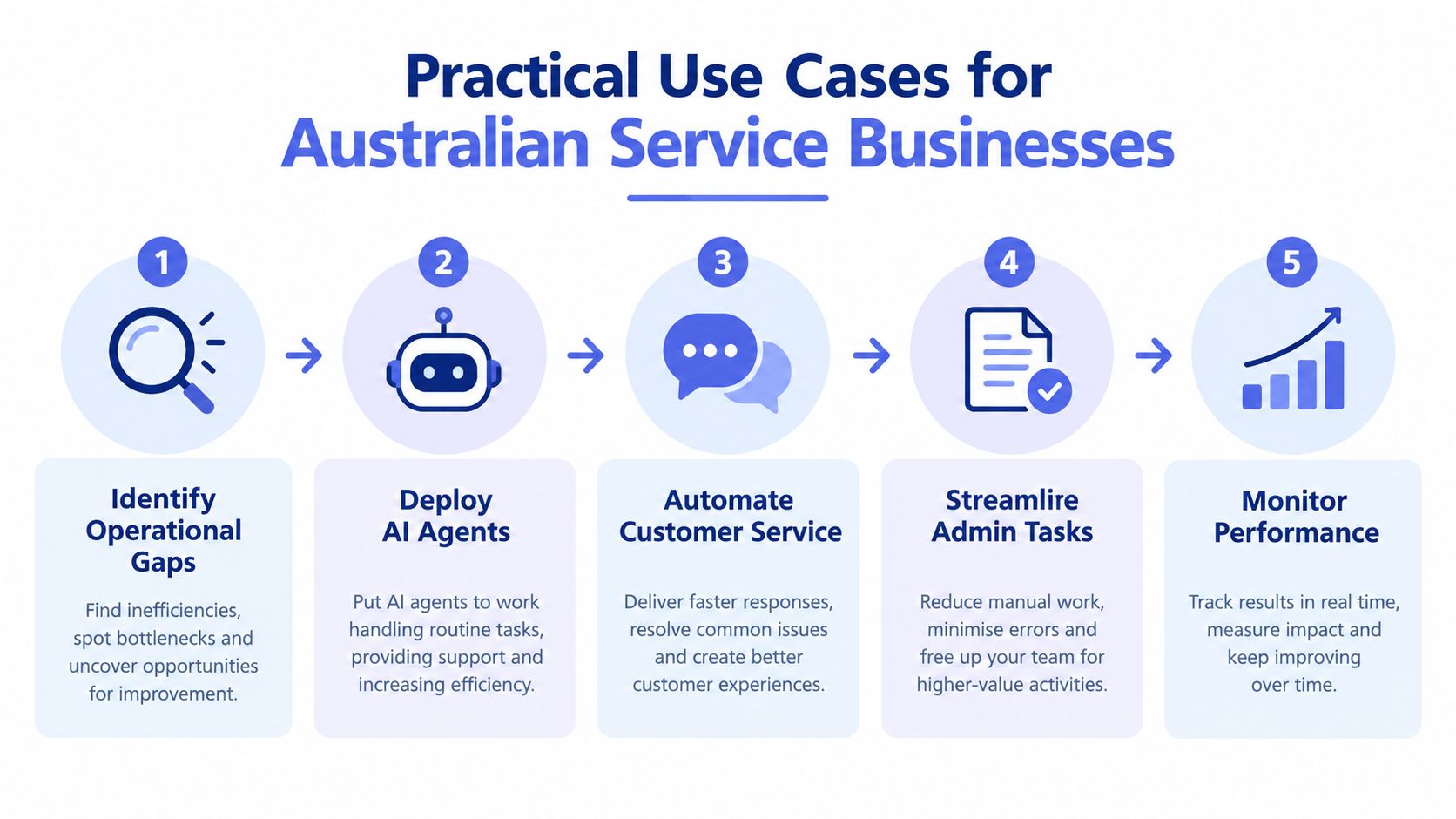
Speed-to-lead is the first obvious win. When an enquiry lands, an agent can capture the details, route it, and keep the owner from responding late. That matters because buyers don't wait around for a tidy inbox.
Lead follow-up is the second. Quotes sit, proposals age, and opportunities go cold because nobody keeps the sequence moving. A managed agent can send the next prompt, log the interaction, and flag anything that needs human attention.
Intake automation is the third. Instead of chasing missing photos, job notes, or brief details, the system can collect them before handoff. That reduces rework and stops jobs from starting half-baked.
The point isn't to automate everything. It's to make sure nothing important depends on memory.
CRM hygiene is the fourth. A messy CRM hides the next action, so the team starts working from instinct instead of truth. Agent-driven hygiene routines keep records current, route stale items, and surface what needs action.
Invoice reminders are the fifth. Cash flow improves when the reminders are polite, timely, and tied to the actual status of the job. You don't need aggressive chasing, you need consistency.
For a deeper example of how these pieces fit together, the internal workflow note at https://truespeak.io/blog/ai-workflow-automation is worth reading alongside your own process map.
Navigating the Australian AI Agent Vendor Landscape
Most owners ask the wrong first question. They ask which tool is the smartest. The better question is which partner can keep the system useful after launch, when exceptions, edge cases, and staff behaviour start to change the workflow.
Choose for Control, Not Just Capability
A vendor should be able to explain where the source of truth lives, how approvals work, and what happens when the agent is unsure. If they can't show you human review gates for sensitive actions, they're selling convenience without governance. That's a bad trade in a service business.
Look for smaller scopes first. A good operator will build the smallest useful system, prove it against real work, then expand only when the evidence says it should. That approach reduces the risk of launching a bloated setup that nobody uses.
You should also ask how the system fits around your current CRM, not whether you need to rip everything out. In most SMEs, replacement is the wrong instinct. Integration and discipline are the key levers.
A useful comparison point is the conversation around open source AI agent frameworks 2026, because it helps separate software choice from operational ownership. The framework may matter, but the operating model matters more.
If you're considering a managed partner, Truespeak is one option in this category. It designs and manages AI operating systems around first response, follow-up, intake, CRM hygiene, and invoice reminders, with the operating layer built around tools already in use. For many SMEs, that matters more than buying another standalone platform.
Managed Services Versus Internal Build-Out Strategies
The internal build sounds attractive because it promises control. You own the logic, the stack, and the timeline. In reality, most SMEs discover that ownership also means maintenance, monitoring, prompt tuning, exception handling, and the constant risk that the one person who understands the setup gets pulled into something else.
Managed Service When Speed and Continuity Matter
A managed service makes sense when the business wants usable automation now, not after a long internal build cycle. It's usually the better fit if the team needs approval gates, reporting, and ongoing tuning without adding another technical burden to operations. That's where a service partner earns its keep.
Internal Build When You Already Have Depth
An internal build-out works better when the company already has technical staff, workflow ownership, and a clear plan for maintenance. It gives you more control over architecture and future changes, but you carry the cost of keeping it alive. If the workflow is simple today and likely to stay simple, this path can make sense.
| Decision factor | Managed services | Internal build-out |
|---|---|---|
| Speed to launch | Faster | Slower |
| Ongoing upkeep | Handled externally | Owned internally |
| Governance | Built into the service model | Must be designed in-house |
| Flexibility | Practical, structured | Highly custom |
| Best fit | SMEs needing continuity | Teams with technical depth |
The security model matters too. Ask how personal data is isolated, how access is restricted, and how exceptions are logged. If a vendor can't answer those questions clearly, the architecture isn't ready for a real business.
For teams that want to understand the build side more thoroughly, the internal note on https://truespeak.io/blog/ai-automation-agency is a useful companion read. It helps separate automation as a product from automation as an operating layer.
Common Pitfalls and Misconceptions in AI Adoption
The most expensive mistake is launching an agent into a broken process and expecting it to clean up the mess. If ownership is unclear, hand-offs are inconsistent, and the CRM is stale, the agent just scales the disorder. That's not automation, that's noise at machine speed.
Don'T Turn the System into a Black Box
A lot of vendors still sell AI as if human judgement is a weakness. It isn't. The right model keeps people responsible for relationships, exceptions, and consequential decisions while the agent handles repetition, capture, and routine follow-up. That division is cleaner and safer.
If a customer complaint, payment issue, or proposal change can create business risk, a human needs to stay in the loop.
The second misconception is that “set and forget” is a strategy. It isn't. Systems drift, language changes, staff workflows evolve, and the edge cases pile up. Without review cadence and exception handling, the agent becomes another forgotten tool.
If you want a useful contrast, the internal note on https://truespeak.io/blog/human-in-the-loop-automation shows why human-in-the-loop design isn't a compromise, it's the operating rule. That's the right mindset for Australian SMEs that want reliability rather than novelty.
Compliance and Data Privacy in Australian AI Systems
Australian SMEs need to treat AI agents as a privacy issue from day one. The Australian Privacy Principles apply whenever personal information is involved, including data used to train, test, or run an AI system. If an agent handles leads, intake notes, CRM records, or follow-up messages, privacy has to be built into the workflow, not bolted on later. (OAIC guidance)
The practical test is simple. For APP 1, assign one person to own the AI process and its records. For APP 3, only collect what the team needs to serve the customer. For APP 5, update your intake notice to say what the agent does, where the notes go, and that a team member reviews the output before any client-facing decision. For APP 6, keep use and disclosure tied to the stated purpose unless you have a clear reason to go further. For APP 10, check that the agent is working from current information before it triggers a response. For APP 11, lock down access, logging, and storage so staff can see who touched the data and when. (Digital Government privacy guidance)
The next change matters too. From 10 December 2026, APP entities are scheduled to be required to disclose in their privacy policies when they use automated decision-making that makes or substantially supports decisions that could significantly affect a person's rights or interests, including the kinds of personal information used and the kinds of decisions involved. (privacy reform summary)
Keep the operating model visible. If the business cannot explain what the agent does, who can override it, and where the record lives, the system is not ready.
Recommended First Steps for Getting Started
Start with the process, not the tool. Map every enquiry, reminder, and hand-off, then make sure each one has an owner, a stage, and a clear outcome in one CRM. If the workflow isn't visible, automation will only hide the gaps.
Then pick the smallest useful system. Don't begin with a grand redesign. Begin with the workflow that leaks the most time or revenue, prove it, and expand from evidence.
When you're ready, get a diagnostic assessment and build around the process you already run. That's how AI agents Australia stops being a buzzword and becomes a reliable operating layer for the business.
Truespeak designs, builds, and manages AI operating systems for Australian service businesses that need faster response, cleaner follow-up, better intake, and visible operations. If you want practical automation around your existing CRM and processes, visit Truespeak and start with the part of the workflow that's costing you time right now.