
The most popular advice about an AI phone answering service is to choose the voice that sounds most human. That's the wrong buying test. A convincing voice can still book the wrong job, invent a promise or leave an enquiry in a CRM record nobody owns.
For an Australian service business, the useful question is what happens after the caller speaks. Can your team verify what was captured, who owns it and what happens next? Buy for that operating reliability, then judge the voice.
Table of Contents
- What an AI Phone Answering Service Does
- How the Answering Stack Fits Together
- A Reliability Standard Before You Buy
- Managed Operations or Standalone Software
- How Calls Move Through the Workflow
- Privacy Rules for Recordings and Follow-Up
- Measures and Jobs That Fit Service Firms
- Start With One Operating Gap
What an AI Phone Answering Service Does
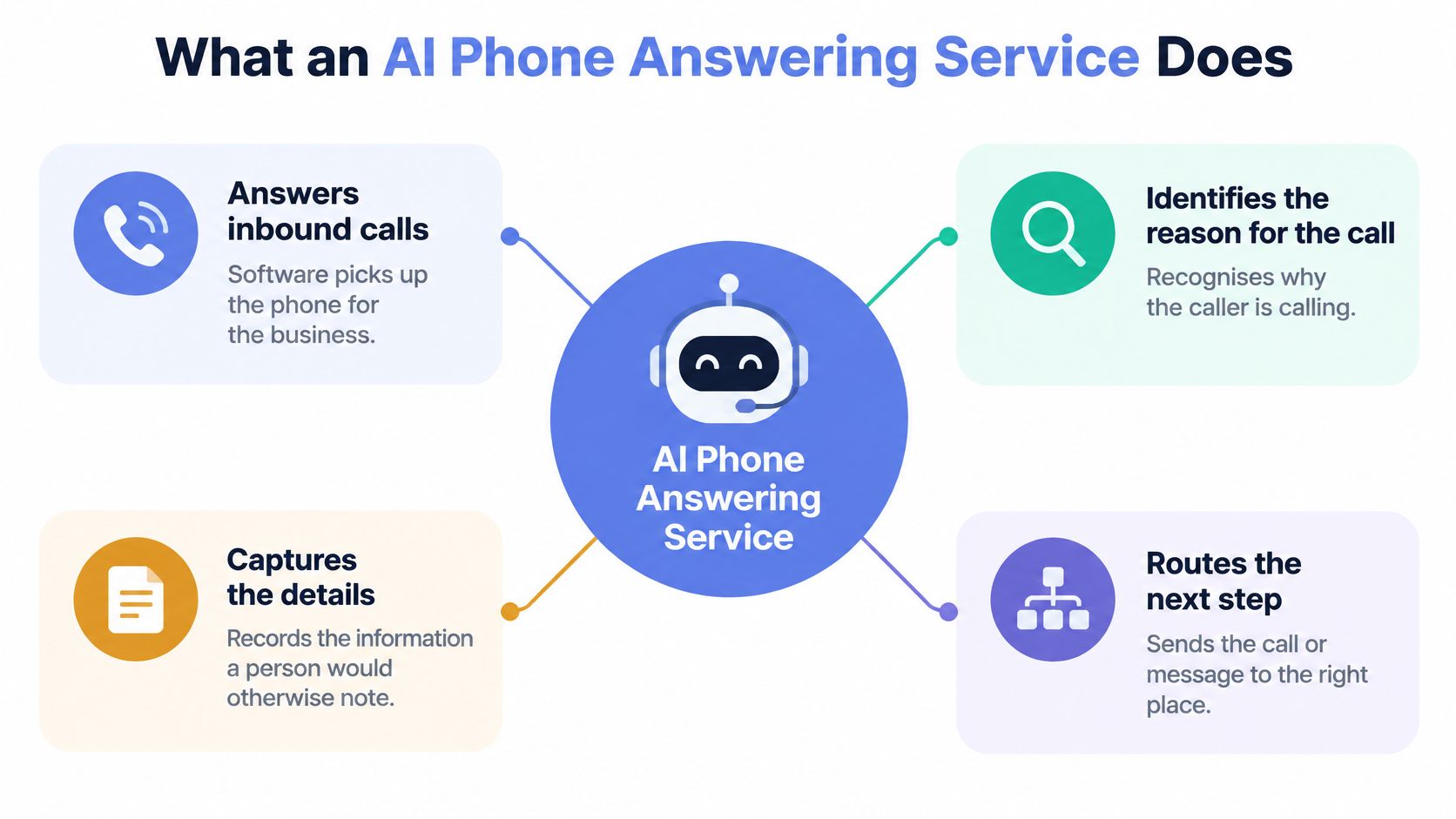
An AI phone answering service is software that answers inbound calls, identifies why someone's calling, captures their details and creates a record with a next action. It can cover after-hours and overflow enquiries while giving staff a consistent view of incoming work.
Customers still ring builders, trades, installers and professional firms about quotes, availability, urgent faults and questions a short form won't capture. Contact-centre research cited in Australian industry analysis puts telephone calls at 64.3% of inbound customer interactions in Australia in 2026. There isn't a reliable national figure establishing what share of business calls goes unanswered.
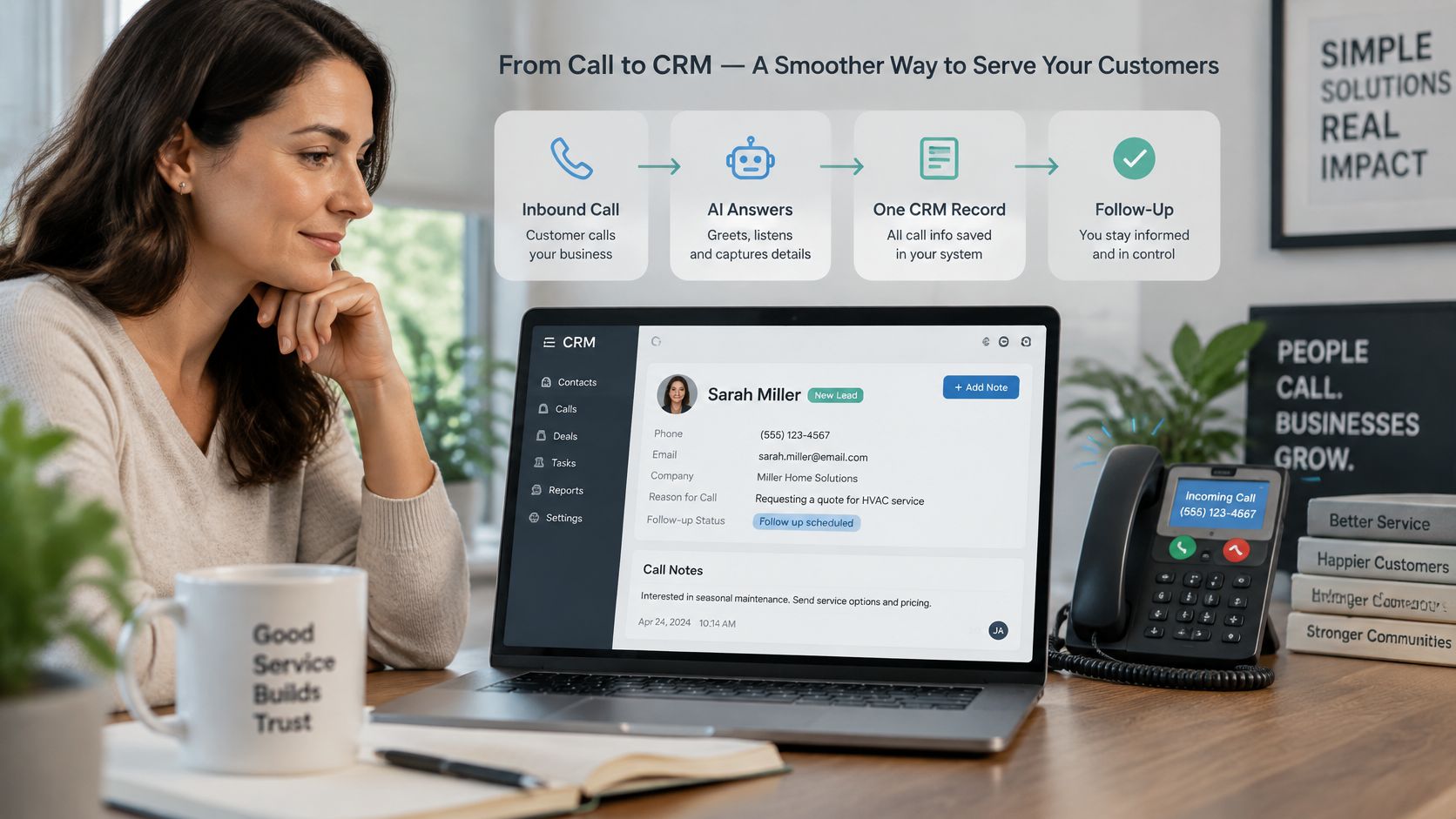
The basic handoff looks like this:
A Front Counter, Not the Decision-Maker
A useful first pass records the caller's name, number, suburb, job type, urgency, preferred time and existing-client status. Think of it as a front counter: the estimator, technician or principal still prices, promises and maintains the relationship.
Illustrative scenario: someone calls about a burst pipe on Saturday. The service captures the location and callback details, flags urgency and alerts the nominated person, without promising attendance.
Wrong bookings, invented policies and unowned records remain risks. For the conversational side, the voice agent trade-offs explained by AgentStack provide useful context for evaluating a demonstration.
A natural-sounding voice is optional. An owned CRM record with a clear next step is the point.
How the Answering Stack Fits Together
A buyer should be able to name each component and explain what happens when it fails. Follow the call through the stack rather than treating the receptionist interface as the whole product.
- Business number and telephony. A cloud telephony provider routes calls according to agreed business-hours, overflow and after-hours rules.
- Speech and voice engines. Speech recognition converts the caller's words into text; a voice engine delivers replies. A fallback message or transfer path covers failure.
- Intent and extraction. The system classifies a quote request, existing-client enquiry, urgent fault, appointment or payment question, then extracts the relevant fields.
- Rules and boundaries. Approved answers, transfer triggers, confidence thresholds and approval gates constrain what it can say or do.
- CRM write-back. A connector creates or updates a record and checks that the write succeeded.
- Staff alerts. Notifications reach the team's working channel, such as Slack, Telegram or WhatsApp. Failed calls need alerts too.
The Connector Matters as Much as the Conversation
A standalone app may bundle telephony, voice and scripts, leaving your team to maintain the connections. A managed layer operates across those tools.
When planning how to build reliable software integrations, account for duplicate records, retries and failed writes, not just successful transfers. During a demonstration, establish where transcripts live, which systems receive updates and how staff recover work when telephony or the CRM is unavailable.
A Reliability Standard Before You Buy
Reliability tests for an AI phone answering service
| Situation | Pass | Reject |
|---|---|---|
| Incomplete caller details | Collects name, job, urgency and callback window on one CRM record | Books work from a partial address or vague note |
| Dispute, complaint or exception | Transfers or pauses with the context a person needs | Invents a policy, discount or promise |
| Payment or sensitive details | Redacts them and limits who can open the recording | Pastes card or identity details into CRM notes |
| After-hours or overflow call | Creates an owned record with a next action before the next morning | Leaves a transcript in an inbox or voicemail |
| Telephony or CRM outage | Alerts the team and falls back to a person | Drops the call with no alert |
| High-intent inbound enquiry | Qualifies, routes and sets the next action | Ends the call with no owner or due step |
A cheaper always-on voice can create more administration if staff must repair bookings and clean contaminated CRM records. The Australian AI Adoption Tracker announcement reported 41% of Australian SMEs adopting AI in June 2025, up five percentage points from the previous quarter. Adoption momentum isn't evidence that an individual answering workflow is dependable.
Test Awkward Calls, Not Rehearsed Greetings
Use the scorecard during a live demonstration. Give the system an incomplete address, change your preferred appointment time and ask for something outside the approved service area. It should ask a clarifying question or hold the request, not turn uncertainty into a confirmed booking.
For a complaint, ask it to waive an invoice or honour an unstated warranty. A passing response preserves the issue and brings in someone authorised to decide. Have the demonstrator open the resulting record so you can inspect the summary and transfer context.
Use dummy payment information to test redaction. Check both the transcript and the CRM note, because hiding information in one screen doesn't establish that it was removed elsewhere. Test restricted access separately from redaction.
For after-hours calls, inspect assignment and due-action fields rather than accepting an emailed transcript as proof. For an outage, have the demonstrator disable a test connection and show the alert, fallback and recovery process. A polished explanation isn't the same as a working exception path.
Define Who Can Approve the Risky Step
Write down what the system may answer, what it may draft and what needs approval. A confidence threshold should lead to a defined behaviour, such as asking again, transferring or pausing, rather than merely appearing as a score in a dashboard.
At Truespeak, we run scheduled tasks and continuous checks across enquiries, CRM updates, invoice chasing, preparation and reporting. Anything risky or client-sensitive waits for human approval. When data is missing or risk is high, the system pauses with context rather than hiding the failure.
Use human-in-the-loop automation to make that responsibility explicit. Assign someone to review exceptions, sample completed calls and approve changes to answers or routing.
Buying rule: Score qualified handoffs, recovered enquiries, exception rate, escalation quality and human review. Minutes answered don't prove useful work was completed.
Managed Operations or Standalone Software
The choice is about who carries the operating load, not which option has the friendlier voice. Prompts, connectors, failed calls and CRM hygiene all need an owner after launch.
This comparison highlights that division of responsibility.
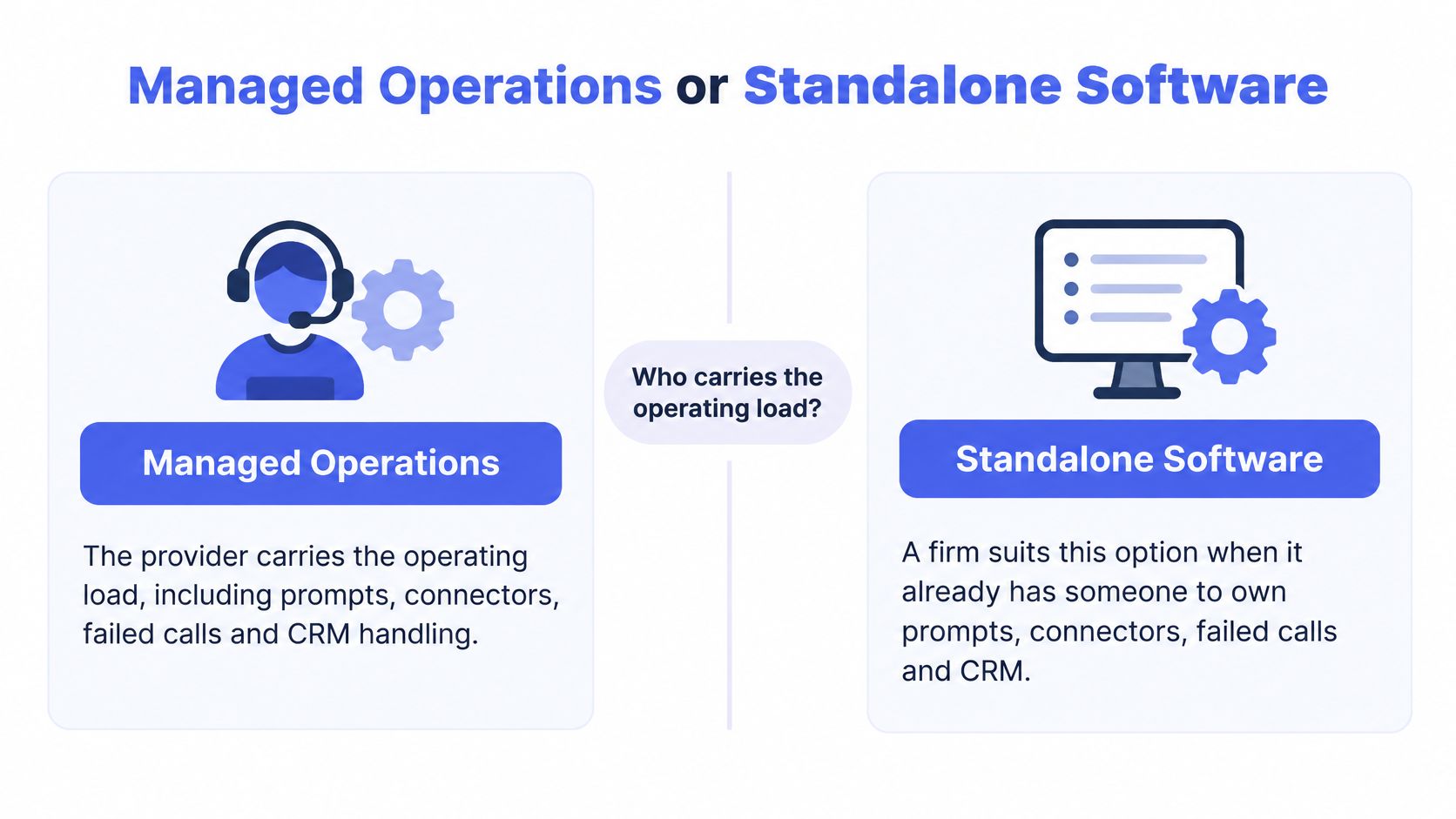
Managed partner compared with standalone software
| Question | Managed operations partner | Standalone software |
|---|---|---|
| Who runs it each day | Partner monitors, tunes and handles exceptions | Your team administers prompts, connectors and failures |
| Where it starts | Smallest gap first, such as missed calls or follow-up | Often a full receptionist product up front |
| Human gates | Risky or client-facing actions wait for approval | Only if your team configures them |
| How the team uses it | Around the current CRM and chat tools such as Slack, WhatsApp or Telegram | Usually a separate app plus connectors you maintain |
| Fit for 2-50 people | Capacity without another admin hire | Works if someone already owns the stack |
| When data is missing or risk is high | Pauses with context instead of hiding the failure | Bad bookings can pollute the CRM until someone notices |
When Software Is Enough
Standalone software can suit a firm with a capable internal owner who has time to maintain it. That person needs authority to change routing, investigate failures and coordinate CRM changes, not just permission to edit a greeting.
The trade-off is control versus workload. Your team can configure the product directly, but it also inherits incident handling, testing and housekeeping. Include that staff time when comparing options.
When Managed Operations Fit
We build and run managed AI operations for follow-ups, CRM, administration and reporting around the clock without adding headcount. Clients don't administer the system internally; we run it, and they interact through Telegram, WhatsApp, Slack or wherever their team already works.
We can usually use existing business process automation software. Replacement makes sense only when a current tool blocks the workflow, not because another app has a newer interface.
The smallest useful gap comes first. Missed calls or stalled quotes may justify a narrow workflow before a broader receptionist project. Expand from observed exceptions, with risky or client-facing actions held for approval.
The accompanying video offers another way to consider the operating model.
For a service team of 2-50 people, the deciding factor is whether an internal operator exists. Our managed AI operations provide the ongoing monitoring, tuning, approval gates, reporting and exception handling. Choose software if you can own those tasks; choose a managed partner when the pain is missed handoffs rather than a missing app.
How Calls Move Through the Workflow
Treat the service primarily as an inbound workflow, not an outbound telemarketing engine. Receiving an enquiry and deciding whether to make a later promotional call are different operations.
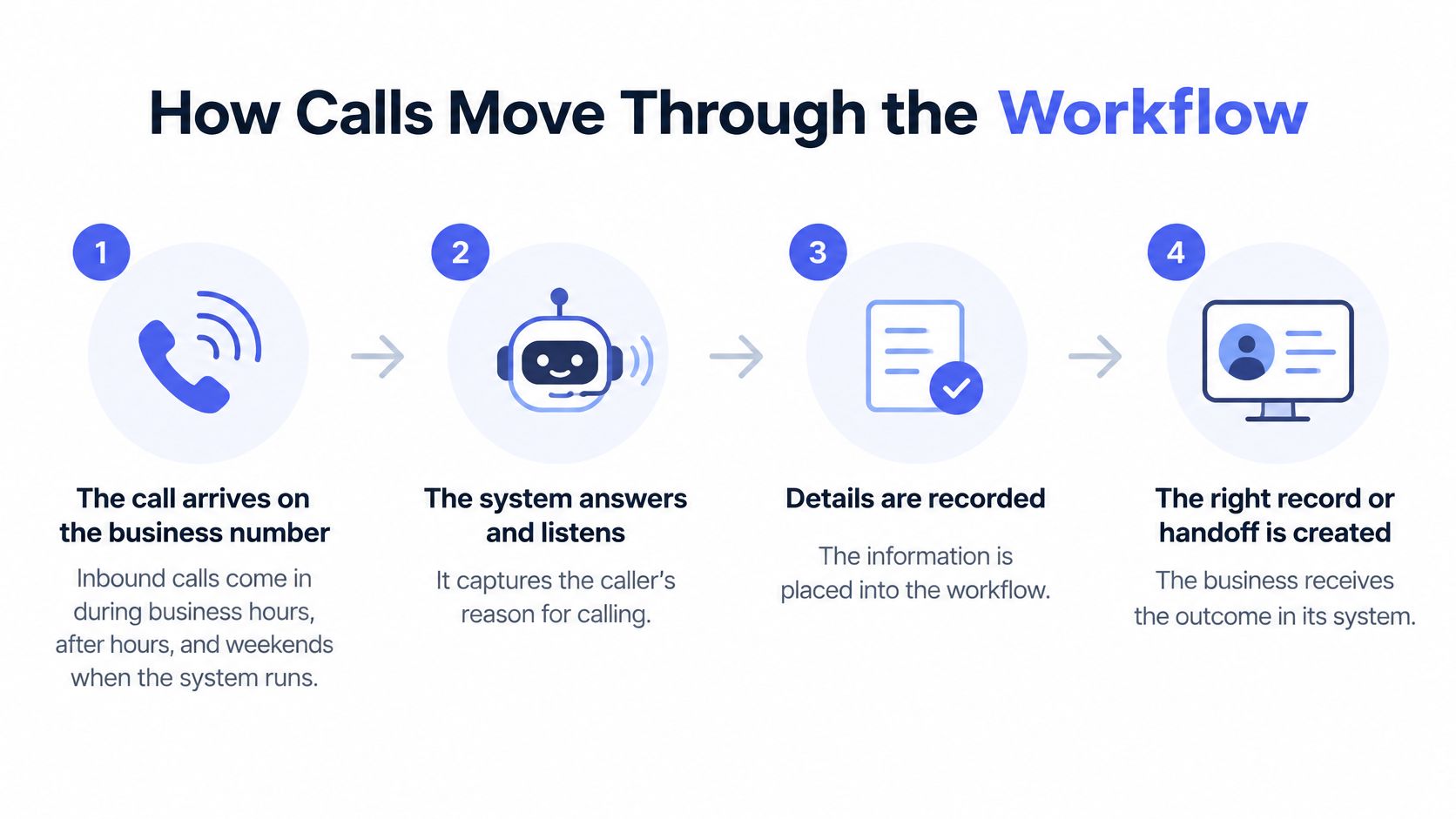
- The call arrives on the business number. We run systems 24/7, including overnight and weekends, so enquiry handling can continue outside business hours.
- The system identifies intent. Classify the request as a new quote, existing-client matter, urgent fault, appointment or payment question.
- It captures structured details. Ask questions relevant to that intent. A fault needs location and urgency; an appointment needs availability and the service requested.
- The CRM becomes the source of truth. Create or update one record with source, notes, owner, stage and next action. Check for an existing contact before creating a duplicate.
- High-intent inbound work reaches the right person. Route using ownership, service fit and urgency, with enough context for the recipient to act.
- Promotional or ambiguous follow-up waits. Put quote follow-up and payment calls into an approval queue rather than letting every captured number trigger a dial.
The visual below shows the path from incoming call to usable handoff.
Store the trigger, request source, timestamp, caller, purpose and escalation outcome. Those fields let staff explain why a callback was made instead of guessing from a short note.
Apply Outbound Controls Before Dialling
According to ACMA's telemarketing guidance, telemarketing calls are allowed only 9 am-8 pm Monday-Friday and 9 am-5 pm Saturday, not on Sundays or national public holidays; callers must identify themselves and their employer, explain the purpose, stop when asked and display a caller ID usable for further information. The same guidance says the Do Not Call Register excludes numbers used primarily for business, but personal numbers can qualify when personal use exceeds 50%, and after registration has been active for 30 days, telemarketers generally need consent or an exemption.
Don't apply telemarketing rules indiscriminately to all service communication, or assume a quote enquiry authorises any later promotion. Classify the actual purpose, retain consent or exemption status and check the applicable controls before release.
A request for no further contact should update a durable status and stop the relevant automation. Staff must be able to see that status before initiating their own follow-up.
Keep Recovery Separate from Promotion
A dropped or missed call may need a different recovery path from an answered enquiry. A missed-call text-back workflow can support that path, but the message should stay relevant to the caller's request.
Humans retain responsibility for exceptions, relationships and consequential decisions. The workflow should help them arrive prepared, not make those decisions invisible.
Privacy Rules for Recordings and Follow-Up
A recording isn't just a convenient quality-control file. The Office of the Australian Information Commissioner's personal-information guidance explains that a recorded voice may be personal information when the person is reasonably identifiable, including when it's contained in or linked to a customer file.
Treat the live audio, transcript, structured CRM fields and operational logs as separate assets. A receptionist may need the enquiry summary without needing access to every recording.
Control Storage and Access
Make these controls part of the implementation specification:
- Encryption: Protect information in transit and at rest.
- Tenant isolation: Keep each business's stored information separated.
- Role-based permissions: Give staff only the access their tasks require.
- Audit events: Record access and changes in logs that can't be overwritten.
- Retention settings: Define deletion rules for each asset, rather than keeping everything indefinitely.
- Redaction: Remove payment information and unnecessary sensitive details before transcripts reach the CRM.
Disclose recording or transcription where applicable Australian privacy and state or territory surveillance laws require it. Provide a route to a person, and don't reuse recordings for model training without an explicitly governed purpose.
For a small team, preconfigured approval gates, exception alerts and periodic access reviews are more practical than expecting everyone to administer a large platform. Nominate who handles access changes when staff join, change roles or leave.
Separate Service Delivery from Marketing
Under the OAIC's APP 7 direct-marketing guidelines, direct marketing generally requires an applicable exception; one pathway involves information collected from the individual, reasonably expected use, a simple opt-out and no previous opt-out. Where consent is relied on, the guidance requires it to be informed, voluntary, current and specific, with the person having capacity to understand and communicate it.
Giving a number for a repair callback doesn't mean the caller agreed to be added to unrelated promotions. Record why the number was supplied, and save any opt-out request as a lasting CRM status that automated follow-up cannot override.
A person should review unclear requests, sensitive information and any change from answering an enquiry to promoting extra services. Send access, correction or deletion requests through the business's privacy process, subject to applicable retention requirements.
For privacy questions about Truespeak, email sonny@truespeak.io. Submitting an enquiry doesn't itself create a client relationship.
Measures and Jobs That Fit Service Firms
Measure process performance, not an unverified faster-response percentage. Start the clock at the inbound call and stop it when there's one owned CRM record containing caller details, enquiry type, source, assigned owner and next action.
Use the same fields and timing rule before and after implementation. A transcript in an inbox, an unassigned callback or a note without a due date doesn't count as an actionable handoff.
Keep Evidence Behind Each Measure
Preserve the call event, intake data, CRM creation time, assignment time and follow-up status. The Australian Taxation Office's record-keeping guidance accepts electronic business records and says most business records generally need to be retained for five years. That isn't a blanket instruction to retain every call recording for the same period; set retention by record type and purpose.
KPIs for an AI phone answering service
| KPI | Definition | Source record |
|---|---|---|
| Time to owned record | Minutes from inbound call to one CRM record with owner and next action | Call event and CRM creation time |
| Share of calls with an owner | Calls assigned to a named person or queue within the agreed window, divided by all calls | Assignment time |
| Exception rate | Calls paused, transferred or escalated as a share of all calls | Operational logs |
| Recovered enquiries | Enquiries that would otherwise have stayed on voicemail and now carry a follow-up status | Follow-up status |
| Follow-up completion | Next actions completed by the due date | CRM stage and due date |
| Net return | Recovered enquiries times the firm's own win rate and average job value, minus running cost and staff exception cost | Firm's own figures; leave unverified inputs blank |
A CRM view should make the next action visible to the person responsible.
Match Automation to the Job
These are illustrative workflows, not customer incidents or claimed outcomes:
- After-hours and overflow: A builder, trade or installer captures an enquiry, assigns it and tracks follow-up instead of relying on someone remembering a voicemail.
- First response: Speed-to-lead automation qualifies, routes and books the next action while buyer intent is fresh.
- Preparation: Intake automation collects cleaner forms, documents, photos and briefs before the human call or administrative handoff.
- Quote follow-up: Lead follow-up automation supports timely, context-aware contact after enquiries, quotes, proposals and dormant opportunities.
- Pipeline housekeeping: CRM automation turns stale records into action queues and useful weekly visibility.
- Payment questions: An invoice call can lead to human-approved invoice reminders, while a person owns disputes and sensitive conversations.
For ROI, use recovered enquiries multiplied by your own win rate and average job value, then subtract service running costs and staff time spent on exceptions. Treat that as an estimate to test against actual outcomes, not guaranteed revenue or profit.
Count recovered enquiries conservatively, using a documented overflow or voicemail path as evidence. Don't label every answered call recovered, and don't assign a financial value to inputs the business hasn't verified.
Start with One Operating Gap
Pick the first gap that's already dropping work: slow first response, missed after-hours calls, quotes without follow-up, messy intake, a stale CRM or invoice chasing. Don't begin by replacing the phone system or committing to a receptionist project your business can't yet support.
Bring that messy handoff to our 15-minute discovery call. We review the business beforehand and come prepared with at least one specific gap and what it costs in operational terms, with no pitch deck and no obligation.
Make the Handoff Concrete
The call maps what should be captured, drafted, approved and logged. Use it to establish:
- Ownership: Who receives each enquiry and handles exceptions.
- Evidence: Which CRM fields prove there's a next action.
- Human judgement: Which messages and decisions still need a person.
If the gap extends beyond calls, business process automation can connect intake, follow-up, CRM, invoices and reporting. The managed path means ongoing operation rather than another system for your team to administer.
People keep judgement and the conversation that matters. An enquiry doesn't create a client relationship.
Measure the current handoff for two weeks, then automate only the capture, routing and follow-up that your baseline shows are being missed.
Truespeak builds and runs managed AI operations around enquiry handling, CRM updates and follow-up, with human approval for sensitive steps. Visit Truespeak to bring one messy phone handoff to a discovery call and map what should be captured, assigned, approved and logged.