
Australia's national eInvoicing network took approximately four years to carry its first million invoices. It carried the sixth million in less than four months, according to the Australian Taxation Office's eInvoicing reporting. That acceleration says more about where structured invoicing now sits than any single milestone. It has stopped being a trial run for technology-forward firms and become the channel government buyers and large suppliers already use.
For the owner of a building company, an electrical contractor or a ten-person professional practice, the useful questions are narrower than the policy. What does your accounting package need to do? Which dates bind you? Where do structured invoices fail? And why doesn't a faster network automatically mean faster cash? Those questions get answered in that order below. Connecting is the easy half. The other half is process.
Table of Contents
- What eInvoicing Looks Like in Australia Now
- A PDF Invoice Compared with a Peppol eInvoice
- How a Peppol Invoice Travels Between Systems
- Government Dates and When the Payment Clock Starts
- Faster Payment Is Possible but Not Guaranteed
- How to Adopt eInvoicing in the Process You Have
- Chase Only Invoices That Are Ready to Pay
What eInvoicing Looks Like in Australia Now
More Australian businesses can now exchange invoices through Peppol, the network that carries structured invoice data between business systems. The Australian Taxation Office oversees the national framework as the Australian Peppol Authority. An eInvoice is not a tax invoice sent electronically. It is structured data delivered so the receiving system can process it without someone opening a document and retyping its contents.
A PDF attached to an email can show the correct ABN and GST details, yet still require manual handling. A scanned paper bill has the same limitation. The distinction is like the difference between sending someone a letter and submitting information in a form their system can read: electronic delivery alone does not remove the work.
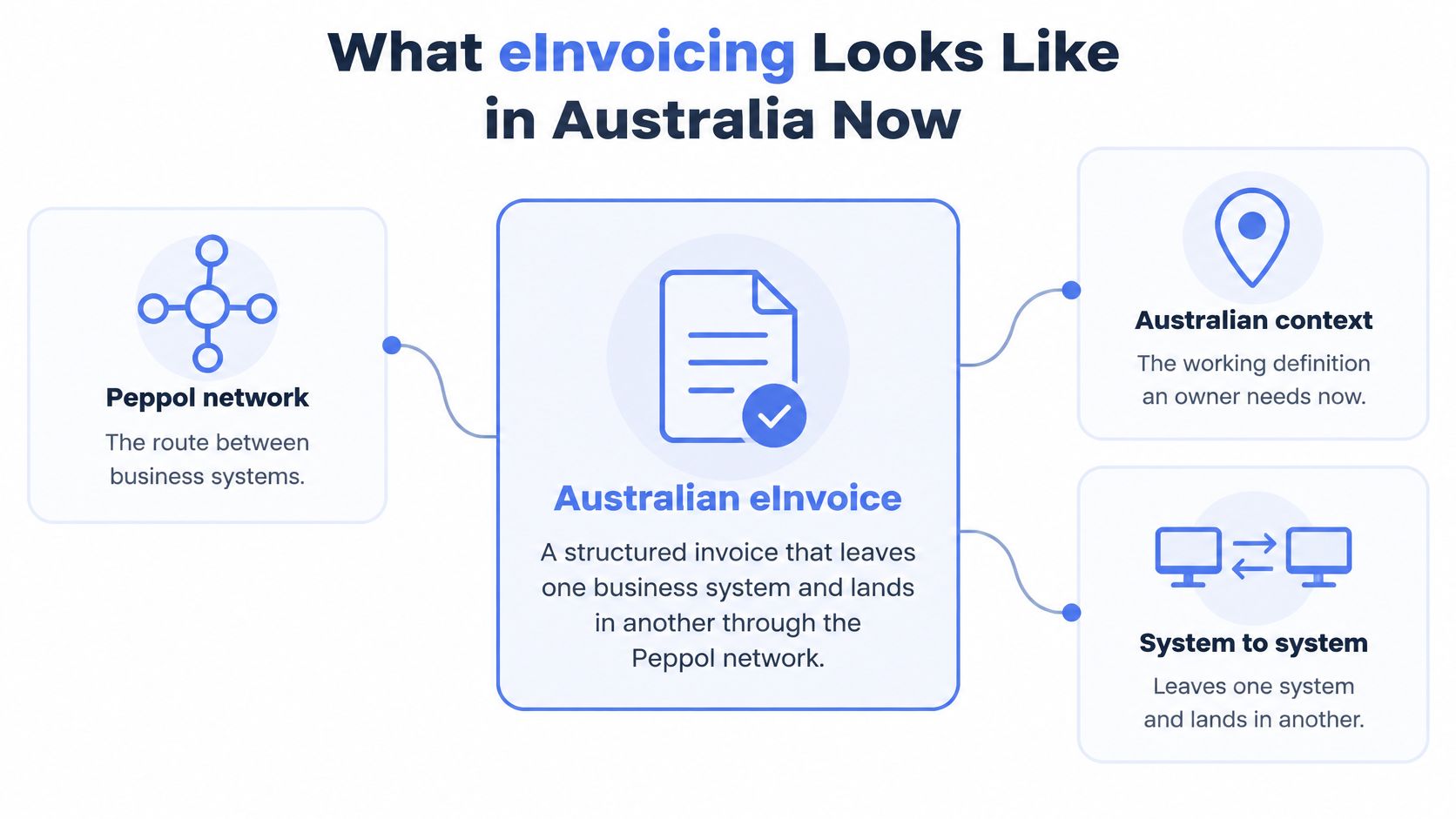
The network is now in regular use, and adoption has grown beyond a small group of early participants. Australian businesses exchange invoices through it, while many others still use processes that depend on email, paper or manual entry. That means a business may encounter Peppol through a customer or supplier before deciding whether to adopt it across its own workflows.
The operational case is about handling, not just delivery. Structured invoice data can reduce re-keying and make information easier for systems to process. But connecting to Peppol does not make accounts receivable touchless. The customer's supplier details must be accurate, the invoice may still need approval, and a mismatch or dispute can delay payment. The network carries the invoice; it cannot resolve a wrong purchase order or decide whether the work was accepted.
For a service business, the practical question is therefore not whether its accounting software can send an eInvoice. It is whether the information is correct before sending and whether someone will notice and handle a rejection, approval delay or dispute. A clean electronic route helps, but cash arrives sooner only when the processes around that route are ready too.
eInvoicing in practice
| Measure | What it means for a business |
|---|---|
| Network adoption | More businesses can exchange structured invoices through Peppol |
| Invoice handling | Structured data can reduce manual entry and checking |
| Supplier details | Incorrect or incomplete records can still cause processing problems |
| Approvals and disputes | These remain part of the payment process, even when delivery is electronic |
| Payment timing | A faster route for an invoice does not guarantee faster payment |
The key distinction is between sending an invoice and getting it paid. Peppol supports the first by delivering structured information between systems. Accurate records, timely approvals and resolved disputes still shape the second.
A PDF Invoice Compared with a Peppol eInvoice
Most poor eInvoicing setups begin with the same mix-up. Somebody assumes that emailing a tidy, well-formatted PDF already counts as eInvoicing, buys nothing, and is then surprised when a government buyer asks for a structured invoice their system can ingest. Treat the PDF as a letter and the eInvoice as a form that files itself. One needs a reader. The other needs a validator.
| Question | PDF by email | Peppol eInvoice |
|---|---|---|
| What is sent | A document a person reads | Structured data the receiving system can post |
| How the other party is found | An email address on the contact record | A Peppol participant identifier |
| Typical re-keying | Buyer staff retype lines, GST and totals | No re-keying when the message validates |
| Fields checked before send | Whatever the sender notices | ABN, invoice ID, dates, lines, GST, terms and totals |
| If details do not match | A reply email or a dispute later | Rejection or misrouting that needs an owner |
| Private-sector duty to send | None from this network | Generally none as a national mandate |
| Government buyer readiness | Can still accept other invoices | Non-corporate Commonwealth entities must be able to receive |
| Attachments and credit notes | Easy to staple on, easy to lose | Need an agreed place in the structured message and a fallback |
The routing row catches more businesses than any other. A Peppol participant identifier is not the email address sitting on your customer's contact card, and it isn't necessarily the ABN either. Someone at your business has to own that identifier, know which entity it publishes and know who can change it. Reviews of the Australian framework point out that the obligations are asymmetric, which is why the confusion persists: non-corporate Commonwealth entities must be able to receive Peppol invoices, while private-sector suppliers generally carry no national obligation to send them.
That asymmetry has a practical consequence. You may be pushed into structured sending by a government client long before any private customer asks for it, so your first implementation should be narrow and well understood rather than a company-wide conversion.
The real shift: connecting to Peppol moves the work from typing to checking. Poor supplier master data, vague approval rules and unresolved disputes don't vanish. They queue somewhere else, and someone still has to clear the queue.
Credit notes, timesheets and supporting documents belong in that conversation before go-live, not after the first rejection. PINT A-NZ allows supporting files, but an attachment never replaces the structured data, and a buyer who isn't on the network still needs a PDF path you've tested. If you're unsure whether your current invoice even carries the right fields, our guide to invoice requirements in Australia covers ABN, GST and payment terms, which are the same fields a validator checks.
How a Peppol Invoice Travels Between Systems
A builder sends a progress claim for a completed government fit-out through four connected corners. The builder's accounting or job system creates the invoice against the contract. The builder's accredited access point packages and transmits its structured data to the buyer's access point, which receives it for the agency. The buyer's finance system then receives the invoice for matching against a purchase order. The message travels through the network rather than by email.
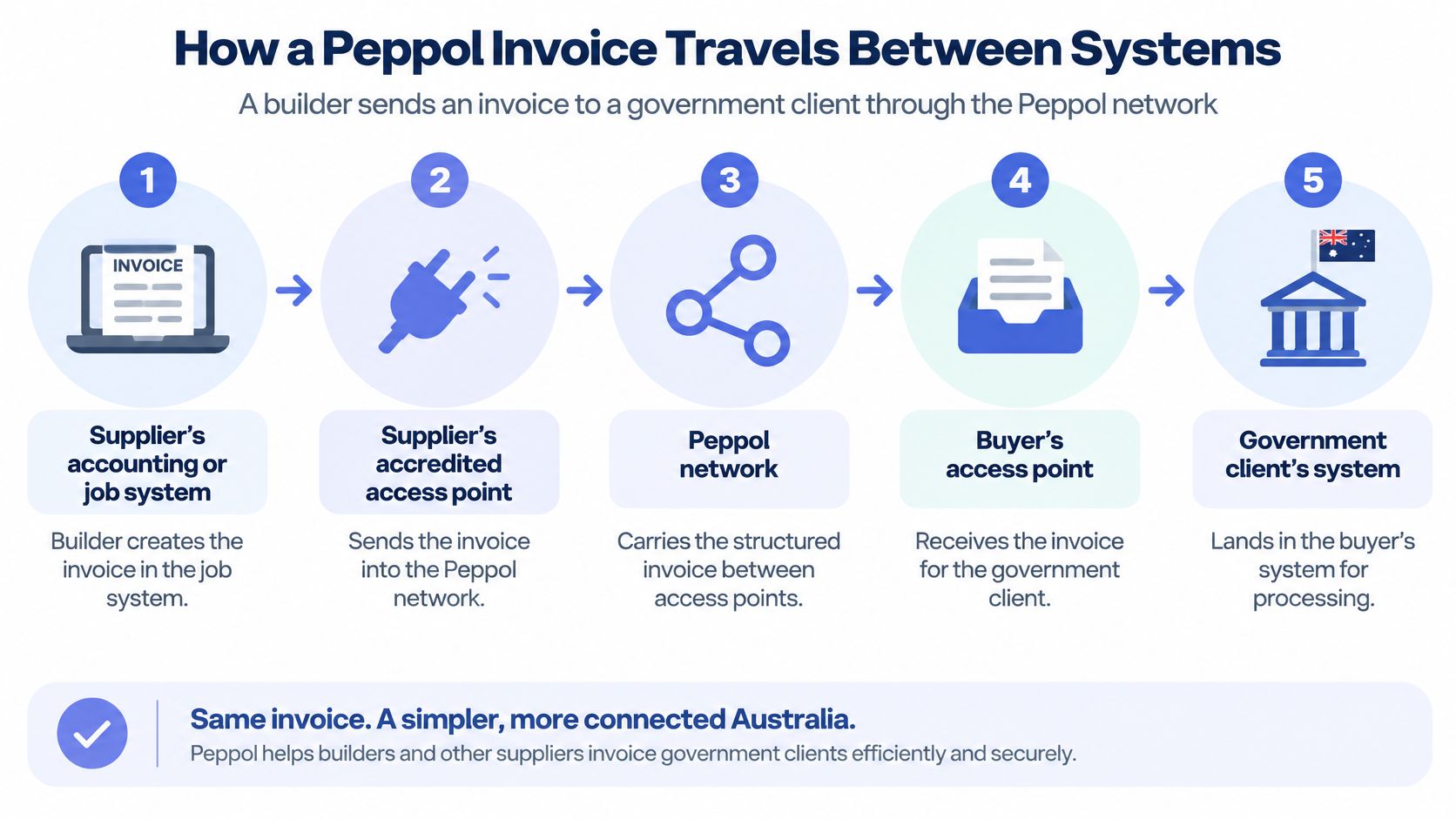
The ATO defines national requirements inside that four-corner framework, including GST and tax-invoice compliance. In practice, the systems exchange structured invoice data, rather than a PDF or email attachment. Before sending, check that the data is complete and consistent:
- ABNs and participant identifiers: confirm both sides' details match the entity receiving the message.
- Invoice identifiers and dates: use a unique invoice number, issue date and due date that agree with your ledger.
- Line items and totals: check descriptions, quantities, unit prices and the resulting arithmetic.
- GST treatment: apply the correct code and amount to each line, not only a total.
- Payment terms: confirm the terms that the buyer's system will use to schedule payment.
Participant-ID ownership can disrupt a rollout even when the software works. Confirm which identifier is published for your business, which entity it points to, and who can change it at your access point or software provider. A former trading name, a restructured partnership or a second ABN can leave the wrong identifier active, sending an invoice away from its intended destination.
The specification also changes over time. Australia and New Zealand share eInvoice specifications that are updated twice a year, so mapping needs periodic review. Australia's profile has moved from the earlier A-NZ Peppol BIS Billing specification to PINT A-NZ Billing. Check the current ATO specification dates, then review your mappings and run a regression test through your access point when requirements change.
If a visual walkthrough helps, this short video follows the same process.
Structured delivery removes re-keying, but it does not make accounts receivable touchless. Master data, approvals and disputes still affect whether an invoice is accepted and paid sooner. Set a clear process for failures: accepted invoices should post into the finance system, while rejected ones need a holding place, a reason and a named reviewer. Keep credit notes, supporting attachments and a PDF fallback for buyers outside the network in the same process, so the team knows how to handle each document when it arises.
Government Dates and When the Payment Clock Starts
Since July 2022, non-corporate Commonwealth entities have been required to be capable of receiving Peppol eInvoices, according to the ATO's guidance on government payment and eInvoicing. This is a requirement for government entities, not a general mandate for private businesses to send eInvoices. Suppliers may still be asked to provide one when working with a government buyer.
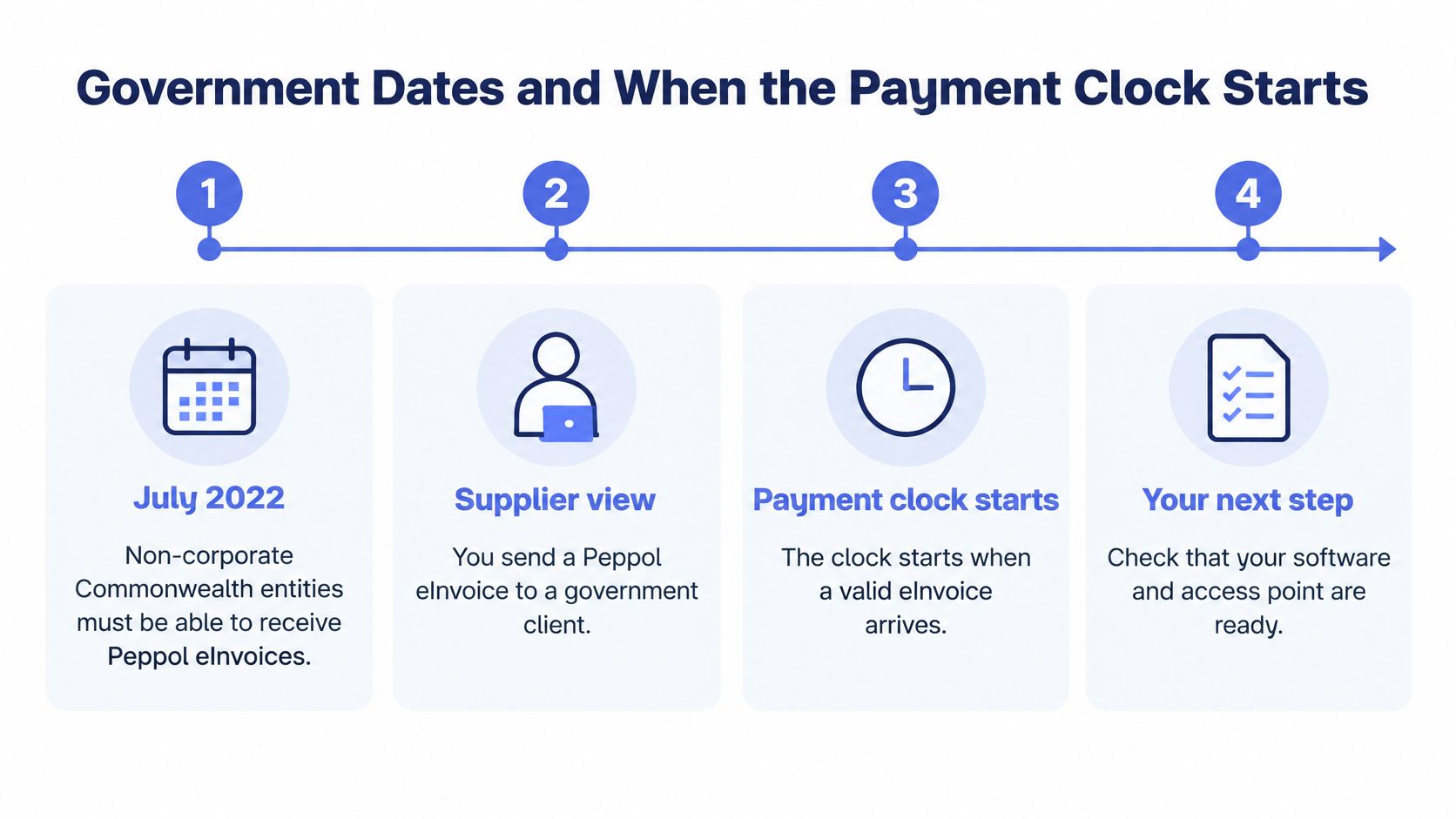
For suppliers, the key question is when the buyer's payment clock starts. Sending an invoice, or having it arrive in the buyer's system, is not enough. The goods or services must have been satisfactorily delivered, and the buyer must have received a correctly rendered invoice. Under the Supplier Pay on-Time or Pay Interest Policy, eligible invoices may have different payment terms depending on the circumstances.
The practical rule: a short payment term depends on satisfactory delivery and a correctly rendered invoice reaching the buyer through the required channel.
Government eInvoicing and payment timing
| Rule | Who it binds | Timing or condition |
|---|---|---|
| Able to receive Peppol eInvoices | Non-corporate Commonwealth entities | Required since July 2022 |
| Share of invoices received as eInvoices | Non-corporate Commonwealth entities working with suppliers | 30 per cent by 1 July 2026 |
| Automated processing and sending | Non-corporate Commonwealth entities | By December 2026 |
| Payment term for eligible eInvoices | Government buyers under the pay-on-time policy | Depends on the applicable policy conditions |
| When the payment clock starts | Supplier and buyer together | After satisfactory delivery and receipt of a correctly rendered invoice |
The government's published policy guidance sets agency targets for receiving eInvoices: non-corporate Commonwealth entities are to work with suppliers toward receiving 30 per cent of invoices by 1 July 2026, and to enable automated processing and sending by December 2026. These targets apply to agencies, not suppliers. They can still shape what government buyers expect from your invoicing process.
Peppol structures delivery between systems, reducing the need to re-key invoice details. It does not make accounts receivable touchless: the buyer still needs accurate supplier and invoice data, completed approvals, and any delivery or scope issues resolved. A message reaching the right system is only one step toward payment.
For a service business, prepare the evidence of completion, confirm the purchase order or contract reference, render the invoice correctly, and send it through the buyer's required channel. If any of these steps is incomplete, the payment clock may not start. Private-customer payment terms remain governed by the agreement between you and the customer; sending an invoice through Peppol does not change an agreed payment term.
Faster Payment Is Possible but Not Guaranteed
An eInvoice can remove manual re-keying between systems, but it cannot approve work or resolve a dispute. For eligible government invoices, it may qualify for a shorter payment term. Whether payment arrives sooner still depends on the buyer's process and the quality of the information submitted.
Published 2025-26 results show that outcomes vary between agencies. The Department of Education's small business payment reporting records 71.08 per cent of eligible eInvoices paid within five days by number and 65.11 per cent by value. The figures illustrate that a shared policy does not produce identical payment outcomes.
Structured delivery shortens the distance between systems. It doesn't approve the work, confirm the purchase order or settle a scope dispute.
Before sending, check the details that can hold up approval:
- The purchase order or contract reference matches the buyer's requirements, including any agreed variation.
- The work has been accepted, and completion evidence is stored where the accounts team can find it.
- Supplier master data is current, so outdated bank details or a trading name do not delay payment.
- The identifier routes to the right entity, particularly when you invoice from more than one ABN.
- GST and totals reconcile with your ledger. A corrected invoice may reset the payment clock.
Track three separate states. Acknowledgement means the message arrived; approval means it passed the buyer's internal process; payment means the money has left. Treating all three as “sent” is like tracking a parcel by its label alone: you know it was prepared, not that it reached its destination.
Step in if an invoice is rejected, acknowledgement does not arrive, the buyer queries the scope, or the due date passes after approval. A reminder workflow should follow up on a valid, accepted invoice and escalate exceptions for a person to resolve. For recurring charges, setting up online rent payments offers a useful comparison: settle the payment method before follow-up is needed. For private work, use the terms in the contract, rather than applying a government rule that does not govern the agreement.
How to Adopt eInvoicing in the Process You Have
Adoption works best as a series of small, reversible moves around the tools you already run. The sequence below assumes an existing accounting package and job records, not a platform replacement.
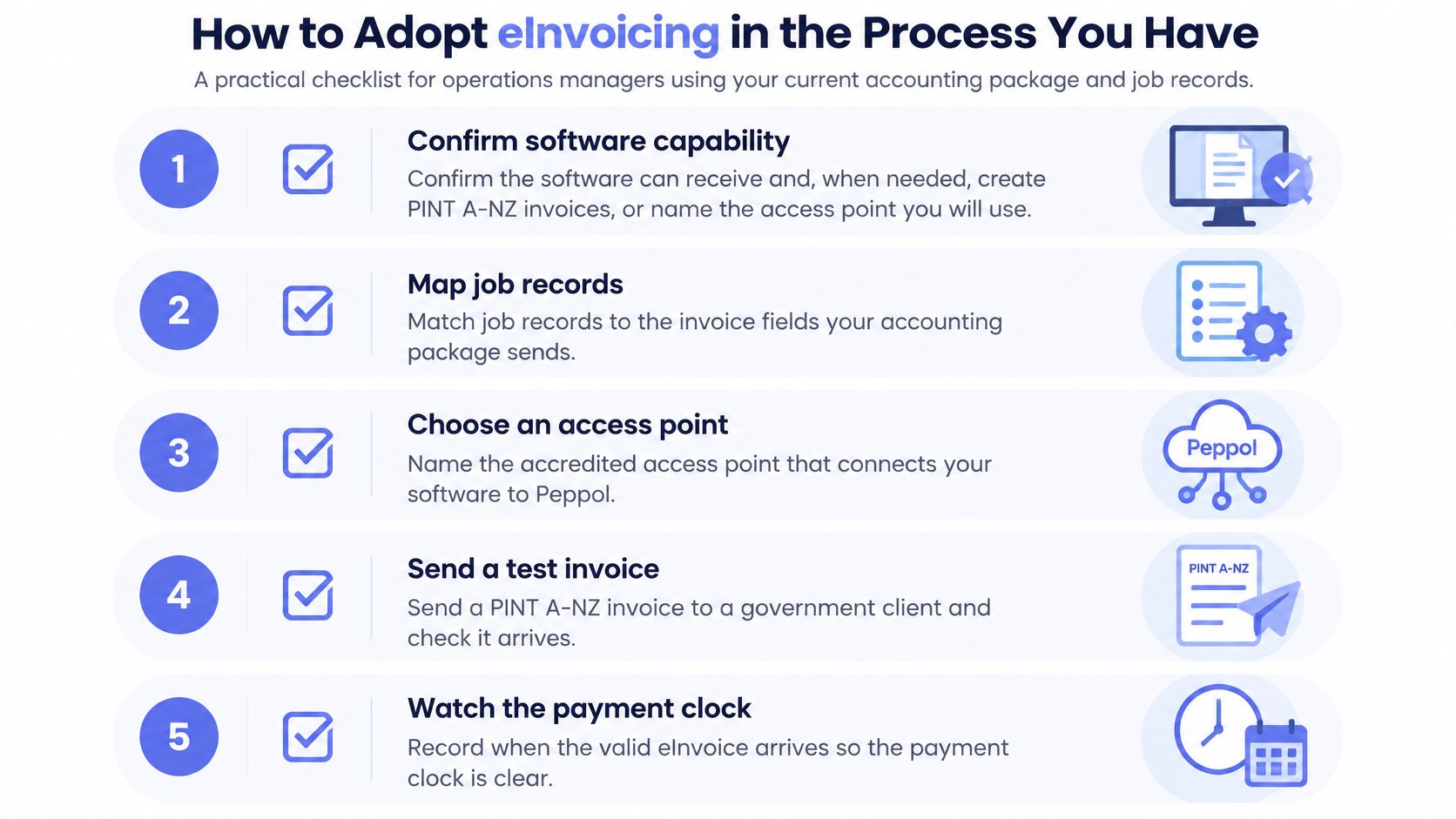
- Confirm software capability. Check whether your package can receive, and where needed create, PINT A-NZ invoices, or name the accredited access point that will do it. There are 53 accredited Australian Peppol service providers on the network, per the ATO's eInvoicing statistics, so the choice is real. Replacing a working ledger is not the first move.
- Register the business and record who owns the participant identifier. Write the owner's name in the runbook, not just in someone's memory.
- Turn inbound receipt on first. Plenty of counterparties can already send, and government demand is receive-led. Receiving costs you nothing in customer behaviour change.
- Map one invoice type end to end. A progress claim or a professional-fee invoice, with ABN, GST, job or purchase-order reference and totals. One clean type beats five half-configured ones.
- Reconcile every inbound eInvoice to something you trust. Match against the purchase order or approved work record, check ABN and GST consistency, and detect duplicates using a supplier-plus-invoice-number key.
- Give exceptions a named owner and a same-day review. Ambiguous cases go to an approval queue with a person attached, or the queue becomes the new filing cabinet.
- Send outbound only to registered buyers. A gardener invoicing a council sends structured from day one because the council is connected. A law firm invoicing a private client keeps the PDF path until that client is on the network.
- Decide credit notes and attachments before go-live. Both are message types your team will meet early, and retrofitting a policy mid-dispute is expensive.
- Review specification changes twice a year. Shared Australia and New Zealand specifications update on that rhythm, so a regression test belongs in the calendar.
The measurement that matters isn't how many invoices you sent through the network. Track straight-through-processing rate, exception rate, time from receipt to approval and overdue days. If exceptions climb while re-keying falls, the bottleneck moved rather than disappeared, and step six needs attention.
If the receiving half of your business is the messier one, what accounts payable automation actually changes walks through matching, approval and exception handling before connectivity is layered on top. Choosing the package itself is a separate decision, and our comparison of the best invoicing software in Australia covers which tools create PINT A-NZ invoices natively.
Chase Only Invoices That Are Ready to Pay
Start with what your books already show. If invoices still leave as PDFs and nothing structured arrives, your next step is receive-ready software and clean master data, not a new chasing habit. If structured invoices already post into your system, build an exception path and send follow-up only after acknowledgement and approval.
The hand-off is simple enough to write down. Accounts confirms the invoice is complete, correctly addressed and accepted by the network. Operations confirms the work itself has been accepted by the client. Only then does a reminder leave the building.
Reminders sent on incomplete or disputed invoices teach customers to ignore your emails, and that habit is hard to reverse. Reducing invoice discrepancies before payment belongs to the same discipline: fix the mismatch, then chase the balance.
A reminder is a nudge on an obligation both sides already accept. Sending one earlier than that turns a payment problem into a relationship problem.
Truespeak's Invoice Reminder Automation drafts polite, human-approved payment follow-up so staff aren't left with awkward manual chasing. It sits after a valid eInvoice, it doesn't replace Peppol, and it makes no promise that connectivity alone clears overdue invoices. You can read how it works on the invoice reminder automation service page. For the wider receivables picture, including how to age and prioritise what's outstanding, our guide to debtor management covers the decisions that come before any sequence is written.
Keep a person on rejections, scope disputes and anything that goes to a customer's inbox in your name. Then review straight-through rate, exception rate and overdue days after 30 days, and expand structured sending only where those numbers improved.
If the structured invoice side of your business is starting to work and the follow-up side still runs on memory and awkward phone calls, Truespeak builds and manages that layer around the accounting tools you already use. Invoice reminder automation drafts the follow-up, holds it for human approval and logs what happened, so chasing stops depending on who has time. Visit Truespeak to talk through where your invoicing process leaks time.