
The job finished three weeks ago. The invoice went out on 30-day terms, the client confirmed it arrived, and now a supplier's bill falls due before the money lands. You open the aged receivables report and get one number that tells you almost nothing, plus a list of names you'd have to ring one by one to work out which ones are a problem.
Chasing is the visible part of that problem, and usually the smaller part. What decides whether cash arrives on time was settled earlier, at quoting: the terms, the deposit, the signed variation, the purchase order number, and knowing who at the customer approves the bill.
Debtor management for an Australian service business is a risk-control process. The reminder sequence is its shortest, most repetitive tail, and it only works when the front end has done its job.
Table of Contents
- Writing a Debtor Policy Your Team Will Follow
- What Debtor Management Covers and Why It Matters
- Ageing Buckets and the Action for Each
- How to Run a Polite Reminder Sequence
- Sorting Disputes, Admin Blockers and Non-Payment
- Metrics That Show Whether Overdue Invoices Are Falling
- Where Automation Fits and Where People Must Decide
- Start With Your Ageing Report This Week
Writing a Debtor Policy Your Team Will Follow
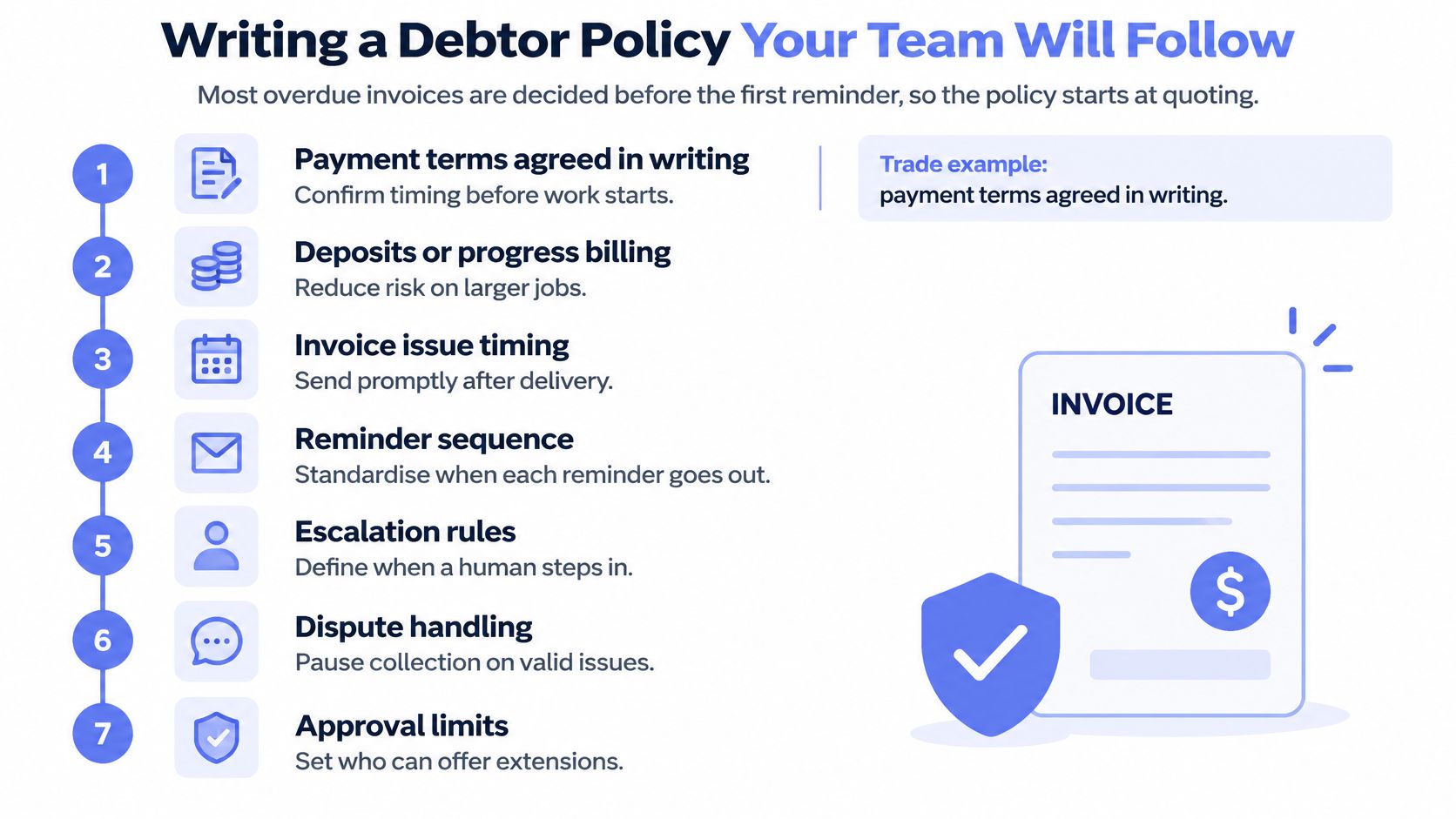
Most overdue invoices are decided before the first reminder is sent. A client who never agreed to a deposit won't pay one later because a message asks nicely, and an unsigned variation becomes an argument about money three months after the work is complete. The policy therefore starts at quoting, not at collections.
A workable policy fits on one page and answers a handful of questions in advance, while nobody is annoyed. This is the shape I'd build first.
The Rules to Write Down Now
- Terms in writing before work starts. State the due date, the payment method and what happens when an invoice runs past it. ASIC's small business director guidance is direct on this: set payment terms before work starts, issue invoices promptly, follow up overdue invoices early, keep written records of communications, and raise concerns before a dispute escalates.
- Deposits or progress billing wherever materials are bought. An installer who orders fittings against a verbal yes has lent the customer money at the point of highest risk in the whole job.
- Milestone billing for builders. Progress claims tied to named stages, with signed variations before extra work begins. Trade example: payment terms agreed in writing on the quote, with the deposit, the claim stages and the variation rule all visible before anyone picks up a tool.
- Retainer replenishment for professional firms. When the balance drops below the agreed floor, work pauses until it's topped up. Say so at the start of the engagement, not the first time it happens.
- A credit limit per customer. Set the maximum exposure you could absorb without a crisis, record it against the client, and hold it even when the pipeline is thin.
Stop-Work Triggers and Named Owners
Three triggers cover most situations: an account passing 30 days overdue with no agreed plan, an unsigned variation on an active job, and a progress claim the customer has stopped responding to. Each trigger needs a person attached to it, not a team. One person approves payment plans, one authorises work to continue, one decides when a debt moves to formal recovery. Money, the customer relationship and compliance all wait for that person's decision, which is the same gate that should sit in front of any sensitive action.
Then comes the record. Every invoice needs its due date, its reminder history, the customer's response, its dispute status and the agreed next action. Without those five fields you have a document rather than a process.
Practical rule: if a new client asks for terms you haven't written down, the answer is the policy, not a judgement call at the counter.
The one-page version, for the desk drawer: terms agreed in writing, deposit or milestone schedule, credit limit per customer, stop-work triggers with owners, reminder day counts, dispute route, and the fields captured on every invoice.
What Debtor Management Covers and Why It Matters
Say a small consulting firm finishes a large project, invoices on 30-day terms and books the cash for week four. The work was done at full cost in week one. The cash lands in week seven. In between, a subcontractor and a software renewal both want paying, and the firm funds the gap from its own buffer.
Debtor management is the whole cycle that decides how wide that gap gets: agreeing terms, issuing accurate invoices, tracking what's owed, reminding customers, resolving problems and escalating when the reminder has stopped working. Accounts receivable is the ledger that records it.
The reminder is the tap. The flow depends on the pipe, which is the terms, invoice accuracy and approval steps set before work starts. A business can send beautifully worded follow-ups all year and still wait 60 days if the purchase order number was missing from the invoice.
ASIC frames late invoice payment as a warning sign that a company may be in financial difficulty, alongside dishonoured payments, overdue taxes and unpaid superannuation. That reframes an overdue account as a signal to review, not just another reason to send a firmer email.
The stakes are measurable. Difficulty paying debts when they fell due appeared in 49.7% of external administrator reports in 2016-17, according to ASIC's corporate insolvency reporting, and in 54.3% of relevant observations in ASIC's 2020-21 insolvency statistics. ASIC also lists an increasing age of accounts payable among the indicators it tracks.
For the accounting side of the same ledger, managing receivables for small business owners is a useful companion on how receivables sit on the balance sheet, and the cash collection process walks the cycle from quote to bank.
The rest of the discipline sits in six parts: the ageing structure that shows where money is stuck, a written policy, a reminder routine, an exception path for disputes and genuine hardship, a small set of metrics, and a clear line between what a system sends and what a person decides.
Ageing Buckets and the Action for Each
One overdue total flattens urgency. A fortnight-old billing error and a four-month-old refusal to pay look identical in the summary line, which is why the summary line gets ignored.
Banding fixes that. Analysis published by the Australian Government's Office of Impact Analysis for the Payment Times Reporting Scheme reviewed approximately 10 million invoices from 76,817 firms and found that 36% of payments to small businesses took longer than 30 days. Payments that ran past 30 days averaged 63 days to settle, and about 13% exceeded 60 days. Those two figures are why 31 days and 60 days are the lines worth drawing in your own report.
| Band | Typical status | Standard action | Owner |
|---|---|---|---|
| Current (not yet due) | Within agreed terms | Confirm the invoice was received and send a pre-due reminder three days before the due date | Billing admin |
| 1-7 days overdue | Likely administrative | Check receipt, purchase order, entity name and accounts-payable contact, then resend the invoice | Billing admin |
| 8-30 days overdue | Routine late payment | Send a polite reminder and call to confirm a payment date | Billing admin with account owner |
| 31-60 days overdue | Escalating | Escalate to the account owner and record any promise to pay | Operations manager |
| Over 60 days overdue | Exception risk | Pause automated messages and route to credit review, dispute validation and a payment-plan or collections decision | Operations manager with finance lead |
How to Build the Report in Ten Minutes
Export open invoices from your accounts system with the customer, issue date and due date. Calculate days overdue as at one fixed reporting date each week, not as at the moment someone opens the file, so the numbers compare week to week. Add the owner column and sort by value inside each band.
The owner column needs a person's name beside the role. "Billing admin" is the function; "Billing admin, D." is the accountability. A band with a team against it has nobody against it. If you want a deeper treatment of how ageing ladders get read, aging insights from Jumpstart Partners covers the interpretation side.
The Check That Tells You Where the Problem Is
Look at where the value sits, not where the invoice count sits. If most overdue value is in the 31-60 day band, your pre-due reminder or your terms aren't working, and firmer language won't fix either. Fix the front end first.
How to Run a Polite Reminder Sequence
A sequence works when every message has one job and the timing has a reason. The eight steps below are the default for 30-day terms. Shift the day counts if your terms differ, but keep the order.
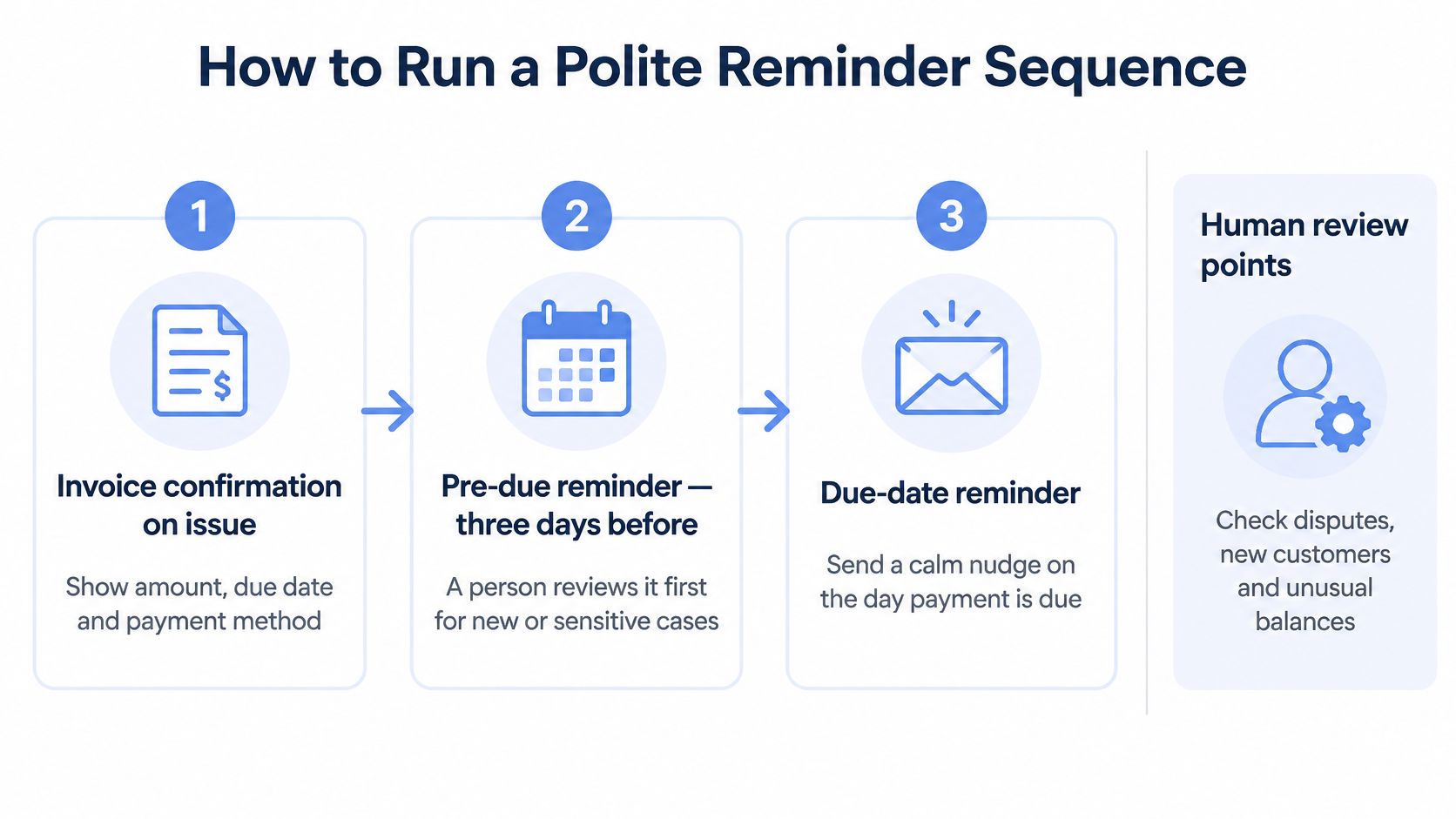
- On issue, send an invoice confirmation. Amount, due date, payment method, and the purchase order reference if the client's accounts team needs one. This single message prevents most "we never received it" delays.
- Three days before the due date, send a pre-due reminder. A person reviews it first for new or sensitive accounts, because the first message to a major client shouldn't be the one that gets the tone wrong.
- On the due date, send a short notice. What was due, when, and how to pay or raise a query. One call to action.
- At one day overdue, check for an administrative blocker. A rejected purchase order, a wrong entity name, an invoice sitting in the wrong accounts-payable inbox. Correct it, resend it, and don't count those days against the customer.
- At eight days, remind politely and pick up the phone. The call is what produces a payment date. Email alone rarely does.
- At fourteen days, put the earlier call in writing. Refer to the agreed date and restate what happens if it slips.
- At thirty-one days, escalate to the account owner with the full history and any known blocker attached.
- Beyond sixty days, stop the automated messages and move the account to the exception route.
The early steps exist because most first-time lateness is administrative. A rejected purchase order at day one becomes a 30-day delay if nobody checks. A named call creates a commitment that a template can't.
This walkthrough runs the same routine from invoice to escalation, and it's worth watching before you rewrite your own:
Message rules are short. Plain facts, no threats, no sarcasm, one clear call to action, and a named person to contact. If a message needs a second paragraph justifying why you'd like to be paid, it's doing the wrong job.
Finance teams running this inside an ERP rather than a small accounts package will find ERP-integrated collections for finance teams useful on mapping the same routine to system queues and worklists. And if you're drafting the messages from scratch, invoice reminder email templates beat a blank page, provided you strip out anything that sounds like a threat.
The split of labour is straightforward: pricing, advice, disputes, relationship-sensitive messages, commercial judgement and edge cases stay with a person, while the system carries the repetition around those decisions.
Sorting Disputes, Admin Blockers and Non-Payment
A late payer isn't the same thing as a blocked invoice. Treat the two identically and you spend goodwill chasing a customer whose accounts team is waiting on a corrected purchase order, while the account that genuinely can't pay gets the same polite nudge it has already learned to ignore.
| Cause | Typical signal | Route to | Reminder status |
|---|---|---|---|
| Administrative blocker | Rejected purchase order, wrong entity name or invoice in wrong accounts-payable inbox | Billing admin | Pause until corrected, then resend and restart the sequence |
| Genuine dispute | Customer questions scope, quality or a variation | Commercial owner | Stop automated chasing and log the dispute |
| Inability to pay | Missed promises, part payments or request for instalments | Finance lead | Continue human contact and agree a written plan |
| Acknowledged, uncontested debt | Customer confirms the amount but does not pay | Director | Escalate with final notice under the policy |
| Unknown cause | No response after repeated attempts | Account owner | Verify contact details before any escalation |
Read that as a routing rule, not a severity scale. The administrative blocker is often the fastest to clear and the least discussed, because it never looks like a credit problem from the outside. The dispute needs a deadline and a commercial owner who can answer the question about scope or quality. Inability to pay needs a written plan with dates, agreed by someone senior enough to honour it.
A question worth asking early: is this customer unable to pay, or unable to get our invoice through their accounts team? The answer changes everything that follows.
Before any escalation, the file should hold the signed quote, the variation approvals, proof of completion and every message sent. Without that evidence, escalation becomes an argument you can't win cheaply.
ASIC and the ACCC are clear in their debt collection guidance that collection communications must have a reasonable purpose and occur only to the extent necessary, and that complaints and disputes must not be ignored: creditors need effective internal processes for logging, assessing and acting on them in a timely way. A sequence that keeps firing automated demands at a disputed invoice fails that standard and damages the relationship at the same time.
When data is missing or the risk is high, the right behaviour is to pause with the context attached rather than push the message out and hope. And if a stalled goods or non-financial services dispute needs outside help, ASIC points to low-cost assistance through the Australian Small Business and Family Enterprise Ombudsman or a state or territory Small Business Commissioner, noting that a breach of contract is a civil matter for the parties, not a criminal one.
Metrics That Show Whether Overdue Invoices Are Falling
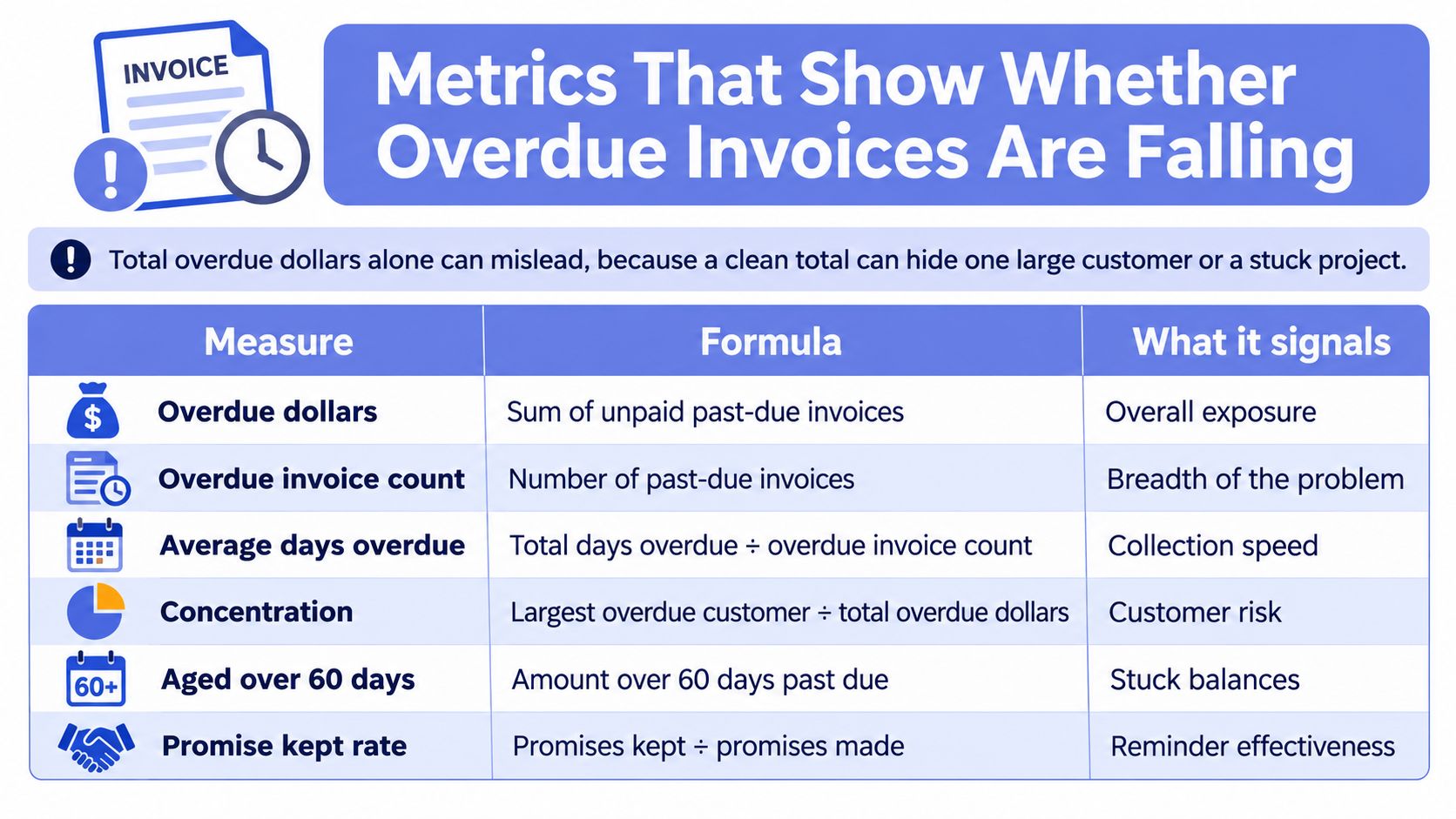
Total overdue dollars is the figure that flatters. A clean total can hide one customer holding a stalled project, or a single invoice that has been "almost resolved" for eleven weeks. Six measures tell you more than the total ever will.
| Metric | How to calculate | What it signals |
|---|---|---|
| Days sales outstanding (DSO) | Receivables divided by credit sales, multiplied by days in the period | Overall speed of cash collection |
| Percentage paid late | Late-paid invoices divided by invoices paid in the period | Payment discipline by customer or cohort |
| Average days late | Total days past due divided by the number of late invoices | Size of the delay, not only how often it happens |
| Overdue value concentration | Value owed by the five largest overdue customers divided by total overdue value | Exposure to a small number of accounts |
| Promise-to-pay kept rate | Promises kept divided by promises recorded | Reliability of verbal commitments |
| Disputed value | Total value of invoices flagged as disputed | Work stuck outside normal chasing |
Late payment and cash stress travel together. Xero's submission to the Australian Government reported that small businesses receiving 60-80% of their payments late experienced 17% more cash-flow crunches than businesses usually paid on time, while its March 2024 data put average waiting time at 22.6 days, with late payments averaging 6.5 days. That's the working-capital case for treating this as a finance control rather than an admin chore.
Set a Baseline Before You Change Anything
Take the last 90 days, calculate each measure by customer and by cohort (residential versus commercial, or project work versus retainer work), and review monthly. Without that baseline, any improvement is a feeling rather than a result.
Then read the shifts in pairs. Falling DSO alongside rising disputed value means chasing is faster but the work is stuck. A falling overdue count with flat DSO means small invoices are clearing while two large ones sit untouched.
Repeated late payment despite accurate invoices and completed work is a credit decision, not a messaging problem. Lower that customer's credit priority and apply it in the next engagement: a deposit, milestone billing or tighter terms on future work.
Your own trailing average sets the benchmark. Compare this month to your own last quarter rather than to an industry figure that was never calculated on your customer mix.
Where Automation Fits and Where People Must Decide
The rule is simple. Automation carries repetition. People carry judgement. Almost every failed reminder implementation I'd expect to see broke that rule in one direction or the other.

What suits a system: invoice issue confirmations, scheduled pre-due and due-date reminders, status updates written back to the CRM or accounts package, the weekly ageing report, and routing each account into the correct band. These are the touchpoints that get skipped when a person is busy, which is exactly when they matter.
What stays human: approving a payment plan, placing a credit hold, responding to a complaint, pricing or scope disputes, relationship-sensitive messages to long-standing clients, and the final escalation decision. None of those improve with speed.
Approval Gates and Stop Conditions
Three gates do most of the work. A person reviews the template set for new customers, the first reminder to a major account, and any message that mentions legal steps or recovery.
Stop conditions run the other way: a dispute flag, a recorded promise to pay, a bounced email address or any customer reply should pause the sequence and alert the owner. A promise with a date on it that still generates a chasing email costs you credibility you can't buy back.
The test for any touchpoint: if it involves money, a relationship, compliance, advice or uncertainty, a person approves it first. Everything else can run on a schedule.
Automation doesn't decide credit risk. Your team does, using the data the system keeps. If you're weighing up tooling, invoice reminder software covers what to look for in the pause logic before you look at anything else.
Start with Your Ageing Report This Week
Run the ageing report from your accounts system today, using the five bands, including the over-60 row. Then fix the handoff costing you the most time, revenue or trust first. Rebuilding the whole process at once is how these projects stall.
The order that works:
- Review the five largest overdue accounts and classify each by cause: administrative blocker, dispute, inability to pay, or unknown.
- Fix the next invoice. Confirm the pre-due reminder fires and the terms are stated before the work starts.
- Write the one-page policy from the checklist, with named owners against each band.
- Set a weekly review at a fixed time, with the same reporting date each week so the numbers compare.
Once the review shows where the admin time goes, consider automating only the repetitive touchpoints. If chasing is still eating the week, Truespeak's invoice reminder automation sends polite, human-approved follow-up built around the approval gates above, and a discovery call is where you'd bring one messy handoff and map what should be captured, drafted, approved and logged. Any system only works when the policy, the owners and the approval gates are clear.
Truespeak builds invoice reminder automation that checks payment status and previous reminders, drafts polite follow-up for your approval, and keeps overdue, disputed and promised invoices visible until a person resolves them. It's built for Australian service businesses that already have a CRM and an accounts package and don't want another dashboard to administer. Visit Truespeak and bring one messy handoff, whether that's the reminder sequence, the dispute route or the report nobody reads.