
You're probably staring at a inbox full of enquiries, a team that's flat out on the tools, and a CRM that only gets updated when someone remembers. That's where most Australian service businesses lose the sale, not in the pitch, but in the gap between the enquiry landing and anyone doing anything useful with it. A lead qualification funnel is not a marketing diagram. It's the operating system that decides who responds, what they ask, how fast they move, and whether the lead is worth a human's time.
Table of Contents
- Where a Lead Qualification Funnel Really Begins for an Australian Service Business
- Defining the Stages of a Lead Qualification Funnel
- The Three Qualification Lenses Every Stage Should Test
- Automation Touchpoints Across the Funnel
- Speed to Lead, Privacy and Human Oversight
- KPIs That Actually Tell You Where the Funnel Leaks
- Two Representative Australian Service Business Examples
- Putting Your Lead Qualification Funnel Into Practice
Where a Lead Qualification Funnel Really Begins for an Australian Service Business
It's 7.40pm. The office is shut, the crew is still on site, and a new enquiry lands from a homeowner asking for a quote by Friday. If nobody sees it until the next morning, that lead is cooling. If it sits until the end of the week, it is probably gone.
Qualification starts at that moment. The business decides whether to acknowledge the enquiry, capture the right context, and move it forward. A 2008 study found 59% of companies receiving online enquiries failed to answer within seven days, and 49% of businesses that sent an automated acknowledgement never followed up again, even while Australian businesses were putting more than A$1 billion into online advertising at the time (itnews).
First Response Is Part of Qualification
For builders, tradies, installers, and professional firms, first response is not customer service fluff. It is the first filter in the funnel. A lead that gets no timely answer may never give you the details needed to judge fit, route the job, quote properly, or book a consult.
Practical rule: if the enquiry has not been acknowledged, it has not really entered your pipeline.
The process has to be visible. A business should know who owns the enquiry, what the next action is, and how long it can sit before someone steps in. If the answer is “until someone gets around to it”, the funnel does not exist, only inbox luck does.
A useful reference point for how a simple lead-management system should handle this is a practical definition of lead management and its core states. The point is not more software. It is a clearer operating rule for what happens the second a lead arrives.
Defining the Stages of a Lead Qualification Funnel
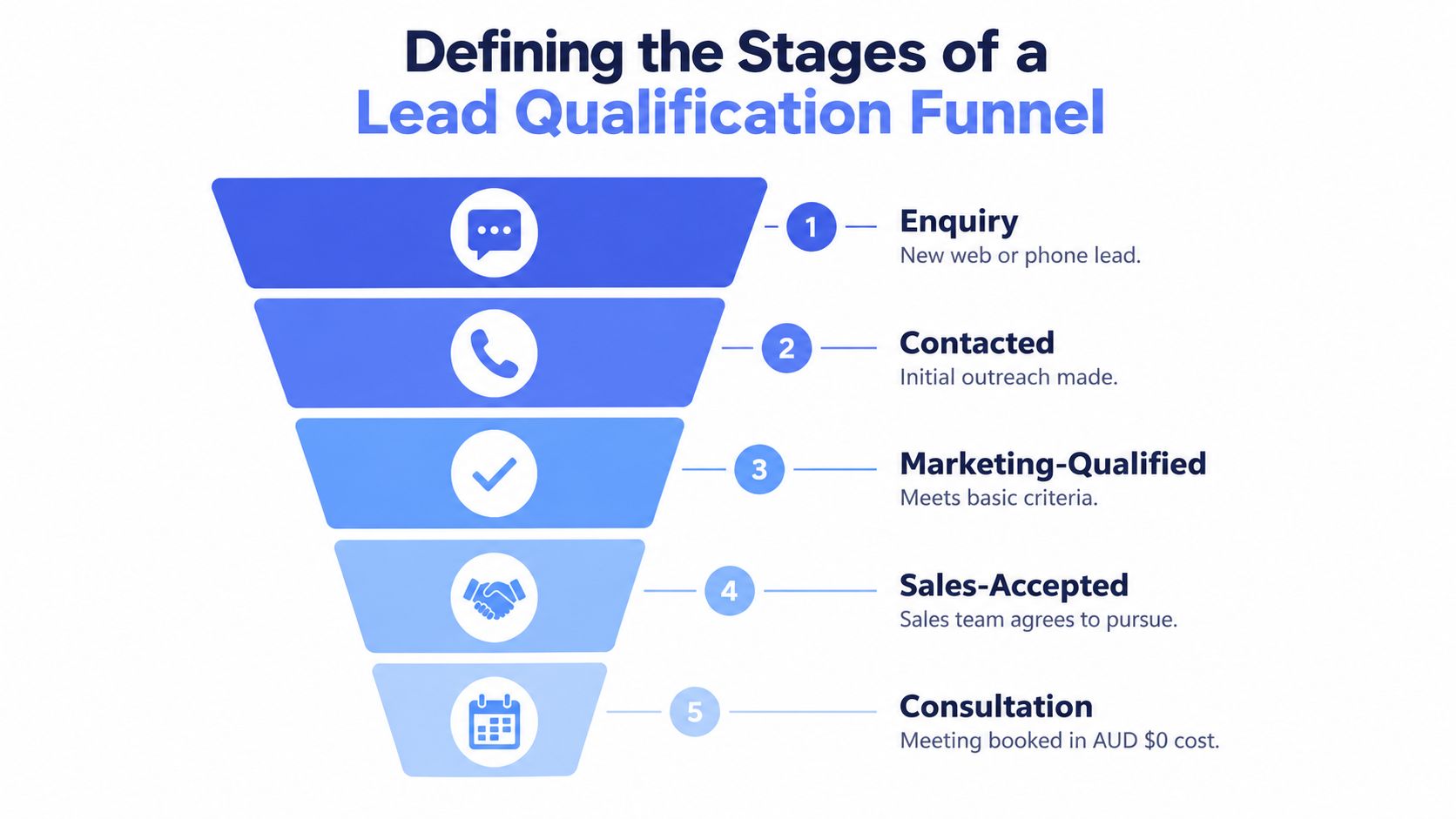
A working funnel starts with CRM states, not jargon. If your pipeline can't show who owns the lead, what happened last, and what must happen next, then it's not a funnel, it's a list. The cleanest setup for a small Australian service business is simple enough to explain at a whiteboard and strict enough to survive a busy week.
Use States That Match Real Work
A practical sequence is enquiry, contacted, marketing-qualified, sales-accepted, consultation booked, then the later outcomes of won, lost, disqualified, or nurtured. Each state needs an owner and a next action. Without both, the stage label becomes decoration.
A lead is contacted when a real outreach attempt has been made. It is marketing-qualified when it meets basic fit and intent criteria. It becomes sales-accepted when the person responsible for the deal agrees to work it. That handoff matters because it stops leads from being “everyone's problem” and therefore nobody's.
The distinction between lost and disqualified also matters. Lost means the lead was real, but the business didn't win it. Disqualified means it should never have progressed, because it was out of area, outside scope, too small, too big, or otherwise not serviceable. If you mix those outcomes together, your reporting becomes useless.
Keep Nurture from Becoming a Dumping Ground
“Nurture” should not mean slow, forgotten, or awkward. It should mean the lead still has potential, but not now. That requires a reason code and a review date, otherwise nurture turns into a graveyard of politely abandoned opportunities.
A strong example of why stage discipline matters is the way structured handoffs work in lead qualification tools that can qualify and route hot leads. Even if you don't use that exact stack, the principle is the same, the CRM has to show movement, ownership, and the reason a lead changed state.
The pipeline should reflect reality, not optimism.
The Three Qualification Lenses Every Stage Should Test
A good funnel doesn't just count leads, it tests them through three lenses, fit, intent, and urgency. If you skip one of those, you end up with either junk in the CRM or real jobs slipping through because nobody asked the right question early enough. The logic is straightforward, the business has to decide whether the lead is serviceable, serious, and ready enough to act on.
Fit Is About Whether You Should Take the Job
Fit covers the hard boundaries. Is the job in your service area, inside your minimum project value, and aligned with what you sell? For a builder, that might mean checking suburb, type of works, and whether the scope matches the crew you've got. For a professional firm, it might mean service type, complexity, and whether the client sits inside your ideal operating range.
Intent Is About Whether the Lead Is Paying Attention
Intent shows up in the source of the enquiry, how recently they engaged, and whether they've already taken the next step. A direct enquiry from a pricing page is different from a casual form fill from a social post. The CRM should capture that difference, because the follow-up sequence should be different too.
Urgency Tells You Whether to Move Now or Queue It
Urgency is the part too many teams mishandle. If the lead says they need a quote this week, that changes the workflow. If they're still gathering ideas for a later project, they belong in a different path. Decision authority sits here as well, because a fast response to the wrong contact still wastes time.
Useful test: if your intake form doesn't help you answer fit, intent, and urgency, it's too thin.
The business logic has to match the offer, not a generic script. The CRM should store those signals as fields or structured notes, then use them to route the lead without forcing staff to retype the same context later. That's how a pipeline starts predicting revenue instead of just recording enquiries.

Automation Touchpoints Across the Funnel
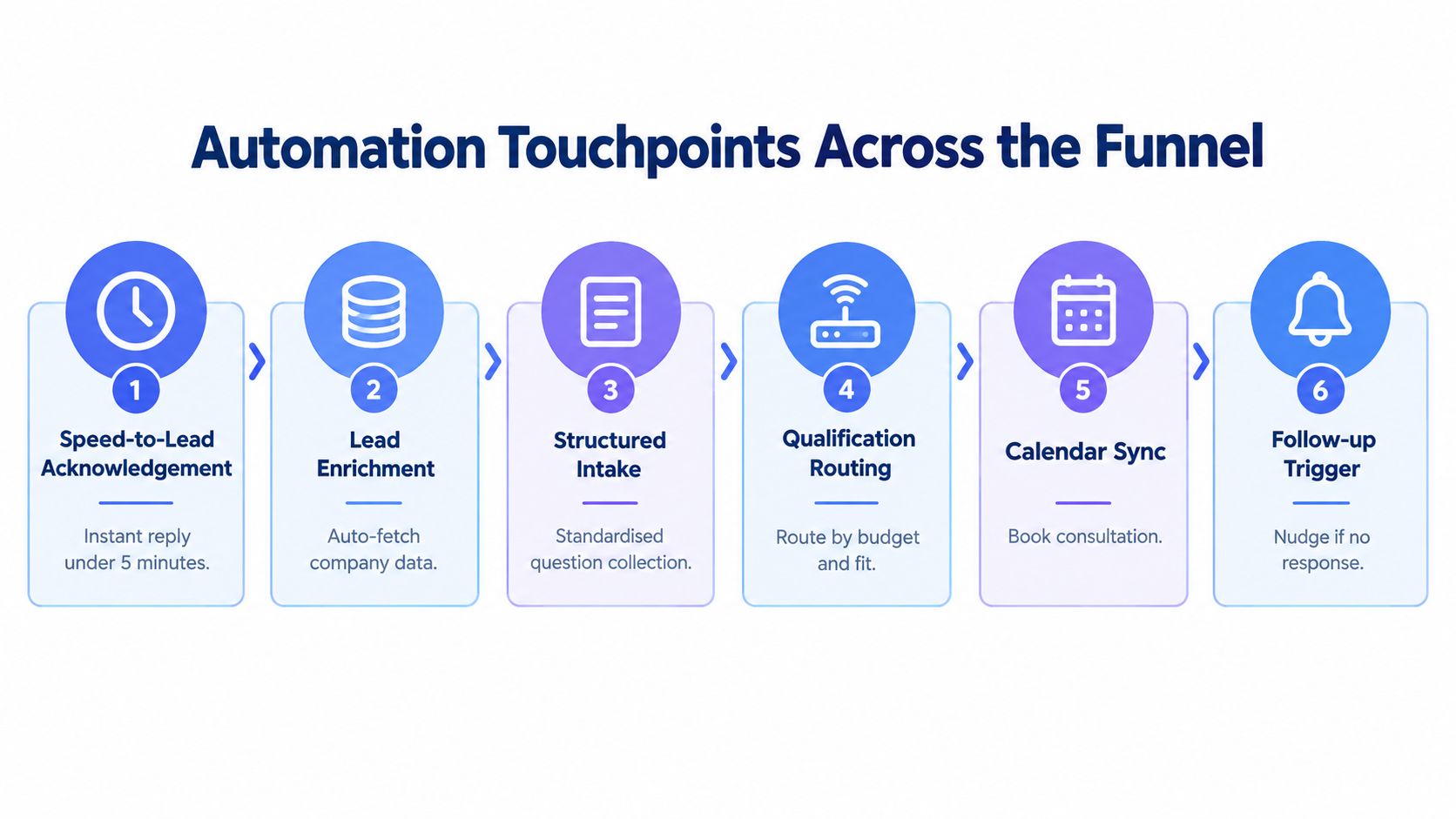
Automation should do the repetitive work around the funnel, not make judgment calls in the middle of it. The best setup is a sequence of small steps that each own one job. If one layer tries to do everything, it ends up doing nothing well.
Start with Acknowledgement, Then Enrich Only What'S Missing
The first touchpoint is speed-to-lead. It should confirm receipt, set expectations, and capture the missing basics, not interrogate the prospect like a form that escaped from a compliance department. If the lead already gave enough context, the response should be short and useful.
Next comes enrichment. Pull in what you can from the record, whether that's company info, source, or prior interactions, so the person who follows up isn't starting blind. Then move into structured intake, where the system collects only the questions needed to decide whether the lead is worth progress.
Route by Service Fit, Not by Who Shouts Loudest
Qualification routing is where many small businesses get sloppy. This step should send urgent, serviceable, well-matched leads to the right owner, while moving low-fit or incomplete leads into a different path. Booking comes after that, and it should sync a next step without making the customer repeat the same information.
For ongoing sequences, lead follow-up automation has one job, keep the conversation alive with context. That includes quotes, proposals, dormant opportunities, and callbacks that shouldn't disappear into someone's memory. It's also where teams can connect related layers like speed-to-lead automation, intake automation, CRM automation, and business process automation as one operating system instead of disconnected tools.
Automation should create ownership, not hide it.
A managed system can also be used here, including Truespeak, which builds and runs lead capture, routing, CRM hygiene, and follow-up workflows around existing tools. The value is in the operating discipline, not the software label.
Speed to Lead, Privacy and Human Oversight
A lead comes in at 7:40 pm. The office is shut, the owner is on a roof, and the enquiry sits untouched until morning. By then, the prospect has moved on or called someone else. Speed matters, but speed by itself does not save a broken intake process.
Australian industry reporting cites a 24 to 48 hour average response window among SMEs against a benchmark of under five minutes, and our analysis of lead response time benchmarks shows what closing that gap requires operationally. The same reporting says contacting a lead within five minutes can produce approximately 21 times higher qualification odds than waiting 30 minutes, as noted by 3P Digital. That is an operating problem, not a marketing slogan.
Fast Is Good, Blind Automation Is Not
The Office of the Australian Information Commissioner says the Privacy Act and Australian Privacy Principles apply when personal information is entered into an AI system or appears in its output, and recommends privacy-by-design practices such as impact assessments, transparent notices, and clearly identifying public-facing AI tools (OAIC). Your first reply should collect the minimum data needed to qualify the job and keep the conversation moving.
APP 7 also matters. If the workflow moves a lead into promotional follow-up, the business needs a valid direct-marketing basis, a simple opt-out, and suppression carried across every channel. The OAIC's direct marketing guidance is clear on calls, email, text, post, and targeted digital advertising.
Human review still has to sit in the loop.
Sensitive documents, images, financial details, and anything the system can misread need a person to check them. The same applies when the model is uncertain or the lead pushes back on the classification. That keeps automation from promising work you cannot service or exposing information you should not share.
For teams comparing how privacy controls work in other jurisdictions, handling customer data under GDPR is a useful contrast point. The Australian rules are different, but the operating lesson is the same. Use the smallest useful data set, keep consent and suppression clean, and make a human accountable for edge cases.
Bottom line: reply fast, qualify carefully, and escalate anything unclear.
A first response should never vanish. If it cannot answer properly, it should acknowledge, route, or hold the lead, not drop it without notice.
KPIs That Actually Tell You Where the Funnel Leaks
Most dashboards look busy and say almost nothing. If you want to know where the funnel is leaking, you need a small set of metrics tied to actual stage movement. Anything else is noise dressed as reporting.
Measure Movement, Not Just Volume
Start with first-response time, both median and 90th percentile, because outliers tell you where the follow-up process breaks. Then track contact rate, intake completeness, qualification rate by source, booking rate, consultation-to-client conversion, time in stage, and loss reason mix. Those are the numbers that show whether the process is moving, stalling, or discarding real opportunities.
The stage-to-stage view matters because Australian funnel benchmarks indicate roughly 10 to 25% lead-to-consultation conversion for professional services and about 30 to 60% consultation-to-client conversion (MarketingFunnels.au). Those are ranges, not targets, but they remind you that stage quality matters more than raw enquiry count.
Read the KPI Against the Operational Failure
| KPI | What it measures | What a bad result usually means | Indicative band |
|---|---|---|---|
| First-response time | How quickly the lead gets a useful reply | Slow intake, poor ownership, or broken routing | Under five minutes is the benchmark cited for speed-to-lead (3P Digital) |
| Contact rate | Whether someone actually reached the lead | Wrong details, delayed follow-up, or weak contact process | Segment by source and operating hours |
| Intake completeness | Whether the team captured the needed facts | Forms are too thin, or staff are skipping fields | Should cover fit, intent, and urgency |
| Qualification rate by source | Which channels send serviceable leads | Some sources are creating low-fit work | Compare source by source, not in aggregate |
| Booking rate | How often a qualified lead gets a next action | Slow owner response or poor calendar access | Track by stage and channel |
| Consultation-to-client conversion | How many booked meetings become jobs | Bad qualification, poor discovery, or pricing mismatch | Use the historical stage data in your CRM |
| Time in stage | How long work sits before moving | Bottlenecks, abandoned handoffs, or weak ownership | Watch weekly, not monthly |
| Loss reason mix | Why deals are lost or disqualified | Repeated scope, fit, price, or timing issues | Should be coded consistently |
Weekly reporting beats monthly reporting for a small team because the work changes too fast to wait. Segment by trade, channel, and urgency, or the blended average will hide the actual problem. If a stage is slow, the reason usually lives in ownership, not in the market.
If the CRM can't tell you where the delay starts, it isn't a reporting system.
Two Representative Australian Service Business Examples
A Sydney trade operator and a small professional firm can use the same funnel shape and still need very different rules. The trade operator is fighting urgency, service area, and calendar pressure. The professional firm is dealing with more back-and-forth, more documents, and a longer decision cycle.
The Trade Operator
A plumbing or electrical business gets a late-night enquiry for a same-week job. The right response is immediate acknowledgement, a few service-fit questions, and a route to the right person if the job matches the service area and minimum value. If it doesn't, the record should be marked clearly so nobody wastes time chasing a poor fit.
Same-day booking windows matter here because the lead often has a practical need, not a research project. The CRM should make it obvious who owns the job, whether the address is serviceable, and whether the next action is a quote, site visit, or decline. That keeps the team from filling the calendar with work they can't reasonably deliver.
The Professional Firm
A small accounting, advisory, or consultancy business usually needs deeper intake. The first response can still be quick, but the follow-up should collect the brief, documents, and any constraints that affect the proposal. A good system keeps the lead visible until the decision is made, then moves it into nurture if timing is the only blocker.
In both cases, the rules are the same. One CRM. One owner per stage. Automated acknowledgement. Human judgement on exceptions. Weekly review of what stalled and why. That's the difference between a process that scales and a pile of unread notifications.
Putting Your Lead Qualification Funnel into Practice
Map the sales process on one page, with the people who touch each lead and the handoffs they use. Set the CRM states, connect first response to intake, then add routing, booking, follow-up, and reporting. That order matters. Automation built on a vague process only makes the confusion faster.
Use the first 30 days after go-live to test ownership, opt-out handling, and stage movement. Every stage needs a named owner, every lead needs a next action, and every channel needs to respect suppression status. If the weekly review is not changing the pipeline, the reporting is decorative.
The pattern those older numbers described has not disappeared, it has just moved into whatever inbox or CRM your team ignores after hours. Treat the first 30 days as the test of whether your funnel is real. If leads sit untouched, or if follow-up depends on memory, the process is not working yet.
If you want a funnel that fits how Australian service businesses operate, Truespeak designs and manages the operating layer around first response, follow-up, intake, CRM hygiene, and reporting. Visit Truespeak if you want enquiry handling to run as a system your team can trust, not a queue they keep surviving.