
Australian shoppers now buy online at a scale no marketing team can match by hand, and growth in retail ecommerce has cooled from its earlier pace. The audience is already there. The market is no longer doing the growth work for you.
That is the useful frame for marketing automation for ecommerce. The software waits for a shopper event and answers it with an agreed message, but it fails when the actual barrier is freight cost, a broken payment step, or a note that should have come from a person. Fix the barrier before adding reminders, and keep the sensitive messages behind human approval.
Table of Contents
- What Marketing Automation for Ecommerce Really Does
- The Core Workflows and the Trigger Behind Each
- Consent and Privacy Rules Before You Send
- Choosing Between Email, SMS, Ads and Personalisation
- Cart Abandonment Benchmarks and When Reminders Fail
- Published Results and Measuring Your Own Flows
- Choose Tools Against Your Workflows Before Buying
What Marketing Automation for Ecommerce Really Does
Think of a well-trained shop assistant who remembers every customer, notices who left a basket on the counter, and follows the same script every time without getting tired. The software version doesn't wander the floor. It waits for an event in the store, checks a short list of rules, and then sends one agreed message.
Say someone adds a kettle and leaves at the shipping step. The trigger is the unfinished cart. The conditions decide who qualifies, such as a consented customer who hasn't bought that kettle in the last fortnight. The action is the email, SMS, ad audience, or on-site change. A stop rule cancels anything still queued the moment the order is paid.
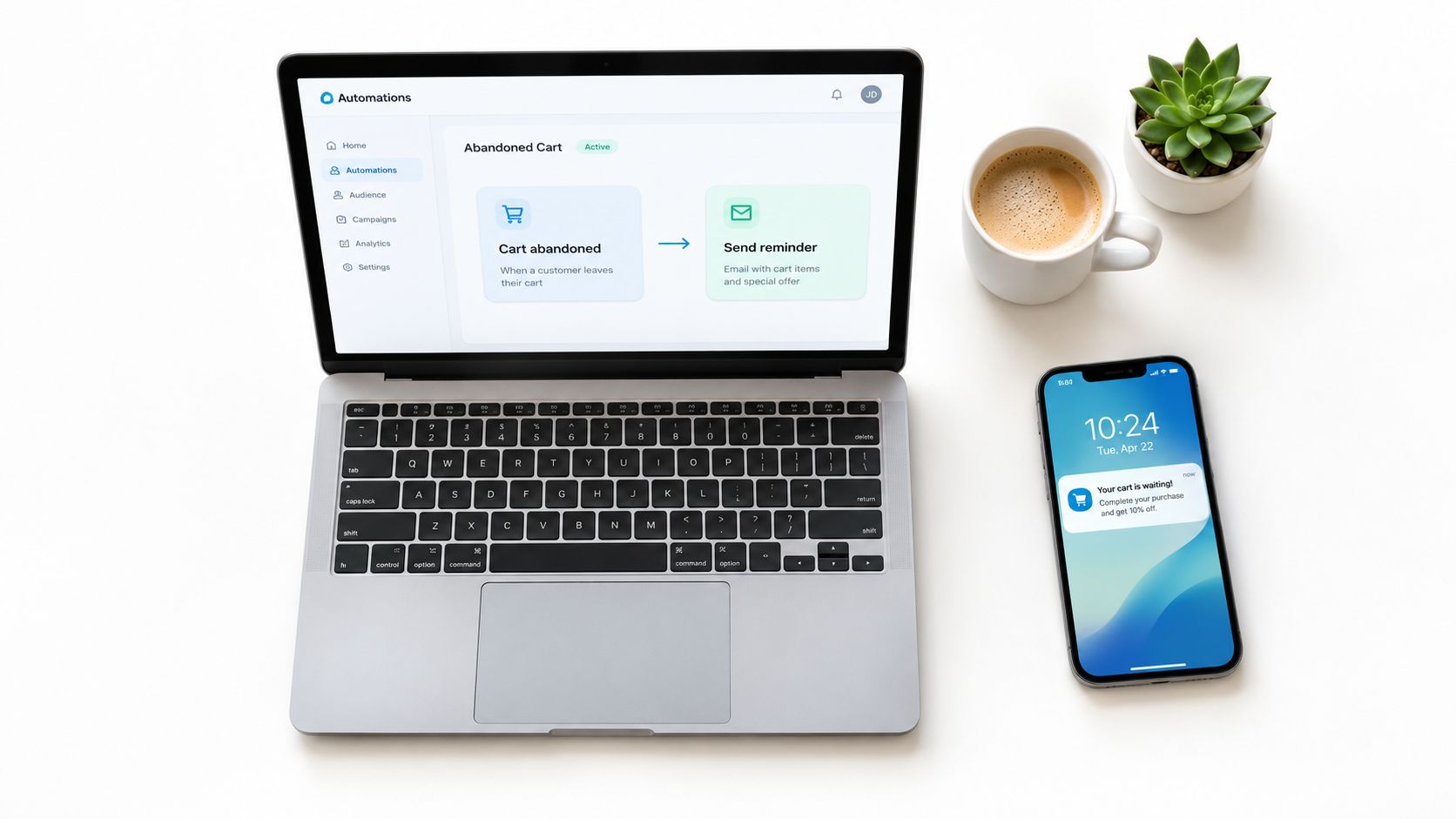
Scale makes the manual version unrealistic. Australian online retail sales reached A$4,061.4 million in September 2024 on a seasonally adjusted basis, according to the Australian Bureau of Statistics. A newsletter sent to everyone on Tuesday can't match that volume of carts and orders. A message tied to the kettle, sent while the shopper still remembers the price, can.
A plain walk-through of automated follow-ups for online stores from Silver Spoon Agency is a useful companion if you want the idea without the vendor pitch.
Automation doesn't set your offer, choose your prices, or write the reply to an upset customer. It only repeats the decision you already made.
If you can't name the trigger, the condition, and the action behind one message your store already sends, that message isn't automated yet. It's a broadcast with a timer.
The Core Workflows and the Trigger Behind Each
Read each row as a job, not a campaign name. The trigger starts the job, the first message is what the shopper really receives, and the success metric is the only number that proves the job worked.
| Workflow | Trigger | First message | Success metric |
|---|---|---|---|
| Welcome series | Sign-up or account creation | Brand story and first-purchase guide | First-order conversion rate |
| Abandoned cart | Item added, checkout not completed | Reminder with product, price and delivery information | Recovered orders and contribution margin |
| Browse abandonment | Product viewed, no basket created | Recap of the product or related items | Add-to-cart rate |
| Post-purchase | Order confirmed | Order details, delivery updates and care tips | Repeat-order rate and support contacts |
| Replenishment | Predicted reorder date for consumables | Reorder prompt | Reorder rate |
| Win-back | No purchase within a store-defined period | Re-engagement offer or new-range update | Reactivation rate |
| Back-in-stock | Item restocked | Availability alert | Orders placed from the alert |
Every row still needs the same three parts. A welcome series starts at sign-up, checks that the address is new and consented, then sends the brand story. An abandoned-cart row starts only when checkout isn't completed, and it must stop if payment lands ten minutes later. A workflow without that stop rule keeps writing to people who have already bought.
Build Order
Start with the highest-intent events. For most stores that is abandoned cart, then post-purchase. Those two fire because someone was already close to money or has just spent it. Browse abandonment is weaker intent, so add it after the cart flow is quiet and deduplicated.
Win-back comes last. You need a definition of "lapsed" that fits the product. Coffee might be 45 days. A sofa might be two years. If you can't state that period, you can't measure reactivation, and the flow will nag recent buyers.
Founder-led Shopify stores can use this automation guidance for founder-led Shopify stores from Arlo Inc. as a build checklist beside the table. The same logic sits behind enquiry sequences, which is why lead nurturing is worth reading if your "cart" is effectively an unpaid quote.
Back-in-stock is the outlier. The shopper asked to be told. Send the availability alert once, then stop. A second "still available" note is how a useful alert becomes spam.
Consent and Privacy Rules Before You Send
Before any promotional sequence runs, apply a yes-or-no test. Do you have consent for this person, on this channel, for this kind of message? If the answer is no, the workflow doesn't send.
Businesses sending marketing emails, SMS, instant messages, or similar commercial electronic messages must obtain the recipient's consent first, identify themselves accurately, and include contact details. The Australian Communications and Media Authority states that businesses must be able to produce evidence of consent if asked. Holding an email address or a mobile number doesn't itself establish permission.
What You Store on the Customer Record
Audit these fields before you switch a flow on:
- Consent status per channel: email, SMS, and any instant-message channel, stored separately.
- Date and source of consent: the form, checkout box, or conversation that created it.
- Sender identity used: the legal name and contact details that will appear on the message.
- Opt-out decisions across every channel: a stop on SMS shouldn't leave email running by accident.
- Sensitive data in the segment: flag health information, racial or ethnic origin, political opinions, and sexual orientation so those segments get a human review.
Under Australian Privacy Principle 7, an organisation generally can't use personal information for direct marketing unless it collected the information from the individual, the person would reasonably expect that use, and a simple opt-out is provided. If someone asks to stop, you must give effect to that request free of charge and within a reasonable period. Sensitive information can be used for direct marketing only with consent.
The Office of the Australian Information Commissioner also notes that commercial electronic messages must comply with the Spam Act 2003, including a functional unsubscribe, while APP 7 separately governs how personal information is used. A flow can be technically able to send and still not be permitted to send.
Order and delivery notifications sit closer to factual content and can fall under different rules. The boundary depends on what the message says. A tracking update is not the same as a tracking update with a discount code bolted on. Check ACMA and OAIC guidance for the live wording. This is general information, not legal advice.
Choosing Between Email, SMS, Ads and Personalisation
Match the channel to how urgent the message is and how much detail it needs. Add a second channel only after the first one has clean consent data and working stop rules. The consent test above applies to each of these, not only to email.
Email is the backbone for welcome, post-purchase, and win-back because it can carry product detail, delivery terms, and a link the shopper can open later. You can also test subject lines over weeks rather than hours. The usual failure is fatigue. Five "just checking" notes in a week train people to ignore the one message that mattered.
SMS fits short, time-sensitive jobs such as a failed payment or a delivery exception. It is also the channel most damaged by over-messaging, so put a tight cap on it, often one operational text per event. The failure mode is intrusiveness. A promotional text at 9 pm about a product someone only viewed reads as a breach of manners, even when the law is satisfied.
Paid ads, usually remarketing to site visitors and cart abandoners, reach people who have already left. They work as a supplement to channels you own, because the ad platform controls much of the delivery. The failure is spend chasing people who already bought. Suppress purchasers, or you pay to advertise a kettle to the person who paid for it yesterday.
Personalisation covers recommendations, dynamic blocks, and on-site changes based on browsing or purchase history. It raises relevance only when the data is current. A wrong recommendation damages trust faster than a generic one. Stale purchase data is the typical failure. Recommending nappies to someone whose last order was three years ago isn't clever. It's a data error with your logo on it.
Practical rule: one clean channel beats two noisy ones. If stop rules aren't cancelling messages after purchase, don't add SMS or ads on top.
Cart Abandonment Benchmarks and When Reminders Fail
More reminders aren't the fix. High abandonment is normal, and a reminder can't repair a checkout the shopper has already rejected.
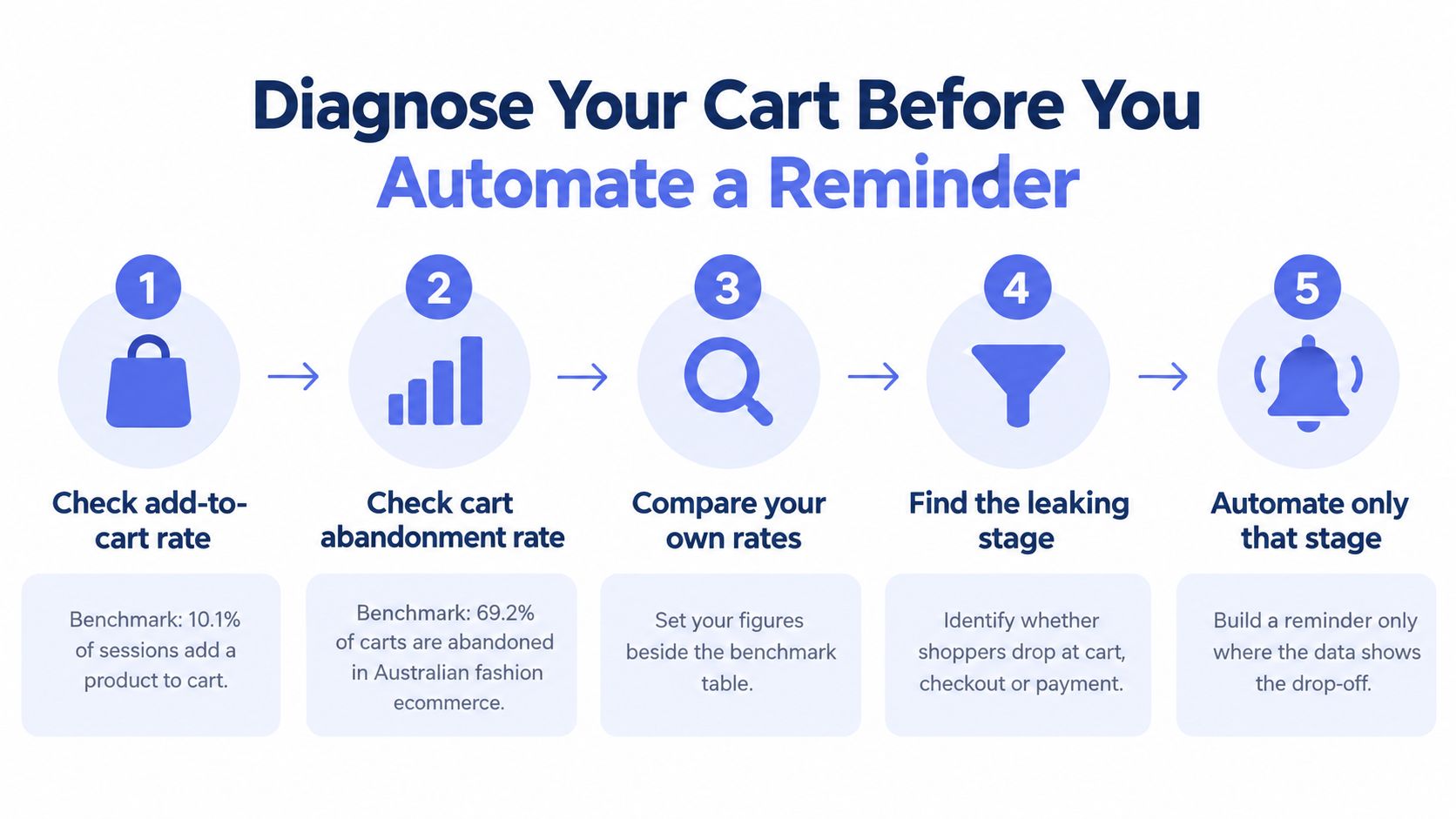
Australian fashion ecommerce benchmarks show about 69.2% cart abandonment, a 10.1% add-to-cart rate, and a 3.1% conversion rate. Furniture and homewares show about 75.8% abandonment, a 9.9% add-to-cart rate, and a 2.4% conversion rate, as set out by Moor Marketing. Judge recovery by incremental completed orders and contribution margin, not by open rate.
| Category | Cart abandonment | Add-to-cart rate | Conversion rate |
|---|---|---|---|
| Fashion ecommerce | 69.2% | 10.1% | 3.1% |
| Furniture and homewares | 75.8% | 9.9% | 2.4% |
A Branch, Not a Blast
- Confirm the shopper is known and has consented. Unknown guests don't enter a promotional flow.
- Check where they stopped: product page, shipping-cost step, or payment step.
- Route payment failures to a payment-retry message, not a discount.
- Surface delivery and returns information when shipping uncertainty is the likely cause.
- Send a product-and-cart reminder only to known, consented users.
- Offer a discount only when margin rules allow and the cart isn't already high-intent.
Australia Post's 2025 ecommerce research identifies unexpected checkout costs, slow delivery timeframes, and unavailable payment methods as major abandonment triggers. Nearly 8 in 10 online shoppers say delivery experience affects satisfaction. A sequence can't recover a purchase when the barrier is freight, a vague delivery window, or a missing payment option. Fix those before you add another email.
Stop conditions are part of the design. No reminder after a completed purchase, a delivery delay, or a refund. You need telemetry for cart value, category, shipping destination, device, logged-in status, and payment failure. Guest checkout and an email capture before payment raise the share of carts you can even see.
Further practical notes sit in these cart recovery tips from Class A Media. The short version is the same. Diagnose the leak, then automate only that stage.
A clear walk-through of the same decision, from benchmark to a single reminder, is in the video below.
Published Results and Measuring Your Own Flows
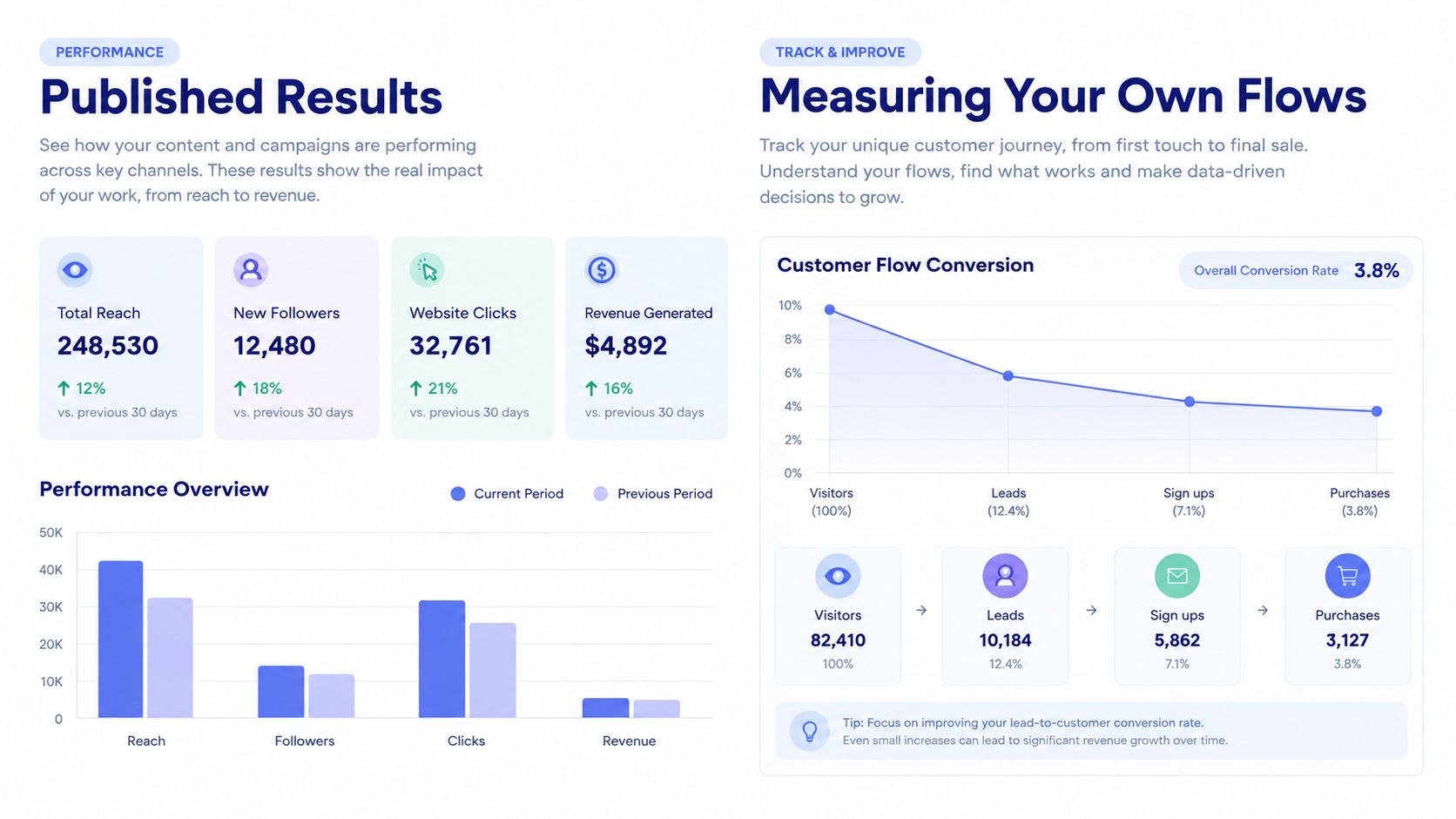
Published benchmarks are an efficiency reference, not a forecast for your store.
What the Published Set Actually Shows
In a 2025 analysis covering 150,000 ecommerce brands, behaviour-based automated emails generated 32.8% of email revenue while representing only 2.3% of email sends. Revenue per automated send was $3.34 versus $0.13 for scheduled sends. The same dataset reported automated email click-to-conversion of 43.36%, compared with 12.25% for scheduled email, while automated push notifications converted at 38.61% versus 4.38% for scheduled push (Omnisend).
The mechanism is intent. Product viewing, cart creation, checkout abandonment, purchase, and replenishment each encode what the shopper just did, so the message can match the product, the timing, and the call to action. That is why a tiny share of sends can carry a large share of revenue.
Treat the dollars as a comparison inside that global set, not as your expected return. The brands already run lifecycle programmes. Your first month will not look like their average, and Australian freight and payment frictions won't show up in a worldwide email benchmark.
Your Own Numbers
Start with revenue per send against your scheduled campaigns. Then distrust flow-attributed revenue. It credits customers who would have bought anyway.
Hold back a group that receives no messages from the flow. Measure orders in the messaged group against orders in that holdout. The gap is the incremental orders. Everything else is a claim.
ROI, in plain arithmetic, is incremental contribution margin minus total running cost, divided by that running cost. Running cost includes the tool, the set-up, and staff review time. Deduct discount cost before you judge margin. A flow that "recovers" $4,000 and gives away $3,200 in codes isn't a win.
Operational Quality
Open rates miss wrong answers and wrong segments. In 2024, 30% of Australian brands reported providing excellent customer engagement, while only 6% of Australian consumers agreed, based on a survey of 4,750 business leaders and consumers published by Twilio. Judge helpfulness through replies, complaints, and opt-outs.
| Metric | How to calculate | What it tells you |
|---|---|---|
| Incremental orders | Orders from the flow minus orders from the holdout group | Whether the flow adds sales or only claims existing ones |
| Revenue per send | Flow revenue divided by messages delivered | Efficiency compared with scheduled campaigns |
| Contribution margin per flow | Revenue less cost of goods, discounts and tool costs | Whether recovered sales are worth the spend |
| Discount cost | Value of incentives redeemed through the flow | Whether offers are eroding margin |
| Unsubscribe and opt-out rate | Opt-outs divided by delivered messages | Over-messaging or a wrong audience |
| Incorrect-response rate | Automated replies later corrected by a person divided by automated replies | Operational reliability of automated answers |
| Escalation rate | Conversations passed to a person divided by total conversations | Whether rules are too narrow or too broad |
| Unresolved queue age | Average time items wait for human review | Bottlenecks in approval and exception handling |
Agree review thresholds before launch. An incorrect-response rate above the level you would tolerate from a new staff member is a reason to pause the flow, not a reason to send more. A rising escalation rate means the rules are either too timid or too broad. A growing queue age means the human gate is the bottleneck, and customers are waiting on you, not on the software.
Review weekly for the first month, then monthly. A practical method for separating attributed revenue from incremental revenue is set out in how to measure the ROI of AI automation. Use the same holdout idea on a cart flow as you would on any other automated job.
A first deployment that respects margin is three stages, not seven. A reminder with the product and its true delivery cost. A second note that answers shipping or returns questions. A final incentive only when your margin rules permit it. If stage one already recovers the order, stages two and three never send.
Choose Tools Against Your Workflows Before Buying
Score the tool against the jobs you already named. Vendor claims come after that.
A workable tool connects to the store, the inbox, and the CRM without rebuilding them. It records consent and opt-outs per channel. It supports triggers, conditions, stop rules, and suppression after purchase. It has an approval gate and an exception queue for sensitive or unclear cases. It reports incremental revenue and the operational metrics above. It lets you export rules and data so you aren't locked in. And the running cost includes set-up, maintenance, and review time, not only the licence.
Red flags are simple. No holdout testing. No audit trail. A shared sender identity with nowhere to store consent.
Approval gates aren't a luxury. The National AI Centre reported that 43% of Australian SMEs used AI during December 2025 to February 2026, but only about half of current users checked AI outputs before those outputs affected customers. Limit automation to low-risk actions, such as an order-status reply. Keep refund explanations behind approval. Keep angry or vulnerable customers with a person.
Six Steps, One Flow
- Map the trigger, condition, and action for the two highest-value workflows.
- Audit consent and opt-out data before anything sends.
- Fix the friction a reminder can't fix, such as delivery-cost wording and missing payment methods.
- Build one flow with a holdout group.
- Add approval gates for sensitive messages.
- Review exceptions and metrics weekly for the first month.
We review your current inboxes, forms, CRM, documents, and spreadsheets before choosing the connection path, and we can usually use your existing business process automation software. Managed AI Operations is the ongoing operating layer after the first automation goes live, covering monitoring, tuning, approval gates, reporting, and exception handling. If you compare outside providers, score each one on this same checklist, including through business process automation. A sober comparison of CRM options is in best CRM automation software. Buy the connection that records consent and stops after purchase. Don't buy the one with the longest template list.
Truespeak designs and runs the operating layer around the tools you already use, including follow-up, intake, CRM hygiene, and human approval gates for messages that shouldn't send themselves. If your store or service business is adding reminders before it has fixed the core barrier, start with one flow, a holdout, and a person on the exception queue. Visit Truespeak to talk through that first workflow.