
A plumber is on a roof, and his phone is in the van. Three calls go unanswered. By the time he rings back, two callers have booked someone else. That is a normal morning for plenty of Australian builders, trades and installers, not a one-off bad day.
Reception is still a large labour category. Jobs and Skills Australia records approximately 181,300 people employed as receptionists nationally, with a 57% part-time share. Another hire covers relationship-sensitive work a voice bot should not own. It does not, on its own, stop revenue leaking from calls nobody picks up.
This guide compares seven options in the best AI receptionist Australia field and gets to the list quickly. I look past the greeting at speed-to-lead, follow-up, managed support, CRM integration, security, local support and pricing. The test is whether the lead reaches one CRM, gets a next action, is followed up, and stays with a person where judgement matters. If you are pricing the phone path itself, start with this forwarding cost breakdown from VoxNote.
Table of Contents
- 1. Truespeak - AI Automation Services
- 2. Giday
- 3. Ozetel
- 4. AnswR
- 5. Hooroo.ai
- 6. Call Assistant
- 7. Alltel AI Answering
- How the seven Australian AI receptionist options compare on published details
- Choosing an AI Receptionist That Fits Your Operation
1. Truespeak - AI Automation Services
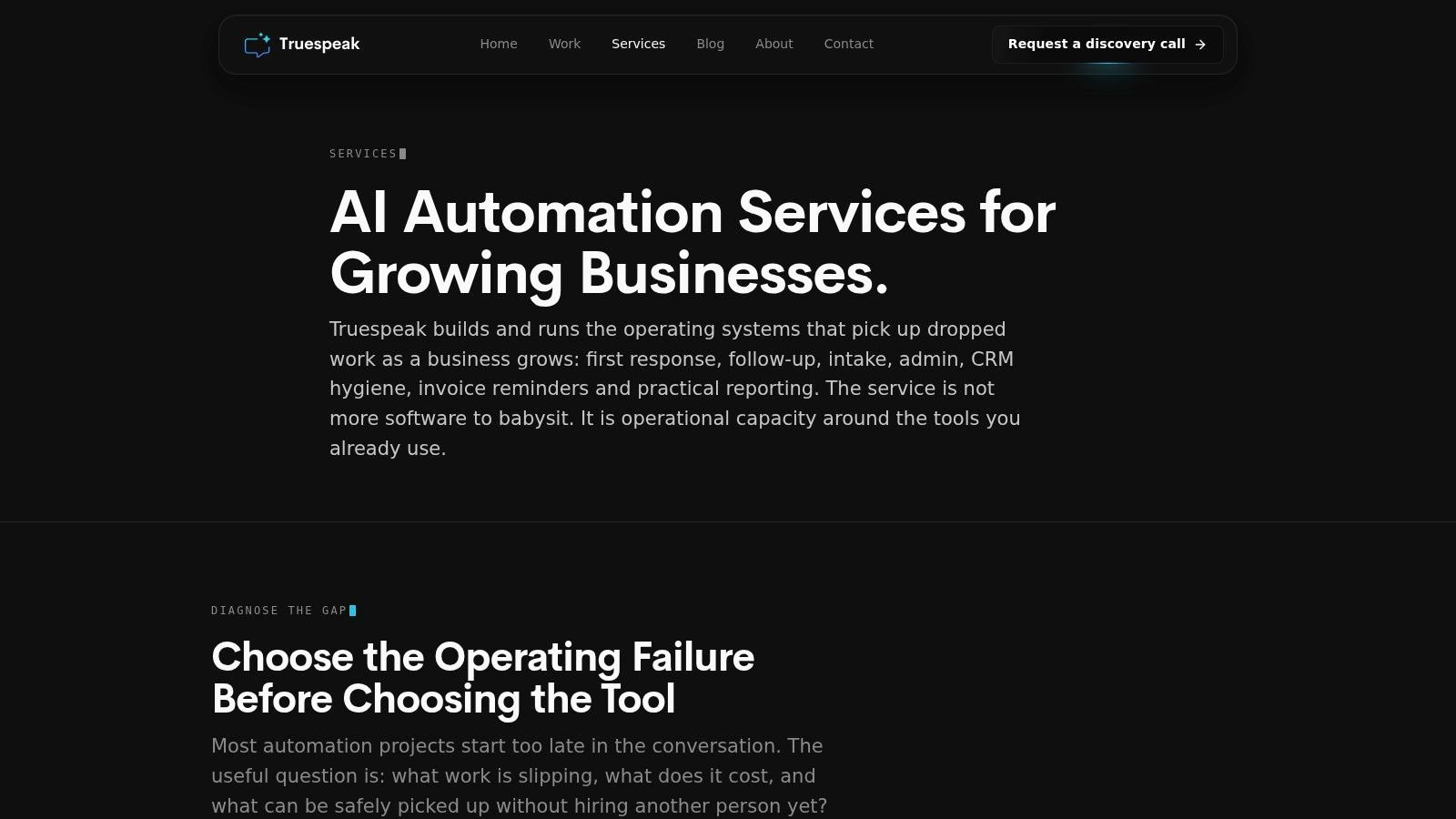
We are a Sydney operations partner for Australian service businesses, not another product your team has to administer. The work sits on the front desk that stalls growth: first response, follow-up, intake, CRM updates and the admin between them. Speed-to-lead automation is built so every enquiry lands in one CRM, is qualified for fit, intent and urgency, and gets an owner, a next action and a visible outcome.
I would not sell this as a phone greeting. Self-serve receptionists answer the call. A managed layer has to finish the job after the caller hangs up. Around 65% of non-adopting businesses cited distrust of AI decision-making or a preference to retain human control, and customer-service chatbot acceptance is only 37%, in the National AI Centre adoption insights. Sensitive or client-impacting messages wait for a person. The system pauses with context when data is missing or risk is high, rather than hiding the failure.
What We Run After the Call
Daily support is useful for capture, routing, reminders and consistent follow-up. People stay responsible for relationships, exceptions and consequential decisions. We do not claim that model is unique, and we do not describe how other Australian receptionists staff their day.
- Capture: forms, inboxes and referrals land in the CRM you already run.
- Routing: high-intent jobs get an owner while vague ones stay visible, not lost.
- Review: scheduled checks cover enquiries, CRM updates, invoice chasing and reporting, with approval gates on anything risky.
Lead follow-up automation and CRM automation can start on one gap and widen once real exceptions show up. Replacement of your stack is only worth it when the current tools block the workflow. A practical read on the phone role is our note on an AI receptionist for small business.
Practical rule: If the gap is after the call, a tool that only takes a message adds a task. The workflow should create the next action and leave judgement with you.
Setup takes more coordination than switching on self-serve software, and the services page does not publish pricing or guaranteed results. I would pick this when you want the operating layer watched. I would not pick it when you only need a cheap after-hours greeting.
2. Giday
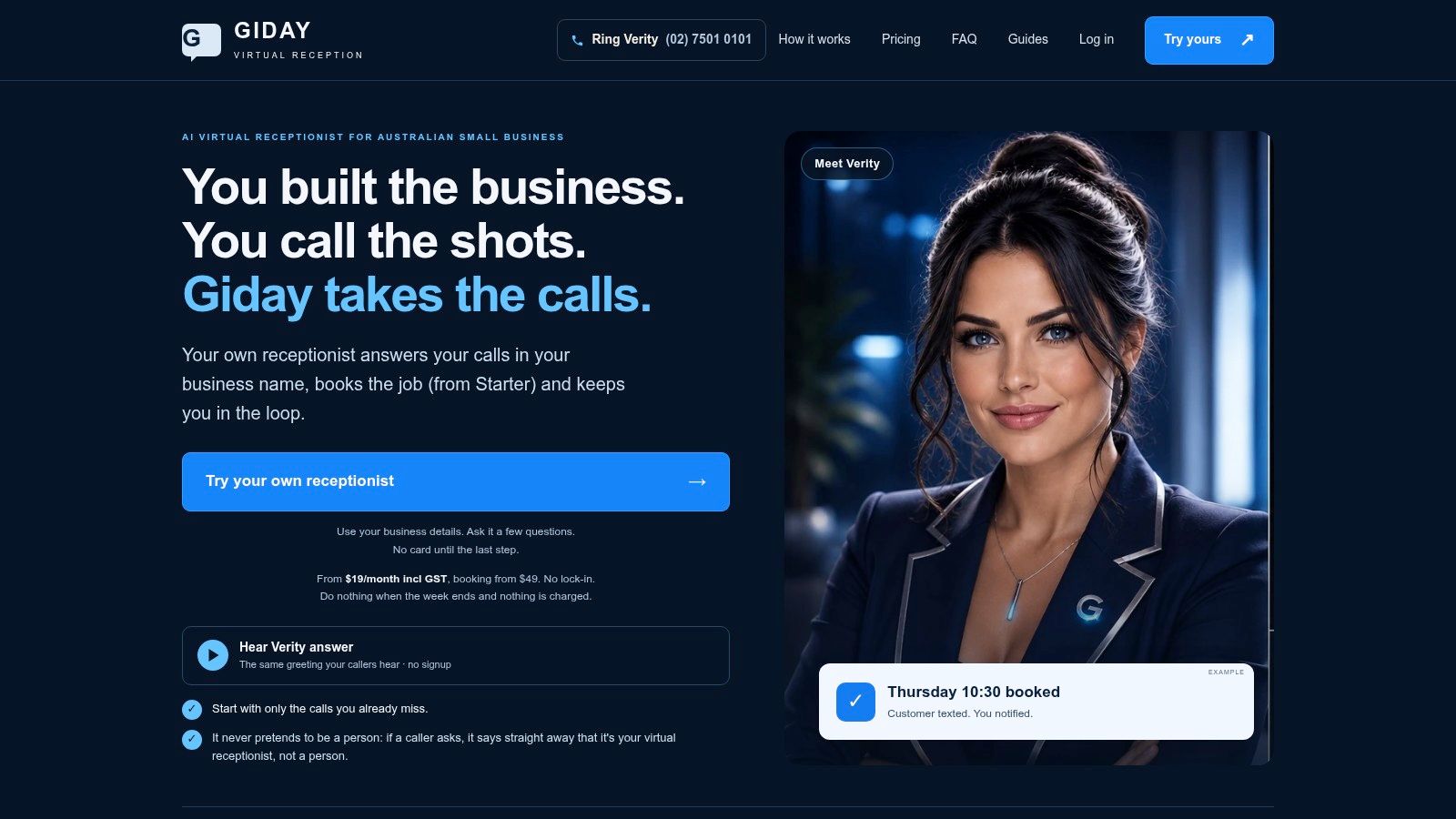
Giday is an Australian-built receptionist for small trades and service operators, and it publishes a price you can read before a demo. Plans start at A$19 per month, with booking from A$49 per month, and the published pricing includes GST. It answers calls around the clock, screens spam and takes messages. Eligible plans book appointments or jobs. Higher plans can quote from a price list you have approved.
Faster pickup is the benefit owners feel. In a 2024 customer-service technology survey, 60% of Australian customer-service professionals named faster response times as the leading operational benefit, while 51% viewed customer trust as a major issue, as reported by Mi3. Missed-call diversion fits that tension. You keep your current answering routine, and Giday takes what you miss.
Where the Plan Line Matters
Booking and quoting are not on the entry tier. Live calendar access is described as a higher-plan feature. Urgent and out-of-area jobs should be tested on a live call.
- Trial: a free trial and month-to-month plans are listed, so you are not locked in to learn the voice.
- Number: you can start on Giday's number or divert only missed calls.
- Quotes: only an approved price list should be used, or the bot will sound more certain than you are.
Details sit on Giday. I would use it when the job is turning simple calls into booked work. I would not stay on the cheapest plan if booking is the requirement.
3. Ozetel
The Australian Bureau of Statistics reported that 12% of businesses used artificial intelligence in 2024–25, compared with 1% in 2022–23, and about 11% of small and micro businesses were among the users. Ozetel is aimed at that uneven middle: trades, professional services, clinics and property. Published plans start at A$39 per month for 25 calls, with extra calls billed separately.
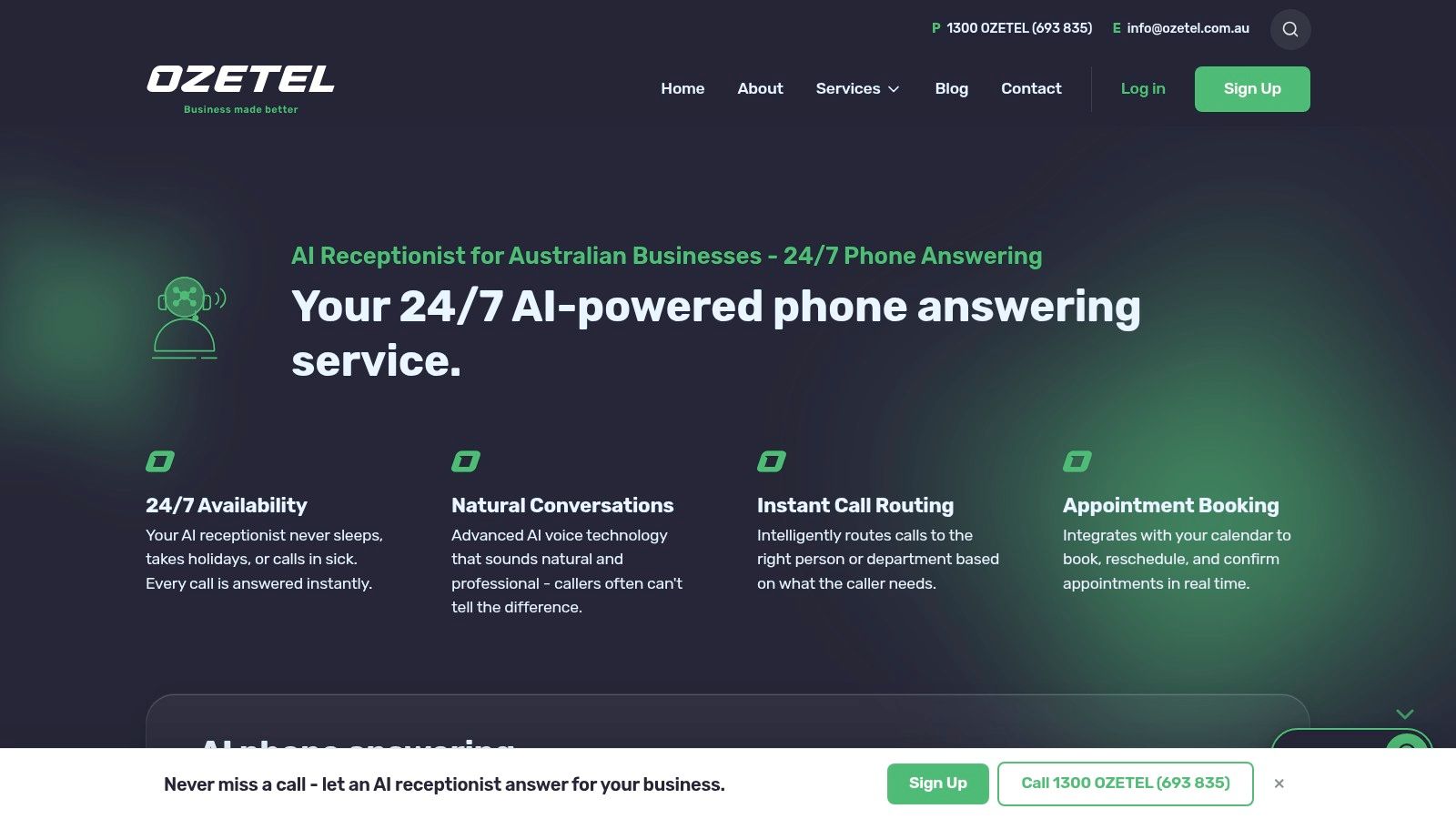
Setup is call forwarding, so you do not swap handsets. You get a custom greeting and script, transcripts and a dashboard. The provider also advertises support for multiple languages. That is enough to hear whether callers finish a sentence. It is not the same as a booked job in your diary.
What the Starter Plan Leaves Out
Appointment booking and live transfers are higher-plan features. CRM integration is listed on Business and Professional. Starter is an entry point for testing answer quality, not a full intake desk. A busy month changes the bill because additional calls are charged on their own.
How you should think about the clock, separate from any vendor claim, is covered in our piece on lead response time.
A low starter price is a test budget. It is not proof the call becomes a qualified booking.
Confirm your existing number and the specific CRM before you commit. The offer is on Ozetel's AI receptionist page. I would trial it when you want a cheap read on call quality. I would not assume Starter books or transfers.
4. AnswR
AnswR names the software on the plan page, which is rarer than it should be. Professional lists Jobber, ServiceM8 and Simpro. Business lists Xero, Cliniko and HubSpot. Starter includes Google Calendar sync, 24/7 answering, and SMS and email notifications. Professional adds service-area filtering and a custom voice or personality. If the call has to become a job card, those names matter more than a friendly greeting.
In 2025, 64% of Australian small businesses reported using AI regularly, and 26% said they used it daily, according to Intuit QuickBooks' Australian small-business survey. Regular use does not mean the notes land in Simpro. You still have to match the tier to the tool.
Minutes, Overages and the Real Bill
Monthly plans cap included minutes, and per-minute overages are specified, so you can model a busy month before you sign. A pay-as-you-go option is there if volume is uneven. Integrations depend on the tier you buy. A Starter subscription will not grow ServiceM8 access.
- Compare usage: included minutes and the overage rate, not the headline fee.
- Match the stack: trade software on Professional, finance and clinic or CRM tools on Business.
- Break it on purpose: call with a vague suburb, an angry tone and a job you do not do.
See AnswR. I would shortlist it when your job system is already one of the published names. I would walk away if the plan you can afford does not include that integration.
5. Hooroo.ai
Say a locksmith takes the call, promises a quote, and the follow-up lives in a text thread nobody owns. Hooroo.ai tries to keep that work in one place. It is an AI receptionist plus job-management workflows: appointment booking, quote requests, customer and job records, quote follow-ups and invoice reminders. Plans include an Australian mobile number, Australian-dollar pricing stated to include GST, a seven-day trial and no lock-in.
Call transfers and text links sit alongside the voice. API and webhooks are listed if you need the record to leave Hooroo and enter something you already trust. The included number will not suit every existing phone setup, and plans cap minutes, texts and users, with extra usage charges.
Follow-Up That Can Become Spam
Quote nudges and invoice reminders are where a bundled product can overreach. ACMA requires consent for commercial email or SMS, a functional unsubscribe, and action on an unsubscribe request within 5 working days. A message can still be commercial if it carries any promotional or sales material. If invoice chasing is the main gap, compare the bundle with invoice reminder automation that keeps a person on the send button.
A receptionist that also chases quotes is useful only if consent, sender identity and opt-out are part of the workflow, not an afterthought.
The product is at Hooroo.ai. I would consider it when you want phone answering and light job admin together. I would skip it if you only need messages and already run a job system you do not want to duplicate.
6. Call Assistant
Warm transfer is the feature I would test first. Call Assistant answers 24/7, offers a choice of voice, takes messages, and sends summaries, transcripts and email alerts. On a warm transfer, your person can accept or decline the call. That is a better default than a bot deciding a safety complaint is "handled". Optional call recording is available. A 14-day trial includes 60 minutes and does not require a card.
The plan comparison lists only one phone number per business, and included minutes and team seats change by tier. If you run two brands on two numbers, ask before you assume the table covers you.
Hosting Is a Question, Not a Badge
The provider says a private AI model can run on its own Australian servers by arrangement for enterprise customers. That is not a standard plan line, so specifications and cost have to be confirmed. Callers still need to know what they are speaking to. The OAIC community attitudes research found 79% of Australians expect to be informed when AI is being used, and 80% want limits on third-party retention. A fluent voice that cannot explain recordings, transcripts and deletion is a weaker buy than a plainer one with a written data path.
Read the plans at Call Assistant. I would look here when staff must choose whether to take the live call. I would not treat "Australian servers by arrangement" as included until it is in writing.
7. Alltel AI Answering
Alltel is a telco selling automated answering, not a job-booking suite. Published plans focus on answering calls, a personalised greeting and closing, capturing caller details and messages, and sending an instant notification. You can send all calls, only unanswered calls, or after-hours calls. Pricing starts at A$15 per month on pay-as-you-go with 100 minutes included, plus a one-off setup fee. Further minutes cost extra.
That shape suits a fallback, not a front office. There is no published booking flow to lean on. If your leak is "we never knew they called", message capture can be enough. If your leak is "we knew, and nobody followed up", it will not close the gap. Whether a responder is worth it past the notification is the question in what an AI lead responder is and whether it is worth it.
In 2024, 59% of Australian small and medium-sized businesses had invested in AI or planned to invest within the following five years, according to Commonwealth Bank research with YouGov. A low published price is a reasonable way to join that experiment. It is a poor way to assume the second call, the quote and the CRM note will appear on their own.
Confirm how forwarding interacts with services you already buy from Alltel, because setup and the all-in cost are not the same as the A$15 line. Plans are on Alltel AI Answering. I would use it as after-hours message cover. I would not use it as the system of record for jobs.
How the Seven Australian AI Receptionist Options Compare on Published Details
| Item | Published starting price | Booking or quoting | CRM or software links | Best for |
|---|---|---|---|---|
| Truespeak - AI Automation Services | Custom service; pricing not published | Tailored workflows for enquiry follow-up and intake | Works with existing CRMs and business tools | Businesses wanting managed, human-reviewed automation |
| Giday | A$19/month; booking from A$49/month | Job and appointment booking on eligible plans; quotes on higher plans | No specific integrations listed | Trades and service businesses converting calls into booked work |
| Ozetel | A$39/month for 25 calls; extra calls billed separately | Booking on higher plans; quoting not specified | CRM integration on Business and Professional plans | Businesses seeking call answering with optional booking and CRM connections |
| AnswR | Tiered plans; starting price not specified | Booking not specified; call answering and notifications included | Jobber, ServiceM8, Simpro, Xero, Cliniko, HubSpot; Google Calendar on Starter | Service businesses wanting calls connected to existing software |
| Hooroo.ai | Published AUD pricing; starting price not specified | Appointment booking and quote requests | Job, customer, quote and invoice workflows; API and webhooks | Service businesses wanting call answering plus job-management workflows |
| Call Assistant | Tiered plans; starting price not specified | Warm transfers and message taking; booking or quoting not specified | No specific integrations listed | Businesses needing 24/7 answering, call summaries and optional warm transfers |
| Alltel AI Answering | A$15/month pay-as-you-go, with 100 minutes; one-off setup fee | Message taking; booking or quoting not specified | No specific integrations listed | Businesses wanting low-cost call and after-hours message coverage |
Choosing an AI Receptionist That Fits Your Operation
Start with your own baseline. Count how many enquiries arrive out of hours, where those leads are written down, who follows up, and how fast that happens on a normal week. If you cannot answer those four points, a new voice will only make a tidier version of the same leak.
The Australian AI Adoption Tracker reported that 41% of Australian small and medium enterprises were adopting AI, and 22% reported faster decision-making. Faster decisions only show up if the call creates a record someone acts on. Shortlist two or three options that connect to the systems you already use. Ring each one with a job you do not service, an incomplete address and a caller who wants a price you have not approved. Then add call overages, texts and setup to the monthly fee and compare that total, not the advertisement.
Giday, Ozetel, AnswR, Hooroo.ai, Call Assistant and Alltel are self-serve or plan-based phone products. They differ in whether they book, which software they name, how minutes are capped, and how much of the job record they try to own. If your gap sits after the call, in follow-up, intake, CRM hygiene or invoice chasing, put those tools next to a managed partner such as Truespeak. We monitor, tune and report on the workflow, and people approve sensitive actions. We usually work around the business process software you already have, and we look first for the single operating gap worth fixing.
Phone routing still has to be designed, not hoped for. This note on integrating voice agents with cloud PBX is a useful check before you forward the main number and discover the after-hours path loops. Pick the option that leaves a next action in one place, at a cost that does not jump the month you are finally busy.
Truespeak designs and manages the operating layer around the tools you already use, so first response, follow-up, intake and CRM hygiene keep moving after the call ends. If missed enquiries and stalled next steps are the problem, not the greeting, start with a practical workflow and human approval where judgement matters. Visit Truespeak to talk through the first gap worth fixing.