
The job's finished, the client seemed happy, and your tax invoice went out on time. Then the due date passes. You're left deciding whether to wait a bit longer or send a message that might sound too sharp.
Don't wait and hope. Use an overdue invoice letter template that matches the stage of the debt, states the facts clearly, and gives the customer one easy next step.
Table of Contents
- Why an Overdue Invoice Letter Protects Cash Flow
- Details to Confirm Before You Send
- When to Send Each Overdue Invoice Letter
- Polite Firm and Final Notice Wording
- Tone Payment Plans and Client Relationships
- How to Choose a Follow-up Process
Why an Overdue Invoice Letter Protects Cash Flow
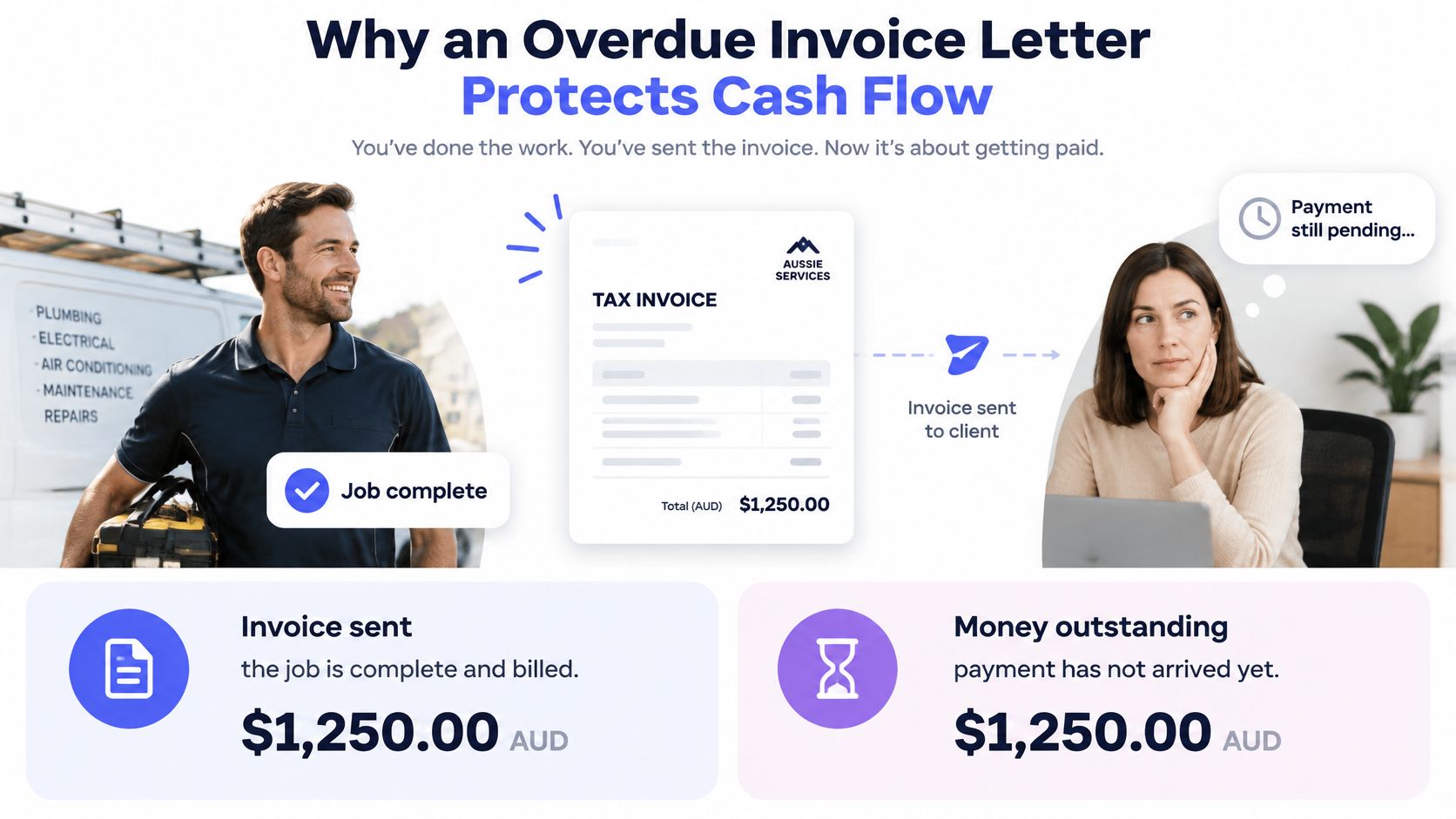
A service business often carries the cost first. Staff have done the work, materials have been paid for, and the customer now holds the money. When follow-up depends on memory or whoever has time that afternoon, overdue invoices keep sliding.
Treat the template as a structured cash-flow control, not an awkward one-off email. Use the same basic system before the due date, just after it, and during escalation, adjusting only the tone and deadline.
Late Payment Is Common and Expensive
The ASBFEO Payment Times and Practices survey found that all respondents had experienced late invoice payments in the previous financial year and about half reported that more than 40% of their invoices were paid late. Almost one in five reported an average delay exceeding 60 days, while 3% reported delays of more than 120 days, according to the same survey.
The cash tied up was substantial. That survey also found nearly half had more than AUD 20,000 in late payments, 14% had more than AUD 100,000 outstanding, and one in four reported bad debts exceeding AUD 10,000. It found 87% experienced reduced cash on hand or savings because of late payments.
Those figures explain why wording alone isn't enough. The letter has to help the owner protect working capital, plan supplier payments, and see which accounts need attention now. Owners wanting broader context can also review working capital guidance for business owners alongside their receivables process.
What the Letter Must Do
Every overdue notice should do five jobs without creating friction:
- Identify the invoice: Give the invoice number and the job or service it covers.
- State the original due date: Make clear why the account is now overdue.
- Confirm the amount outstanding: Remove doubt about the balance.
- Explain how to pay: Restate the payment path so no extra exchange is needed.
- Set the next action: Ask for payment, confirmation, or details of a query by a clear point.
Practical rule: A good overdue letter is factual enough that the customer can act immediately and professional enough that the relationship can continue.
A repeatable sequence makes that easier than drafting from scratch each time. Businesses that want the sequence scheduled around their existing systems can review how invoice reminder automation supports staged follow-up while keeping sensitive wording under human control.
Details to Confirm Before You Send
Don't choose the wording first. Confirm the invoice is correct, due, and supported. A firm letter built on the wrong amount, wrong contact, or unresolved delivery issue creates more work and puts the relationship at risk.
Reconcile the Account First
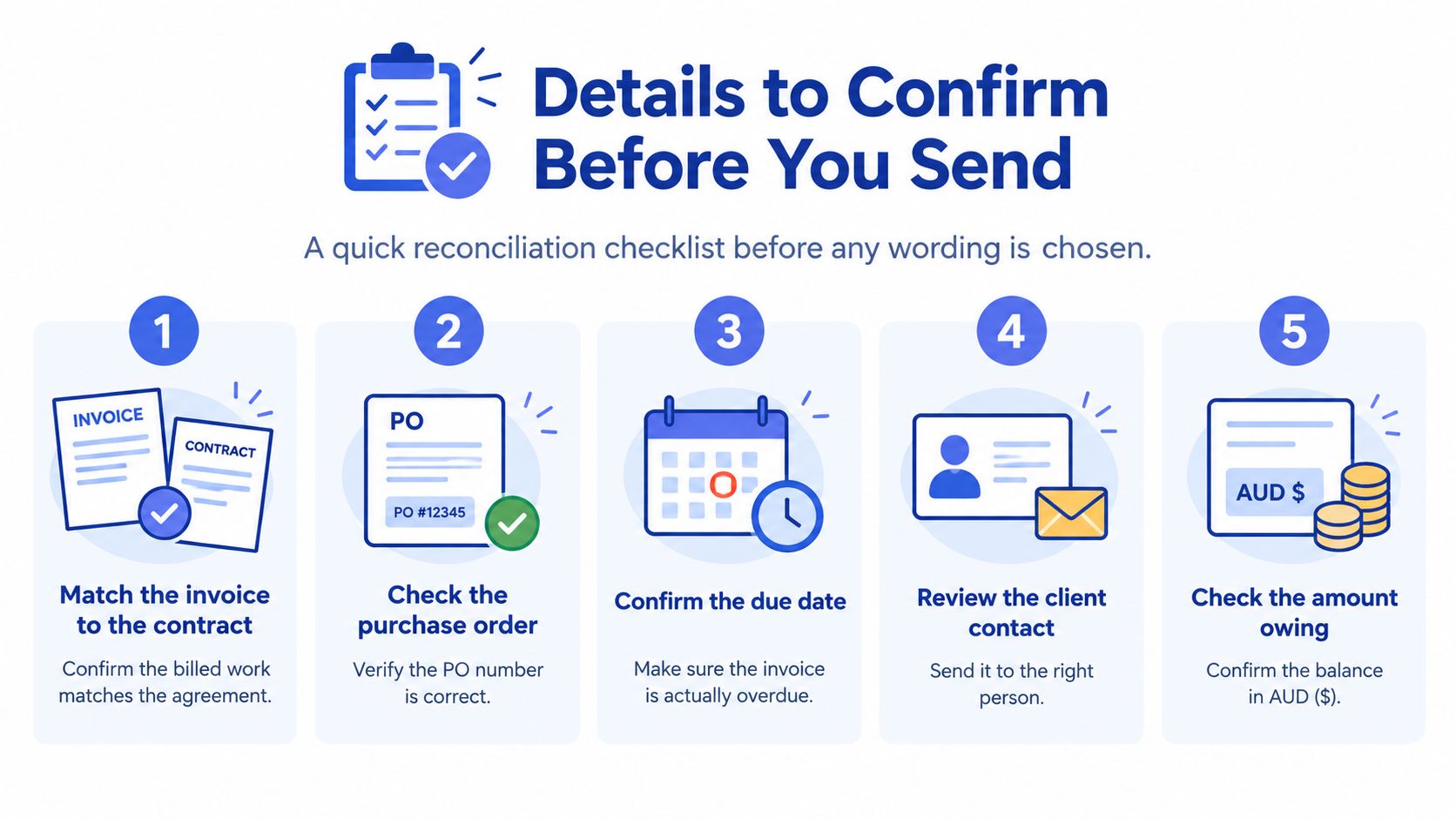
Run this short check before any overdue invoice letter leaves your business:
- Match the contract: Confirm the billed work, price, payment terms, and due date match what was agreed.
- Check the purchase order: Verify the purchase order number and customer legal entity where a purchase order applies.
- Confirm completion evidence: Locate delivery, sign-off, timesheets, photos, reports, or other proof relevant to the service.
- Review the tax invoice: Check the supplier legal name, ABN, invoice number, issue date, service description, and GST treatment where relevant.
- Look for disputes or part payments: Make sure no line item is already under query and the amount outstanding reflects payments received.
- Confirm the recipient: Send the notice to the person or accounts team able to approve or process payment.
Fields Every Australian Template Should Carry
Include the supplier's legal name and ABN, the customer's legal entity, invoice number, issue date, and due date. Add the amount outstanding, whether that amount includes GST where relevant, and a brief description of the service and agreed payment terms.
Also include bank or other payment instructions and a direct contact for questions. Ask the customer to reply promptly if payment has already been made or if any part of the account is disputed.
Australian Government guidance explains that detailed item descriptions reduce invoicing disputes and clear payment methods help customers act. It also supports offering multiple payment options so the reminder can be matched to a particular service, invoice, and agreed terms, then paid without another exchange.
Attach the documents the payer may need. At minimum, attach a copy of the dated invoice. Where the customer needs evidence to approve payment, include the relevant purchase order, completion record, or other supporting document rather than forcing them to ask.
Apply the Stranger Test
Read the draft as someone who knows nothing about the job. Could that person identify what's owed, why it's owed, when it was due, and how to pay? Could they raise a factual query without hunting through earlier emails?
If a stranger can't pay or raise a precise query from the message alone, the letter isn't ready.
That test catches most avoidable delays. It also protects your team from sending automated pressure when the problem is a missing purchase order number, an unclear service description, or a tax detail that needs correction.
When to Send Each Overdue Invoice Letter
One aggressive demand isn't a collections process. Use stages, with each stage triggered by the contractual due date, not the invoice date.
Terms may depend on milestones, completion, approval, or another performance condition. Confirm the obligation has fallen due under the contract before you describe the invoice as overdue.
Use a Dated Escalation Sequence
| Stage | When to send | What it asks for | Tone |
|---|---|---|---|
| Courteous reminder | Immediately after the due date | Payment, confirmation that payment is underway, or notice of a query | Helpful and factual |
| Second notice | 7 days after the first overdue point | Payment or a reply by a stated date | Firmer and more specific |
| Formal demand | 14 to 21 days into escalation | Payment by a final internal deadline | Formal, without unsupported threats |
| Professional recovery review | After internal verification and documented contact attempts | A decision on external help or further action | Controlled and evidence-based |
Record each notice, response, promise to pay, and dispute. Your team should be able to pick up any account and see its stage, owner, last contact, and next dated action.
The timing matters because normal terms can already feel long. The Payment Times Reporting Regulator update reported an average common payment term of about 29 to 30 days, only roughly 66.5% of invoices paid on time, and an average time of 64 days for 95% of small-business invoices to be paid.
Keep the Commercial Front End Clear
Collections are harder when the original offer, acceptance, and payment terms were vague. Align the quotation, contract, invoice, and reminder so the customer sees the same terms at each point. Businesses that also sell services or products online can use guidance to set up offers for online sales as a reminder to keep the buying path and terms clear before an account becomes overdue.
If you use accounting software to trigger reminders, align its stages with your contract terms rather than accepting a default sequence blindly. The practical guide on sending invoice reminders in Xero is useful where Xero is already part of the workflow.
Know What Not to Threaten
Don't threaten interest, collection costs, legal action, or credit reporting unless you've checked the contract and applicable Australian law. Unsupported threats can damage trust and weaken later recovery discussions.
Pause automated reminders while a genuine service, price, or tax dispute remains open. Move that account out of the standard sequence, assign an owner, and record the specific issue to resolve. Resume the sequence only when the facts are settled and the customer has a clear amount and due date.
Stage check: Before sending, you should be able to say which stage the account is in, what evidence supports it, and what will happen next if there's no reply.
Polite Firm and Final Notice Wording
Use short, factual wording you can adapt. These examples are generic starting points, not past client letters, and they shouldn't be presented as wording that guarantees immediate settlement.
Replace every bracketed field before sending. Keep the subject line specific, attach the invoice, and include only consequences or interest terms already supported by the agreement.
Polite First Overdue Notice
Use this immediately after the due date when there's no known dispute:
Subject: Invoice [number] now overdue
Hello [name],
Our records show invoice [number] for [amount] was due on [original due date] and remains outstanding. A copy is attached for easy reference.
Please arrange payment using [payment method and details]. If you've already paid, please reply with the payment date so we can update our records. If something on the invoice needs clarification, please contact [name and contact details].
Thank you, [Your name, business legal name, ABN]
This version assumes an oversight, processing delay, or missing information. It gives the customer two clean paths: pay now or identify the problem.
Firm Second Notice
Use firmer wording when the first note hasn't produced payment or a useful reply:
Subject: Second notice for invoice [number]
Hello [name],
Invoice [number] for [amount] was due on [original due date] and is still outstanding. We sent a reminder on [date] and haven't received payment or details of a query.
Please pay by [specific date] using [payment method and details], or contact [name] before that date if you dispute any part of the account. A copy of the invoice and [supporting document] is attached.
Regards, [Your name, business legal name, ABN]
The change is specificity, not hostility. You're naming the earlier contact, setting a reply or payment date, and making silence harder to sustain without inventing consequences.
Final Notice and the Letter of Demand Boundary
A routine reminder is not the same as a letter of demand. Keep that boundary clear.
The Australian Government letter of demand template covers the amount outstanding, GST treatment, due date, payment terms and instructions, supporting documents, and a request for payment within seven days. It allows interest only where the contract agreed it and states that further recovery action may follow if payment isn't received within that period.
A generic final notice can follow that pattern:
Subject: Final notice for invoice [number]
Dear [customer legal entity],
Invoice [number] for [amount, including or excluding GST as applicable] was due on [original due date] under [brief description of agreed terms]. Despite reminders on [dates], the amount remains unpaid.
Please pay within seven days of this letter using [preferred payment method and bank details]. [Include the agreed interest wording only where the contract provides for it.] Copies of the invoice and supporting documents are attached.
If payment isn't received within seven days, we may take further recovery action.
[Authorised name, business legal name, ABN, contact details]
Before using final wording, re-check the contract, purchase order, invoice delivery, tax details, and any disputed work. Escalation should be a deliberate human decision, not just the last email in an unattended automation sequence.
Tone Payment Plans and Client Relationships
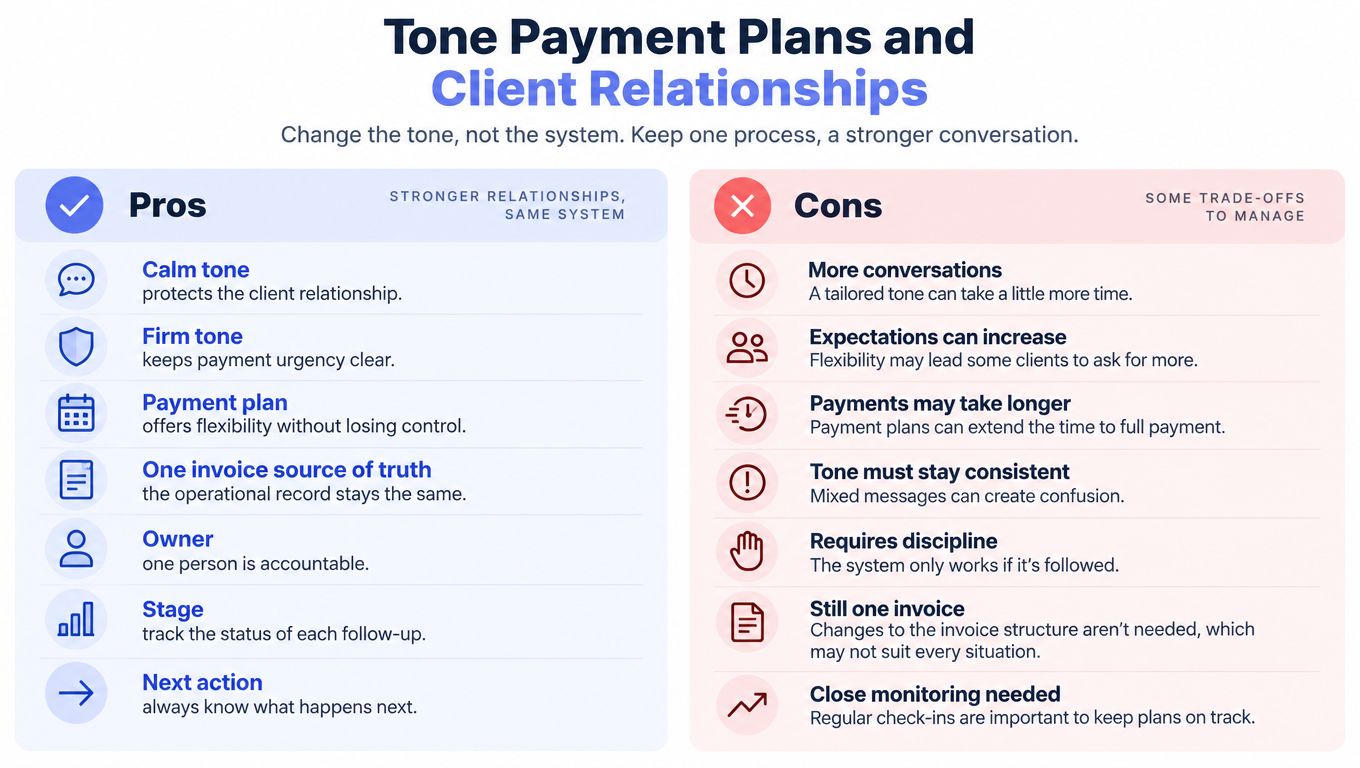
Don't build separate collections systems for different customers. Keep one operational record for every account: the invoice as the source of truth, an owner, a stage, a next action, and a response expectation. Then adjust the human contact around that record.
Match Contact to the Relationship
For a long-term client, start with a more personal contact from the person who manages the relationship. Give them room to explain an approval problem, missing document, or genuine query. Still name the amount, due date, payment path, and date by which you need a reply.
For a one-off customer, move sooner to the short factual reminder. There's less relationship context to draw on, so clarity and consistent follow-through matter more than a long explanation.
For a repeat late payer, keep the tone professional but reduce open-ended flexibility. Use shorter reply windows, record promises precisely, and require human approval before new work or another extension is offered.
Automation can schedule the sequence and surface accounts that need attention. It shouldn't decide when a valued relationship needs a phone call instead of another template.
Handle Financial Difficulty Without Blurring the Debt
A customer may be unable to pay in full. Australian Government guidance says a business can ask whether a payment plan is needed and split the debt into smaller regular amounts. The same guidance describes a letter of demand where payment still hasn't arrived, recognises disputes, points businesses toward the Australian Small Business and Family Enterprise Ombudsman, and notes that a debt collector may charge a fee.
Payment plans are already a practical part of SME recovery. Australian SME data reported in 2025 found only 22% of surveyed businesses said all invoices were paid on time, 59% said up to one-quarter were late, and 39% used payment plans or revised terms. Separate research reported there found 17% of SMEs estimated losing more than AU$2,500 per month because of late payments, up from 11% in 2024.
If you agree to instalments, put the arrangement in writing:
- Total debt: State the full amount covered by the plan.
- Instalment schedule: Record each amount and date.
- Payment method: Specify exactly how each instalment must be paid.
- Default consequence: State what happens if an instalment is missed.
- New work position: Confirm whether further work pauses until the plan is current.
Don't rely on a friendly verbal promise. Informal revised terms can blur the original due date and make the next overdue invoice letter harder to justify.
Flexibility works only when the debt, dates, and consequences stay visible.
How to Choose a Follow-Up Process
A strong template won't rescue a process nobody owns. Choose how follow-up will continue after the first letter, because most accounts need an accurate record and repeated, stage-matched contact.
Compare the Three Practical Options
- Ad-hoc emails: Someone chases payment when they remember. This creates inconsistent tone, missed promises, and no reliable next action.
- Staged in-house sequence: Your team uses shared templates, one invoice record, an account owner, and dated follow-up. This suits many service firms if someone reviews the queue consistently.
- Managed reminder workflow: The sequence runs around your existing accounting and customer tools, with people approving sensitive wording, disputes, and escalation. This suits firms where follow-up keeps being displaced by delivery work.
Choose the staged approach over ad-hoc chasing. Clear due dates and an easy payment path support collection, but they don't replace ownership, evidence checks, and follow-through.
Measure the process on your own accounts rather than counting letters sent. Track days sales outstanding, the share paid within 7 days of a reminder, the promise-to-pay kept rate, dispute-resolution time, and recovery cost.
Where a growing service firm wants that sequence run as an operating layer, Truespeak is a Sydney AI operations partner that designs and manages practical systems around existing CRMs and business tools. In that model, the invoice stays the source of truth, each account has an owner and next action, reminders continue until the matter is paid, disputed, or escalated, and people approve exceptions. Its overview of invoice reminder software options and workflow fit can help frame that choice.
Start this week with one overdue account. Reconcile it, send the letter that matches its stage, record the owner, and set the date you expect a reply. Only after that account is under control should you decide whether to schedule the same sequence more widely in-house or hand the operating routine to a managed process.
If overdue follow-up is still relying on memory, Truespeak can design and manage a human-approved invoice reminder process around the tools you already use. Visit Truespeak to discuss a staged system where every account has an owner, a next action, and a clear escalation point.