
The job's finished, the customer is happy, and the invoice is sitting past its due date while wages, fuel and supplier bills keep landing. That gap is where a good overdue payment email earns its keep. It's not a confrontation. It's a timed, recorded step in a workflow that protects cash flow and the relationship at the same time.
Table of Contents
- The Cash-Flow Moment Most Australian Operators Know Too Well
- Why Timing Beats Wording in Overdue Payment Emails
- A Five-Stage Overdue Payment Email Sequence
- Diagnose Before You Demand
- The Operating Layer Around the Emails
- When to Escalate and What to Say in a Letter of Demand
- Putting It Together This Week
The Cash-Flow Moment Most Australian Operators Know Too Well
You've done the work on site or delivered the service, sent the invoice promptly, and heard nothing. Payroll is due Friday. A supplier wants payment before the next delivery. BAS and super obligations don't move because a customer is slow.
That pressure turns chasing payment into a personal task, usually squeezed in after hours by the owner. The fix isn't harsher wording. It's a repeatable process anchored to the due date, with clear ownership and a written record of every contact.
Why This Is a Structural Problem, Not a Personal Failure
Late payment in Australia is widespread enough that ad hoc chasing will always leave gaps. An Australian parliamentary analysis based on more than 10 million invoices from over 76,000 small businesses estimated that delayed payments from large businesses represented approximately $77 billion annually, with more than one-third of small-business invoices paid after 30 days and an average payment time of 63 days for those late invoices, according to the parliamentary analysis of small-business payment times.
For operators wanting broader habits around invoicing discipline and follow-up, Accountant She Ltd's payment guide is a useful companion read alongside a tighter internal reminder process.
- Cash impact: Every extra week unpaid affects your ability to pay staff and suppliers and accept new work.
- Relationship impact: A factual, early reminder feels routine. A frustrated email after weeks of silence feels personal.
- Record impact: Dated emails create the audit trail you'll need if a dispute or formal escalation follows.
Treat the first reminder as routine operations, not as an accusation. Most customers respond better to a prompt, factual note than to a delayed demand.
Why Timing Beats Wording in Overdue Payment Emails
Operators often spend longer polishing a single email than designing when it should go. That's backwards. An average message sent on a predictable schedule does more work than a perfectly written message sent sporadically.
The timeline graphic below maps the shift in purpose as an invoice ages, from low-friction nudge to escalation point.
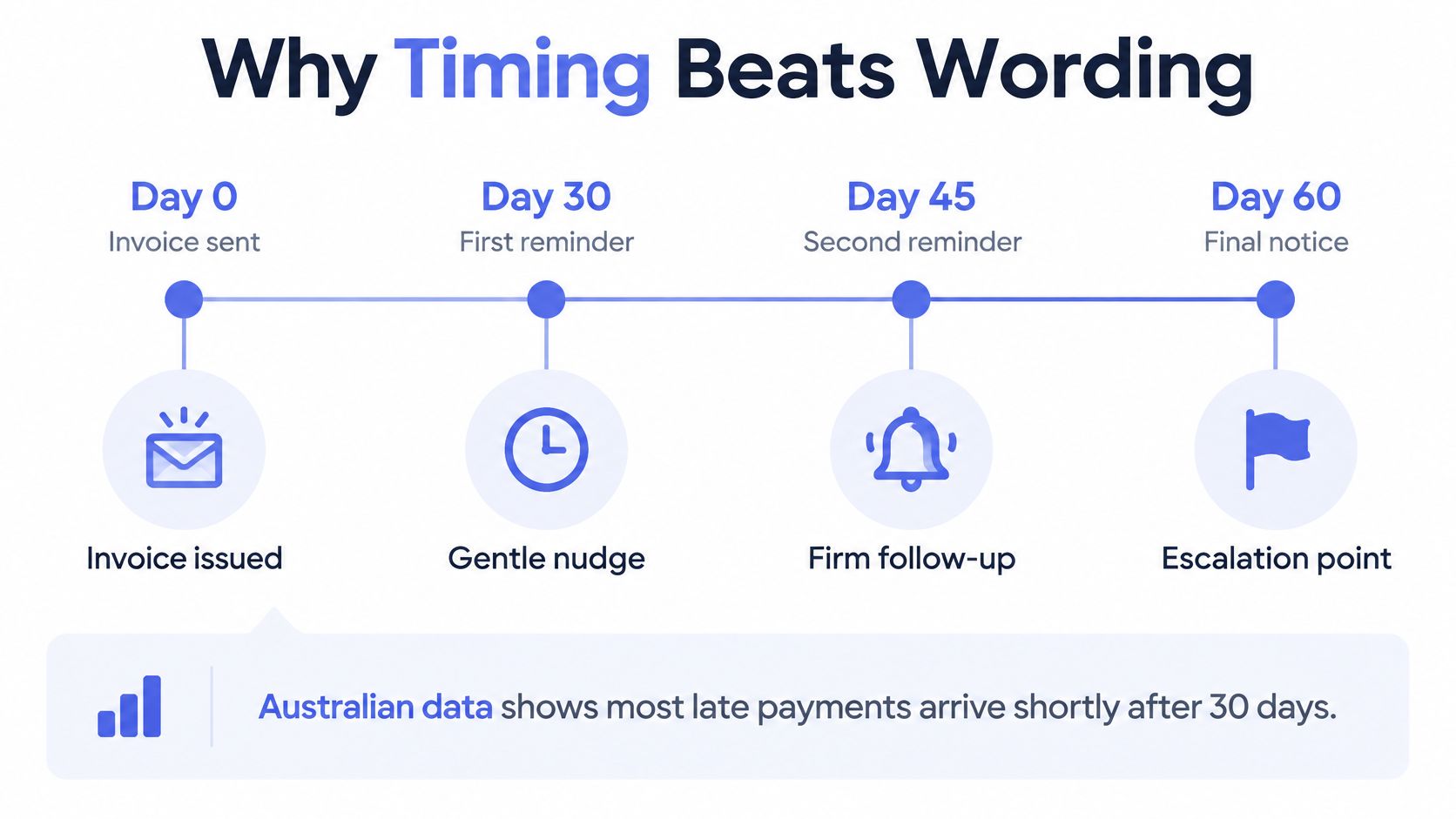
Invoice Age Changes the Job of the Email
Early on, the email's job is discovery. Has the invoice reached the right person? Is a purchase order number missing? Is approval stuck? Later, the job changes to securing a specific commitment date, and eventually to documenting escalation. Using the same escalating tone at every stage ignores those differences.
The persistence of the problem justifies that staged design. The Australian Small Business and Family Enterprise Ombudsman's Payment Times and Practices Inquiry, based on a survey of 2,783 businesses, found that around half said more than 40% of their invoices were paid late, while separate reporting on the inquiry found that 28% of respondents experienced late payment on more than 60% of their invoices, as summarised in the Ombudsman's reporting on late payments from big business to small business.
That pattern means silence isn't a cue to wait. It's a cue to move to the next planned step.
Two Tracks, Not One Ladder
- Low-friction track: Pre-due and just-overdue reminders that confirm receipt and make payment easy.
- Commitment track: More direct messages that ask for a payment date, a phone call, or an account review.
Jumping straight to a firm demand skips the first track entirely. You'll sometimes get paid that way, but you'll also create disputes with customers whose only problem was a missing reference or the wrong inbox. Timing, paired with the right question at each stage, is what makes an overdue payment email sequence a cash-flow control rather than a sales script.
A Five-Stage Overdue Payment Email Sequence
Build the sequence around the invoice due date, not around when someone remembers to chase. Each stage keeps the facts constant, invoice number, amount, due date and payment method, while the call to action becomes more specific.
Australian government guidance supports that consistency. It recommends putting payment terms in contracts and invoices, including when payment is due, accepted payment methods and how overdue debts will be collected, as set out in Business.gov.au guidance on payment terms. Your reminder can then point back to agreed terms instead of inventing new ones mid-chase.
The Sequence at a Glance
| Stage | When to send | Primary CTA | Tone |
|---|---|---|---|
| Pre-due reminder | Before the due date | Confirm receipt or pay early | Courteous |
| First overdue notice | Just after the due date | Pay now or raise a query | Friendly, factual |
| Second follow-up | About 7 days overdue | Confirm payment date | Direct |
| Third follow-up | About 14 days overdue | Commit to a specific date | Firmer |
| Escalation notice | About 30 days overdue | Phone call or account review | Formal |
Stage Wording You Can Adapt
Stage 1, pre-due. Subject: Invoice [number] due on [date]. Body: Thank the customer, name the amount and due date, include the payment link or bank details, and invite them to reply if anything needs correcting. This catches processing problems before they're overdue problems.
Stage 2, first overdue. Subject: Invoice [number] is now overdue. Use a plain opening such as: 'I am following up on invoice [number] for [amount], which was due on [date] and is still unpaid. Please confirm payment has been made, or let us know if there is a query we should resolve.' There's no published winning subject line to copy here. A subject that plainly identifies the invoice is recognisable and easy to act on.
Stage 3, around seven days. Ask a narrower question: when will payment be made? Restate the payment details so the customer doesn't need to search for the original invoice.
Stage 4, around fourteen days. Reference your earlier reminders, ask for a commitment date by return reply, and offer a short call if there's a problem. Mention interest or fees only where your contract allows them.
Stage 5, around thirty days. Move from email-only chasing to a phone or account-review escalation. State the next step clearly, keep the language neutral, and log who now owns the account internally.
Businesses in membership-based sectors face the same timing problem in a different setting, and payment reminder templates for fitness studios show how other service operators structure staged reminders for recurring customers.
Firmness test: You've stated the invoice, amount, due date and next action without apologising for asking, and you've left room for a genuine query. That's firm and polite at once.
For staged or milestone work, check the contract before sending stage two onwards. The ATO notes that payment may be tied to instalments or milestones and that complete invoice information improves on-time payment, as explained in ATO invoicing guidance for contractors and suppliers. A demand sent before a milestone condition is met undermines your credibility.
Diagnose Before You Demand
The most overlooked message in the sequence isn't firmer. It's diagnostic. Before you demand payment, find out whether you're dealing with a fixable process delay or genuine cash-flow distress. Those two situations need different responses.
The workspace image below reflects where this work happens, in a short, deliberate email rather than a long negotiation.
Recent Atradius research found that only 37% of B2B invoices were paid on time, 52% were overdue and 11% were written off as bad debt, and 39% of Australian SME respondents reported offering payment plans or revised terms while 32% used late fees or interest charges, according to reporting on Atradius findings for Australian businesses. With overdue payment that common, assuming unwillingness to pay will be wrong often.
Four Checks Before Any Firm Demand
- Right contact: Did the invoice reach the person who can approve or pay it?
- Missing input: Is a purchase order, reference or approval outstanding?
- Genuine query: Is there a dispute about scope, quality or amount?
- Customer cash position: Is a defined payment date or short plan more realistic than immediate full payment?
A diagnostic overdue payment email asks those questions directly. For example: 'We have invoice [number] for [amount] showing as unpaid from [due date]. Has it reached the right person for approval, and is anything missing from us that is holding it up? If timing is the issue, please reply with the date you can pay so we can update our records.'
For a clearer picture of the bookkeeping discipline behind that triage, what AR management actually does outlines the tracking and follow-up functions that sit behind individual reminders. Sector-specific workflows vary, and how allied health clinics can chase NDIS invoices shows how diagnosis matters where third-party approval sits between service and payment.
The trade-off is real. Offering a short plan may delay full payment, but it can recover a viable account and preserve repeat work. A threat-based template sent to a customer with a process problem tends to produce silence or dispute. Escalate firmly when diagnosis produces no answer, not before you've asked.
The Operating Layer Around the Emails
An overdue payment email fails when nobody owns what happens next. The operating layer, ownership, records, stop conditions and review gates, matters more than any single line of copy.
The checklist below summarises the controls that should surround every sequence.
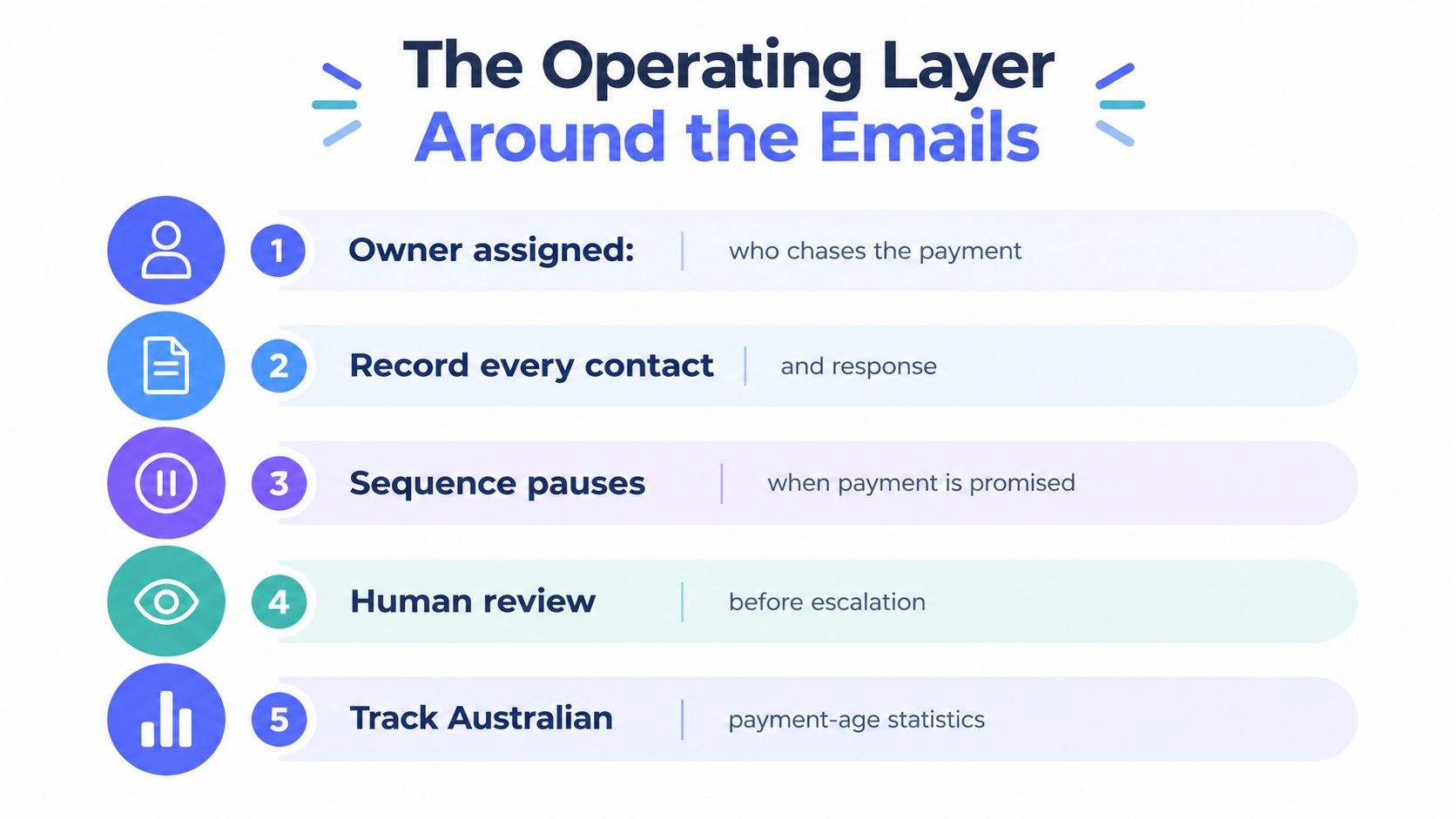
What to Record for Every Invoice
- Sent time and delivery status: Proof the reminder went out.
- Invoice state: Current, overdue, disputed, part-paid or promised.
- Customer response: The reply itself, not a staff member's summary of it.
- Promise-to-pay date: A specific date you can follow up against.
- Escalation owner: One named person, not a shared inbox.
That record turns follow-up into a reviewable queue. Stalled items surface in a weekly check instead of sitting unnoticed until they're seriously aged.
Stop Conditions and Human Review
Automation should pause the moment one of three things is logged: payment received, a dispute raised, or a promised payment date recorded. Continuing to send reminders after any of those events damages trust and wastes attention.
Route disputed, high-value, vulnerable or legally sensitive accounts to a person before any further message goes out. Truespeak, as one option in this space, provides invoice reminder automation that drafts follow-ups, queues routine reminders and pauses sensitive cases for human review, which reflects the same principle: systems handle timing and visibility, people handle judgement.
If a promised date passes without payment, that's your escalation trigger. Don't restart the friendly sequence from the top.
The workload case is straightforward. Atradius reported that 75% of past-due B2B invoices were paid within 30 days after the due date, while 58% of Australian SMBs spend up to three hours per week on payment collection and 20% spend six to 12 working days per year chasing overdue invoices, as detailed in the Atradius Payment Practices Barometer for Australia. A documented system concentrates that effort in the window where most late invoices still resolve.
When to Escalate and What to Say in a Letter of Demand
A letter of demand isn't a stronger reminder. It's a formal step with different rules, and the image below marks that shift from routine email to documented demand.
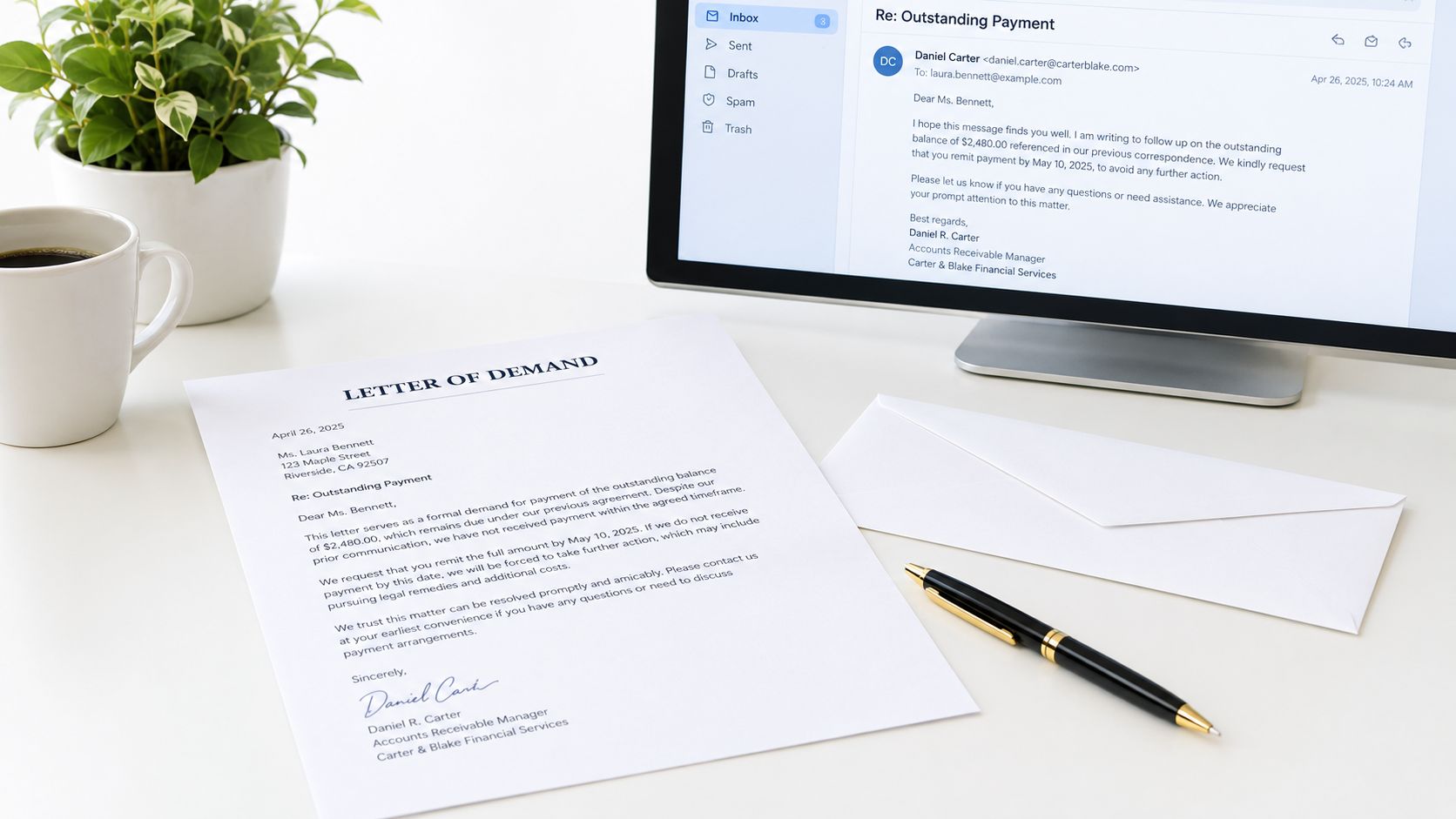
The Australian Government's published letter-of-demand template requests payment of the invoiced amount, plus late-payment interest only where that interest was agreed in the contract, within seven days of the letter's date, and states that further recovery action may follow if payment is not received within that period, as shown in the Australian Government letter of demand template.
Two disciplines follow from that template. First, don't add interest, fees or consequences your agreement doesn't support. Second, any deadline you state must be one you're authorised and prepared to act on.
Treat silence past the escalation stage or a broken promise-to-pay as the trigger for internal review. Bundle the contract, invoice, reminder history and customer replies, and decide who approves the letter before it goes. Firmness at this point means accuracy, not volume.
The short video below walks through the escalation thinking in practical terms.
Putting It Together This Week
You don't need new software to start. You need terms, timing and ownership written down.
- Confirm your terms: Payment terms are stated in contracts and on invoices, including due date and payment method.
- Set your stages: Pre-due, just overdue, then escalations tied to invoice age, each with one clear call to action.
- Draft in order: Write the diagnostic email first and the demand last, so tone follows evidence.
- Assign and record: One owner per invoice, with sent times, responses and promised dates logged.
- Define stop conditions: Payment, dispute or promised date pauses the sequence immediately.
If you're comparing tools to run the sequence, invoice reminder software is a practical starting point for evaluating what to automate and what to keep with a person.
If manual chasing is eating hours you don't have, Truespeak designs and manages invoice reminder workflows around the tools you already use, with human review for sensitive accounts and a clear record of every follow-up. Visit Truespeak to see how a managed, human-approved reminder sequence could work for your business.