
You're probably staring at a messy stack right now. Leads are coming in from the site, the phone, the inbox, and whoever's on duty is doing their best to keep up. The temptation is to buy an AI tool, bolt it on, and hope it clears the backlog, but that's usually how businesses end up with another system to babysit.
The better move is simpler. Diagnose the workflow first, fix the hand-offs, then automate the repeatable parts. That's how ai implementation works for Australian service businesses that need more capacity without turning the office into a project room.
Table of Contents
- The Case for Diagnosing Before Implementing
- Running a Diagnostic Assessment of Your Current Workflow
- Choosing Your Smallest Viable AI Pilot
- Integrating with Existing CRMs and Tools
- Monitoring KPIs and Measuring Return on Investment
- Maintaining Human Oversight and Continuous Tuning
The Case for Diagnosing Before Implementing
Most owners make the same mistake. They buy software because the demo looked slick, then discover the actual problem was never the model, it was the process. If the enquiry is landing in the wrong inbox, nobody owns the follow-up, or the job details live across three spreadsheets, AI just speeds up the mess.
A diagnostic-first rollout starts with the actual workflow, not the assumed one. It asks where the work enters, who touches it, what gets delayed, and which steps keep falling through the cracks. That lines up with the practical view of business process management in Truespeak's guide to business process management, because you can't automate what you haven't mapped.
Practical rule: if the process isn't visible on paper, it isn't ready for automation.
That's also why a decent operating plan beats a flashy tool selection. A useful reference point is AI implementation for pipeline growth, not because you need another vendor pitch, but because pipeline only improves when the underlying hand-off discipline improves too. If you skip diagnostics, you usually create fragmented automations, more exceptions, and extra admin for staff who were already flat out.
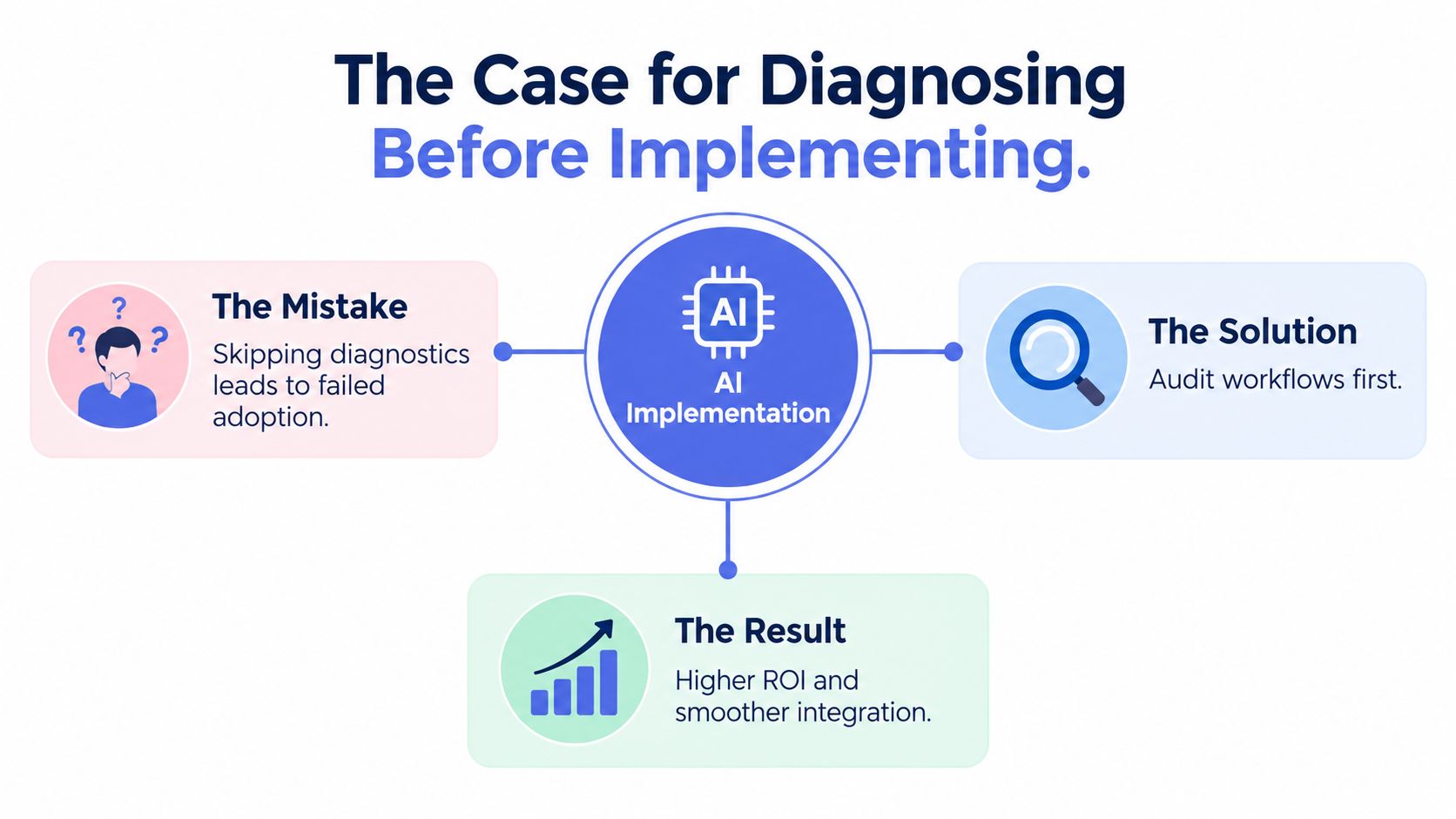
The result you want is boring in the best way. Clear ownership, fewer surprises, and a workflow that can actually carry automation without breaking under pressure.
Running a Diagnostic Assessment of Your Current Workflow
Start with the customer journey as it runs today. Use the actual path, the one that happens when a lead arrives, a form is submitted, or an invoice goes overdue. Identify where information is captured, which application holds the source of truth, who owns each stage, and where hand-offs stall.
Then map the work that repeats. Capture, enrichment, routing, reminders, and routine admin are the first places to look, because they can be standardised without stripping out judgement. If a step depends on relationship nuance, a negotiated exception, or a high-stakes decision, keep it with a person.
A process is ready for AI when it is visible, well-designed, and has a named owner at each stage. If your team is living in inboxes and spreadsheets, the operational design comes first. A system that helps rather than adds noise depends on that design being done first.
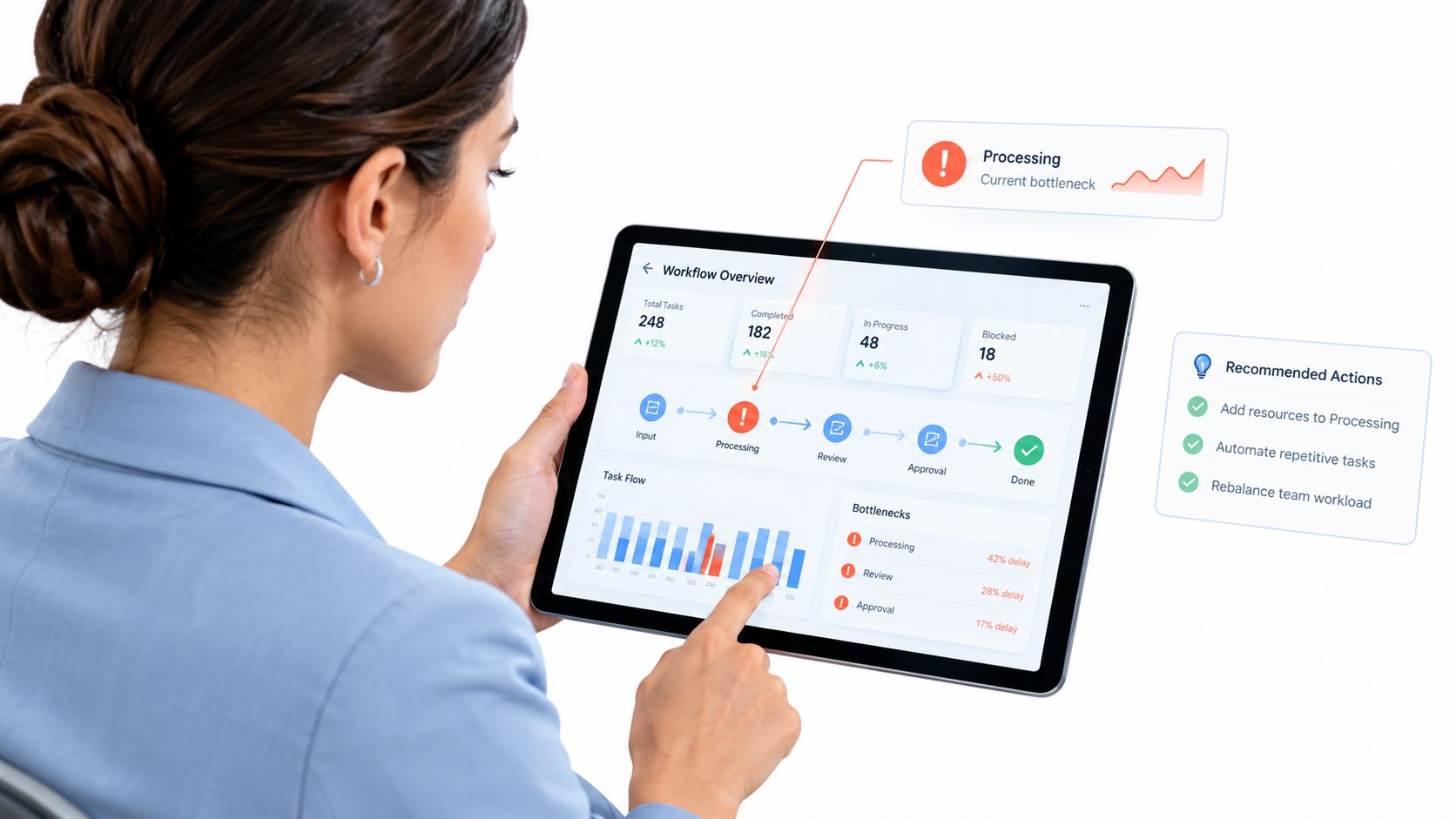
Use a narrow, high-frequency workflow as the pilot. Map the trigger, required context, decision rules, action, verification step, and exception path, then set a baseline before you automate it. Governance gaps, weak digital infrastructure, unclear human-AI roles, and poor use-case selection are the usual reasons AI work stalls, which is why the order matters.
For the data quality side of that problem, see Truespeak's CRM data quality note.
Don't start with automation. Start with the process that keeps breaking.
If you are unsure where to begin, the diagnostic should point to the same answer every time. Pick the workflow that is high-volume, repeatable, and already costing you time through rework or delay. That is the one worth testing first.
Choosing Your Smallest Viable AI Pilot
The first pilot should be the smallest workflow that carries real pain and clear rules. That is where AI can prove value without dragging the team into a broad rollout they do not trust. For most service firms, the choice usually sits in one of four jobs.
| Pilot option | Best when | What it fixes |
|---|---|---|
| Speed-to-lead automation | New enquiries need immediate handling | Faster first response, routing, next-step booking |
| Intake automation | Briefs are incomplete or messy | Structured capture, fewer follow-up loops, cleaner handover |
| Lead follow-up automation | Quotes and proposals go cold | Consistent nurturing, fewer dropped opportunities |
| Invoice reminder automation | Cash collection is lagging | Polite follow-up, fewer overdue accounts, less manual chasing |
The Australian Government's AI Adoption Tracker (source) reported in June 2025 that 41% of Australian SMEs were adopting AI. Truespeak's small business automation view fits that reality. The main issue is not software availability. It is whether the business has a workflow worth automating and a team ready to own it.
Pick the pilot that hits the most frequent pain in the shortest chain of steps. If leads are being lost because nobody replies fast enough, start there. If the office keeps chasing missing job details, take intake first. If quotes go quiet after day two, follow-up is the better bet. If cash is the problem, move straight to invoice reminders and stop dressing it up as a broader transformation project.
The first AI pilot should remove friction from one workflow, not redefine the business.
Keep the scope tight. Broad transformation sounds impressive. It fails in practice because busy teams do not have time for vague change programs. A small pilot gives you a clean read on ownership, data quality, and whether the process is actually ready for automation.
Integrating with Existing CRMs and Tools
Do not rip out the CRM just because it's clunky. Most businesses need a working layer around the system they already use, not a wholesale replacement that drags the team into retraining and data migration hell. The smarter approach is to build around the source of truth, then connect AI where it can write, route, remind, or flag work safely.
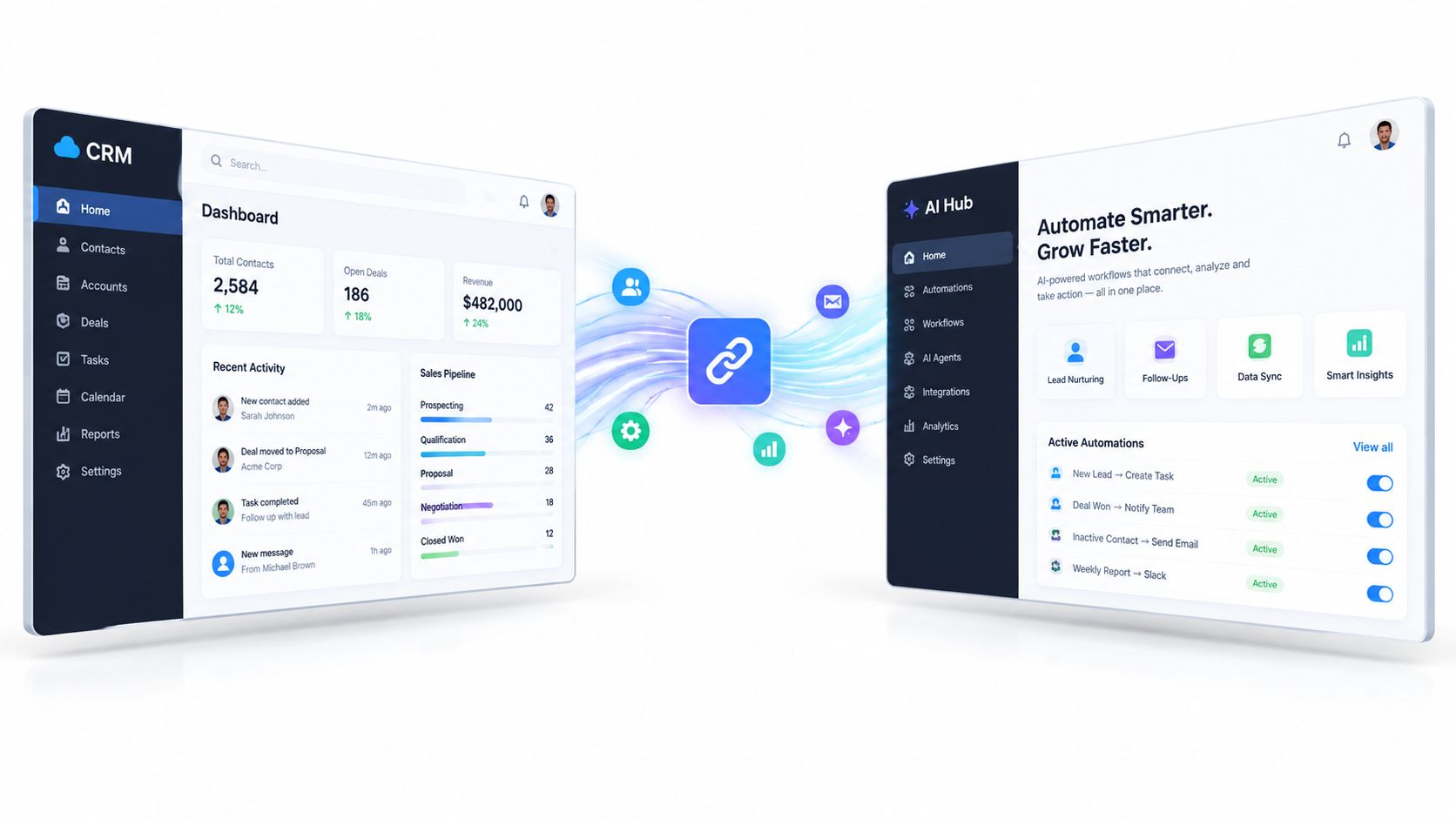
Before you connect anything, map the workflow and the information flow. The Australian privacy regulator says organisations using commercially available AI should check whether the product has been tested for the intended use, how human oversight will be embedded, what privacy and security risks exist, and who can access personal information entered into or produced by the system. That means integration is a governance task, not just an API task.
A solid setup uses restricted access, isolated environments, and separate permissions for testing and production. The Australian Cyber Security Centre also recommends least-privilege access, multi-factor authentication, software updates, and regular backups, which is exactly the posture you want before AI touches a CRM, inbox, accounting stack, or shared drive. Sensoriium's notes on scaling B2B with structured CRM are useful here because structured CRM only works when the workflow and permission model are disciplined.
Set approval gates for anything client-facing or commercially sensitive. Role-based training matters too, because staff need to know what the system can do, what it must never do, and when to override it. If you're looking for a managed model that sits around existing tools rather than replacing them, Truespeak's managed AI operations is built around that operating style.
The rule is simple. Minimum necessary access, clear ownership, and no live connection until the process is documented and the fallback path is ready.
Monitoring KPIs and Measuring Return on Investment
Sending more emails is not business value. Capturing more data is not business value. If the workflow does not improve the outcome that matters to the owner, you have just made the machine busier.
Set the baseline before launch. Track missed enquiries, response times, follow-up completion, CRM rework, overdue invoices, and staff hours before you automate anything. After launch, watch the same workflow for exception rates and human-review time, because those numbers show whether the system is helping or just producing more activity.
A faster first response only counts once it becomes a qualified appointment, and a sent reminder only counts once cash lands. Activity sits upstream of outcome, and too many AI projects stop counting at the upstream stage.
The measurement gap in Australia is real. The Governance Institute reports (source) that 93% of surveyed organisations say they cannot effectively measure AI return on investment, 72% of Australian chief data and AI officers say AI has not met ROI expectations, and more than 80% of small corporates and 71% of mid-market organisations report underperformance. That is why set up Google Analytics for brand tracking is a useful reminder, even outside classic website work, because disciplined measurement starts with knowing what changed and why.
If you cannot tie the workflow to a commercial result, you do not have a result, you have an output.
Measure one economic metric, one service metric, one quality metric, and one risk metric. That mix forces the conversation back to value instead of vanity. It also stops teams from declaring victory because the inbox is quieter while cash flow and conversion remain flat.
Maintaining Human Oversight and Continuous Tuning

AI implementation is not a set-and-forget job. The Australian Government's December 2025 to February 2026 AI adoption insights say governance and human control need to be operating requirements, with data and actions classified by sensitivity, access restricted, approval boundaries defined, representative cases tested, drift monitored, and the system reviewed to make sure it still serves its intended purpose. That matters most in customer communications, CRM updates, intake documents, and payment reminders.
The operating model should include a post-launch runbook. That runbook needs prompts, rules, logs, alerts, owners, review cadence, and clear escalation paths. If the workflow starts producing odd routing, weak wording, or too many human overrides, the system should be tuned, not defended.
Sensitive actions should stay under human approval until the workflow has earned trust. That includes client-impacting communication, payment follow-up, and any update that could create a service issue if it lands wrong. The point is not to keep people in the loop for the sake of it, the point is to keep the business in control of its own operating standards.
The best systems get stricter where they need to and looser where they've proved themselves. That only happens when real exceptions, not assumptions, drive the next adjustment.
If you want a cleaner first rollout, Truespeak maps the workflow, connects the tools you already use, and manages the system after launch so it keeps doing useful work. For Australian service businesses that want AI to support response, follow-up, intake, CRM hygiene, and invoice reminders without creating another internal admin burden, visit Truespeak and start with the diagnostic first.