
The most repeated advice in small business finance is to build a bigger buffer and keep a closer eye on the books. Neither fixes the problem most Australian service businesses have. Their cash isn't missing, it's sitting in a quote nobody chased, a variation agreed by phone and never billed, or an invoice with no named person responsible for collecting it.
Cash flow management in a small business is an ownership problem before it's a forecasting problem. A forecast tells you a shortfall is coming. It doesn't tell you who rings the customer on Tuesday, who raises the invoice for the milestone finished last Thursday, or who decides to stop work. This is a weekly operating system for owners and operations managers of Australian service businesses: one page, one owner per exception, one dated next action.
Table of Contents
- The Weekly Cash Flow Report to Run First
- Why Profitable Service Work Still Runs Short of Cash
- Build a 13-Week Cash Forecast You Can Defend
- Find the Leaks Before the Invoice Is Sent
- Set Payment Terms That Move Cash Forward
- Chase Payment Without Damaging the Relationship
- Measure the Change and Fix One Handoff First
- Choose Financing Only After the Levers Are Pulled
The Weekly Cash Flow Report to Run First
Run this at the same time every Monday, on one page, in about twenty minutes. The lines below are the whole report.
| Report line | What it shows | Confirmed or estimated | Action it triggers |
|---|---|---|---|
| Opening cleared cash | Bank balance cleared at the start of the week | Confirmed | Sets the baseline for every other line |
| Confirmed receipts | Invoices already paid or scheduled to clear this week | Confirmed | Allocate against this week's committed payments |
| Probable receipts | Promised payments and expected repeat work | Estimated, weighted by the customer's payment history | Chase the ones the week depends on |
| Invoices due and overdue | Due this week, then overdue in 1 to 30, 31 to 60, 61 to 90 and 90 plus day bands | Confirmed | Collect the highest value and oldest first |
| Committed payments | Payroll, superannuation, GST, PAYG withholding, suppliers, rent and loan repayments | Confirmed | Ring fence statutory money before anything discretionary |
| Forecast closing cash | Opening cash plus weighted receipts minus committed payments | Calculated | Compare with minimum headroom |
| Minimum cash headroom | Forecast closing cash minus the next four weeks of unavoidable payments | Calculated | Trigger for action when it falls below your threshold |
| Exceptions | Material items a person has to decide | Confirmed | One named owner and a dated next action |
Where Each Line Comes From
Opening cleared cash comes from the bank feed, not the accounting balance, because uncleared card settlements and pending transfers aren't spendable. Confirmed receipts come from your accounting software (Xero, MYOB or QuickBooks) matched against the feed. Probable receipts come from the same receivables list, discounted by what that customer has done before.
Ageing bands come straight from the receivables ageing report, split by due date rather than invoice date. Committed payments come from the payroll run, the BAS and super calendar, supplier statements and the loan schedule. If you want a second view on structuring these lines, the cash flow guidance from Allied Tax Advisors is a useful companion read for owners who've never separated statutory money from trading cash.
Read It in This Order
Compare forecast closing cash against minimum headroom first. A forecast shortfall against upcoming commitments is the trigger for action, and it's the only line that tells you whether you can meet payroll and the next BAS. Overdue balances come second, and they answer a narrower question: which collection calls happen this week.
A payment promise is not cash. Record it as a probable receipt with a date and an owner, and leave it out of confirmed receipts until it clears.
The exceptions list is where the report earns its keep. Unbilled completed work, a disputed invoice, a high value quote gone quiet, a customer whose payment behaviour has slipped: each gets one named owner and a dated next action, not a note in a spreadsheet.
The scale of the underlying problem is well documented. In a recent Australian survey reported by Airwallex, 77% of surveyed SME owners and leaders said they'd experienced a cash-flow crisis, and 32% identified late customer payments as a contributor. Most of that is preventable administration, not bad luck. Missed follow-up, incomplete intake and unrecorded scope changes are operational failures, and a weekly page with owners attached is how you catch them while they're still cheap to fix.
Why Profitable Service Work Still Runs Short of Cash
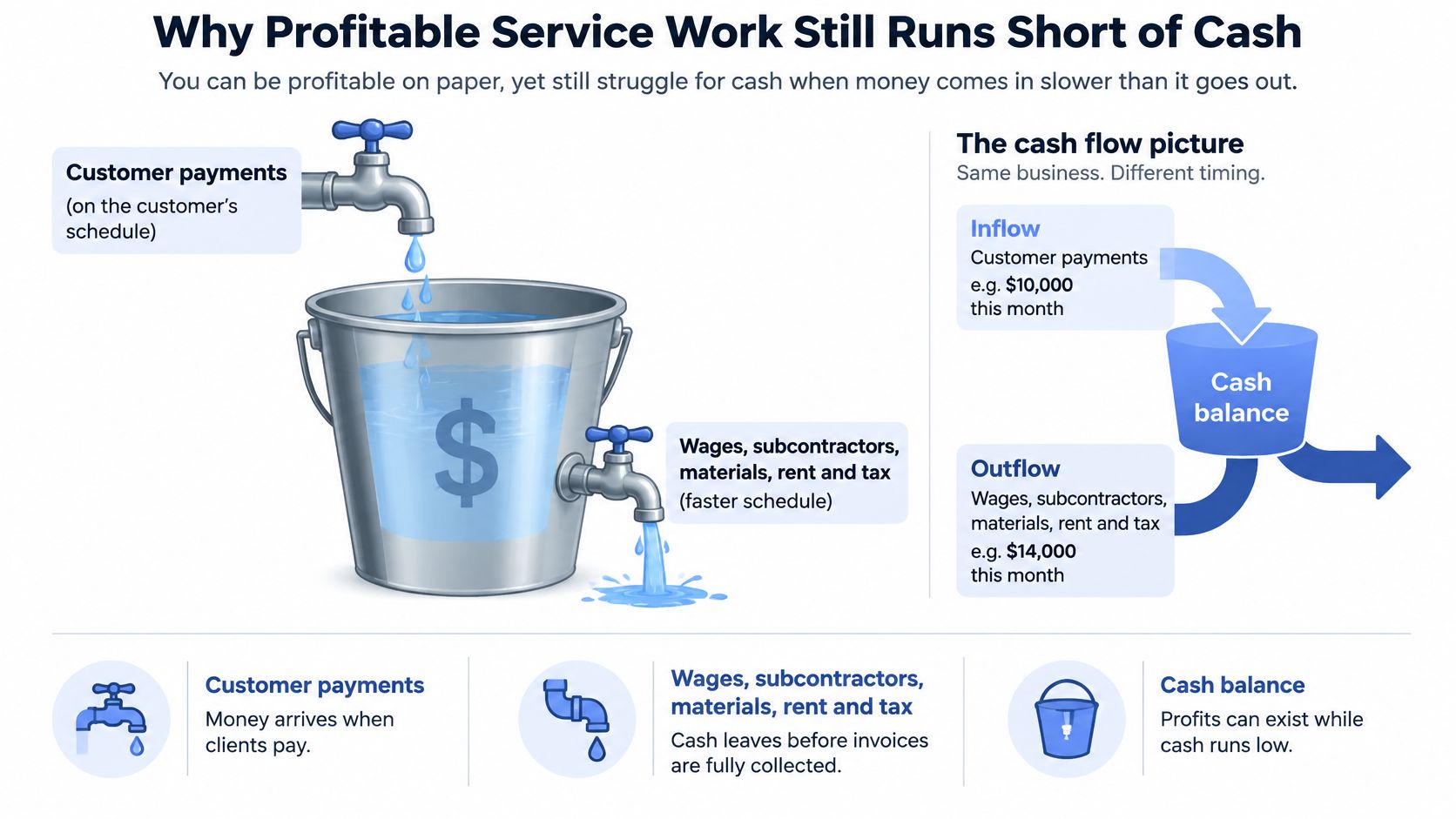
Think of your cash balance as a bucket with two taps. Customer payments drip in through one tap on the customer's schedule. Wages, subcontractors, materials, rent and tax drain out through the other on fixed dates you don't control. The bucket can be full of profit on paper and empty on Friday.
Three Numbers Owners Mix Up
Profit is revenue minus costs over a period. Invoiced revenue is work you've billed but not been paid for. Cleared cash is what the bank says you can spend today. Only the third one pays a subcontractor.
Walk the service cycle and mark where you fund the work. Enquiry and quoting cost you time before any money arrives. Delivery costs labour, materials and subcontractors. The invoice goes out after acceptance. Then you wait. Every stage between starting work and cleared payment is a period where you're the lender.
The consequences aren't theoretical. In the Australian Small Business and Family Enterprise Ombudsman's analysis of companies entering liquidation between July 2018 and June 2019, registered liquidators nominated inadequate cash flow in 51.2% of cases, ahead of poor strategic management at 42.9% and trading losses at 38.9%. Unpaid invoices and extended payment terms were common sources of that stress, which means the business model wasn't necessarily the problem.
A short explainer on separating profit from cash position is worth twenty minutes of your week.
The Exposure Sits with the Smaller Supplier
The Ombudsman's position paper on supply chain finance found approximately 53% of invoices issued by small businesses to large businesses were paid late, representing about $115 billion in outstanding earnings and reducing small business working capital by an estimated $7 billion each year. Nearly 40% of small businesses reported significant cash-flow pressure as a result.
Averages hide the thing that hurts you. One large customer paying at 90 days can matter more than twenty small ones paying at 40, because that single balance is the payroll you can't cover. That's why the system tracks named invoices and named customers rather than a monthly total.
The same logic applies wherever billing depends on clean documentation. Practices working through claim rejections will recognise the pattern in this piece on how to reduce claim denials in medical practices: the work is done, the revenue is earned, and a paperwork gap holds the cash.
Build a 13-Week Cash Forecast You Can Defend
A defensible forecast is one where every receipt has a reason behind its date. Build it in this order.
- Set a 13-week horizon. A quarter is long enough that BAS, PAYG withholding, superannuation and income tax instalments all appear on the grid. A four-week view hides exactly the obligations that break you.
- Start from the cleared bank balance. Not the accounting balance, which includes money still in transit. Everything downstream inherits this number, so it has to be spendable cash.
- Enter receipts invoice by invoice at the expected payment date. Weight each one by observed behaviour: 95% for a customer that always pays on terms, 50% for one that routinely runs past them. An Australian Government analysis of more than 10 million invoices from 76,817 firms found 36% of trade-credit payments to small businesses took longer than 30 days, and those payments averaged 63 days. A 30-day invoice collected at 63 days is roughly 33 extra days you're financing.
- Move statutory money into earmarked sub balances as receipts land. GST, PAYG withholding and super aren't yours to spend. The ATO reports just under 70% of small business tax obligations were paid on time, compared with nearly 90% across the broader taxpayer population, and advises setting cash aside from operating inflows.
- List committed payments by week. Payroll and super on their actual dates, supplier statements, rent, loan instalments, insurance. Use the due date, not the date you usually get around to paying.
- Calculate weekly closing cash and minimum headroom. Headroom is forecast closing cash less the next four weeks of unavoidable payments. Set your own threshold in dollars and write it at the top of the sheet.
- Reconcile actuals into week one every Monday, then roll forward. Compare what you predicted against what cleared. The gap is your forecasting error, and it's the fastest way to learn which customers you've been too generous with.
Two Variations Worth Running
Model a 30, 60 and 90 day collection scenario for your top five customers. If the 90-day case breaks headroom, you have a concentration problem, and no amount of chasing fixes it. Terms and deposits do.
Decision rule: a headroom breach triggers deposits, staged billing or spend deferral before it triggers borrowing.
Keep the model in whatever your team will update. A spreadsheet in a shared drive that gets reconciled weekly beats a dashboard nobody opens. If you're weighing up dedicated tooling, this overview of how Lucentive handles treasury systems shows what a heavier setup involves, which is useful context for deciding you don't need one yet.
Find the Leaks Before the Invoice Is Sent
There's no universal ranking of cash leaks, and anyone who gives you one is guessing. Unpaid invoices delay cash you've already earned. Slow quotes, scope gaps and stale follow-up delay or reduce future receipts. Both hurt, and which hurts more this month depends on your job mix.
For most growing service businesses, the work already costing time or revenue is slow response, inconsistent follow-up, messy intake, missed CRM tasks or invoice chasing. The practical rule is to make every quote, scope change and outstanding invoice visible with one owner and a next action, then work the list by value, age and urgency.
| Leak | What it looks like | Early trigger | First action |
|---|---|---|---|
| Quote with no follow up | Proposal sent, no reply, no next step recorded | A quote with no owner and no follow up date | Assign an owner and a call date within three business days |
| Unbilled scope change | Extra work agreed by phone and never invoiced | A variation mentioned in a message but missing from the job record | Raise the variation before the extra work starts |
| Incomplete intake | Job stalls waiting on documents, photos or site access | Missing items found at handover | Require structured intake before the job is scheduled |
| Unbilled completed work | Milestone finished with no invoice raised | Completion marked in the job record with no invoice number | Invoice on acceptance, the same day |
| Missing deposit | Start date booked with no money received | Booking confirmed without a deposit receipt | Make the deposit a condition of the booking |
| Stale follow up | Dormant enquiries and old quotes never revisited | No activity on the record for 30 days | Run a weekly list of high value dormant quotes |
| Disputed invoice | Payment withheld while the dispute is open | Customer queries the amount or the scope | Pull it from the reminder sequence and resolve it with one named person |
The Trigger Matters More Than the Label
Each row has an event that surfaces it before money is lost. A variation mentioned in a text message is a trigger. A job marked complete with no invoice number is a trigger. A booking confirmed without a deposit receipt is a trigger. Build the trigger into the record, not into someone's memory.
Quotes are the leak owners underestimate, because nothing looks wrong. The job never starts. If your quoting lives in email and a folder of PDFs, this comparison of quote management software is a sensible place to start tightening the follow-up dates.
The Weekly Sweep
Four lists, run alongside the cash report:
- Unbilled completed work: every finished milestone with no invoice number against it.
- Quotes with no activity for 30 days: sorted by value, highest first.
- Variations not yet invoiced: anything agreed verbally or in a message thread.
- Jobs scheduled without a deposit received: these are bookings, not revenue.
Give each list one owner. A sweep with no owner attached is just a longer report.
Set Payment Terms That Move Cash Forward
Terms are a cash decision made at quote stage, not an admin detail added when the invoice goes out. If you accept 60-day terms from a customer whose materials you buy on 14-day terms, you've agreed to lend them money at zero interest.
Federal business.gov.au guidance on payment terms is explicit that terms should be written into both invoices and contracts, specifying accepted payment methods, when payment is due (upfront, by instalment, on delivery or within 30 days), whether credit is offered, and how overdue debts will be collected. Without clear terms, customers may pay late, dispute the payment or refuse to pay.
Structures That Bring Cash Forward
Write these into the quote, not just the invoice:
- A deposit that covers materials and week one labour. Price it from the actual cost of starting, not a round percentage.
- Progress claims at accepted milestones. Acceptance is the trigger, so define what acceptance looks like in writing.
- Shorter terms for new customers. Extend terms once you've seen how they pay, not before.
- Staged billing on long jobs. One invoice at completion means one long wait at the end.
If you're unsure what an Australian invoice needs to carry alongside those terms, the requirements for ABN, GST and payment terms on Australian invoices are worth checking against your current template.
Concentration Is the Risk Terms Have to Answer
The Payment Times regulator reported that the average time for large businesses to pay 95% of their small business invoices increased from 58 to 64 days in the reporting period covering 1 January to 30 June 2025, and noted the slowest payments were becoming slower. You can't negotiate that average down as a small supplier. You can decide how much of it you'll carry.
Segment customers by observed payment behaviour, then set a credit hold or stop work trigger that fires before the next job starts, not after the third overdue invoice. A customer at 90 days who wants more work is asking you to increase your exposure.
Finally, start the clock immediately. business.gov.au's cash flow guidance recommends sending an invoice as soon as a sale is made and following up quickly when it stays unpaid. Same day invoicing on acceptance, with a named owner for every invoice raised, is the cheapest improvement available to most service businesses.
Chase Payment Without Damaging the Relationship
Before any reminder goes out, read the contract. business.gov.au's invoicing guidance advises confirming the agreed payment date, payment method and what both parties agreed would happen if payment was late, and using an invoicing system to track customers and monitor money owed. It also points businesses towards reminders or letters of demand when debts remain unresolved.
The sequence below is an illustrative default, not a verified cadence. Tune the timing against your own customers' behaviour and keep the wording under your control.
| Stage | When it sends | What it says | Who approves | Where it goes instead |
|---|---|---|---|---|
| Pre due nudge | Five business days before the due date | Confirms the invoice arrived, restates the amount, due date and payment method | Owner approves the template once | Disputed amounts removed from the sequence |
| Due date reminder | Morning of the due date | Short factual reminder with invoice number, amount and payment link | Scheduled on the approved template | Accounts on agreed extended terms |
| First overdue notice | Three to seven days after the due date | Courteous note referencing the contractual due date and asking for a payment date | Admin or owner approves each send | Long standing or sensitive relationships |
| Personal follow up | Fourteen days overdue | Phone call or direct email agreeing a payment date and the next step | Owner | Disputes and commercial decisions |
| Formal escalation | Thirty days overdue or a broken payment promise | Letter of demand referencing the contract terms plus a credit hold or stop work decision | Owner, with any adviser | Any amount under dispute |
| Hold or stop work | After escalation fails | Written notice of suspension under the agreed terms | Owner | Case by case judgement |
Start Calm, Because Forgetting Is Common
Government guidance recommends beginning overdue follow-up with a polite phone call or email, since some late payments happen because customers forget. A calm first contact often resolves it without touching the relationship. Keep templates short and factual: invoice number, amount, due date, payment method, one clear ask.
What Leaves the Sequence
Sensitive messages and commercial decisions wait for approval. Pricing, advice, disputes, relationship-sensitive messages, commercial judgement and odd cases where trust matters more than speed stay with people. In practice that means disputed amounts, sensitive accounts and long standing relationships exit the automated sequence before any further message sends, and a named person takes over.
Log three things every time: what was sent, what was promised, and what actually cleared. A promise with a date is a follow-up task, not a receipt.
If your chasing currently lives in someone's inbox and gets skipped in busy weeks, this guide to debtor management covers how to structure the queue so escalation happens on a rule rather than on mood. The point isn't to send more messages. It's to make sure the right message goes out on the right day, and that a person decides when the tone needs to change.
Measure the Change and Fix One Handoff First
In a representative workflow, the change is unglamorous. Invoice tracking moves from a spreadsheet plus memory to one shared view where every invoice has a status, an owner and a next action. Reminders run on approved wording. Anything disputed, sensitive or unusual routes to a person. That's a change in how work is held, not a claimed reduction in days outstanding.
Judge it across comparable periods, and account for changed payment terms or customer mix before you attribute any difference to the new system.
| Measure | How to compare | Watch for |
|---|---|---|
| Overdue balance | Totals taken at the same point in each month | Shifts in customer mix |
| Ageing bands | Same 1 to 30, 31 to 60, 61 to 90 and 90 plus day bands at each month end | One large invoice distorting a band |
| Average days to payment | Mean days from invoice date to cleared payment | Changed payment terms |
| Days sales outstanding | Receivables divided by average daily sales over the period | Seasonal swings in sales |
| Value in dispute | Dollar value held in disputed invoices | Disputes resolved early in the period |
| Unbilled completed work | Dollar value of finished milestones without an invoice | Timing of job completions |
Fix One Handoff, Then Expand
The first process to automate is the handover that costs the most time, revenue or trust. Pick that one this month. If it's payment chasing, our Invoice Reminder Automation provides polite, human-approved payment follow-up that doesn't rely on awkward manual chasing, which you can see described under invoice reminder automation. If it's quotes going quiet, look at lead follow-up automation. If it's variations and intake, business process automation maps the triggers and exception paths, and managed AI operations keeps the system tuned after launch.
Expand only when the weekly report shows the first fix holding. If you'd rather build the reporting habit yourself first, ASIC provided 21 free training courses for small businesses in 2024 covering record keeping, cash flow, deductions, GST and superannuation, which is a low-cost next step.
Choose Financing Only After the Levers Are Pulled
Borrowing is a legitimate tool. It's also the fastest way to hide a process problem, because it converts a collection failure into an interest expense. Pull the free levers first: deposits, staged billing, spend deferral, and the reminder sequence run properly.
The options a small service business meets differ in how they behave in your weekly report:
- Overdraft or business loan: fixed repayments that become a committed payment line every week, usually with security or a personal guarantee attached.
- Line of credit: drawn only when needed, so it sits as available headroom rather than cash, with a cost whether you draw or not.
- Invoice finance or factoring: a provider advances part of an approved invoice for a fee, which brings cash forward but leaves the late payer's behaviour unchanged.
Before signing anything, answer four questions. Has the overdue balance been chased through the full sequence? Are the terms still right for your current customer mix? Can repayments be covered from headroom across the next thirteen weeks? Who owns the decision?
Read the government's small business finance guidance and the lender's written terms rather than a comparison site, and check the fee structure and default provisions yourself. Rates change, so quote nothing from memory.
If your cash is stuck in quotes nobody chased, variations nobody billed or invoices nobody owns, that's a workflow problem we can map with you. Truespeak builds and manages human-approved invoice reminders, follow-up and reporting around the tools you already use, starting with the single handoff costing you the most time or revenue. Visit Truespeak to book a short, no-pressure discovery conversation about where your receipts are stalling, with no pitch deck and no obligation.